Felix Brausse, Mario Borgwardt, Johannes Mahl, Matthew Fraund, Friedrich Roth, Monika Blum, Wolfgang Eberhardt, Oliver Gessner
{"title":"Real-time interfacial electron dynamics revealed through temporal correlations in x-ray photoelectron spectroscopy.","authors":"Felix Brausse, Mario Borgwardt, Johannes Mahl, Matthew Fraund, Friedrich Roth, Monika Blum, Wolfgang Eberhardt, Oliver Gessner","doi":"10.1063/4.0000099","DOIUrl":null,"url":null,"abstract":"<p><p>We present a novel technique to monitor dynamics in interfacial systems through temporal correlations in x-ray photoelectron spectroscopy (XPS) signals. To date, the vast majority of time-resolved x-ray spectroscopy techniques rely on pump-probe schemes, in which the sample is excited out of equilibrium by a pump pulse, and the subsequent dynamics are monitored by probe pulses arriving at a series of well-defined delays relative to the excitation. By definition, this approach is restricted to processes that can either directly or indirectly be initiated by light. It cannot access spontaneous dynamics or the microscopic fluctuations of ensembles in chemical or thermal equilibrium. Enabling this capability requires measurements to be performed in real (laboratory) time with high temporal resolution and, ultimately, without the need for a well-defined trigger event. The time-correlation XPS technique presented here is a first step toward this goal. The correlation-based technique is implemented by extending an existing optical-laser pump/multiple x-ray probe setup by the capability to record the kinetic energy and absolute time of arrival of every detected photoelectron. The method is benchmarked by monitoring energy-dependent, periodic signal modulations in a prototypical time-resolved XPS experiment on photoinduced surface-photovoltage dynamics in silicon, using both conventional pump-probe data acquisition, and the new technique based on laboratory time. The two measurements lead to the same result. The findings provide a critical milestone toward the overarching goal of studying equilibrium dynamics at surfaces and interfaces through time correlation-based XPS measurements.</p>","PeriodicalId":74877,"journal":{"name":"","volume":"8 4","pages":"044301"},"PeriodicalIF":0.0,"publicationDate":"2021-07-08","publicationTypes":"Journal Article","fieldsOfStudy":null,"isOpenAccess":false,"openAccessPdf":"https://sci-hub-pdf.com/10.1063/4.0000099","citationCount":"1","resultStr":null,"platform":"Semanticscholar","paperid":null,"PeriodicalName":"","FirstCategoryId":"101","ListUrlMain":"https://doi.org/10.1063/4.0000099","RegionNum":0,"RegionCategory":null,"ArticlePicture":[],"TitleCN":null,"AbstractTextCN":null,"PMCID":null,"EPubDate":"2021/7/1 0:00:00","PubModel":"eCollection","JCR":"","JCRName":"","Score":null,"Total":0}
引用次数: 1
Abstract
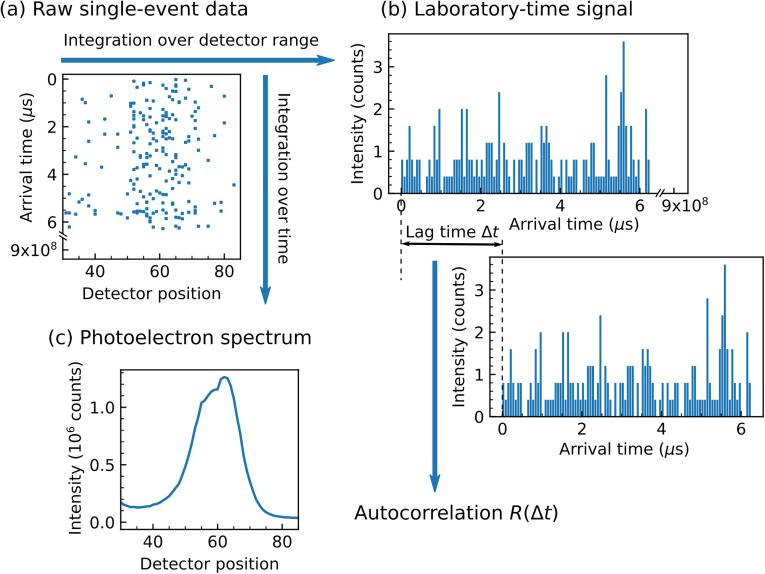
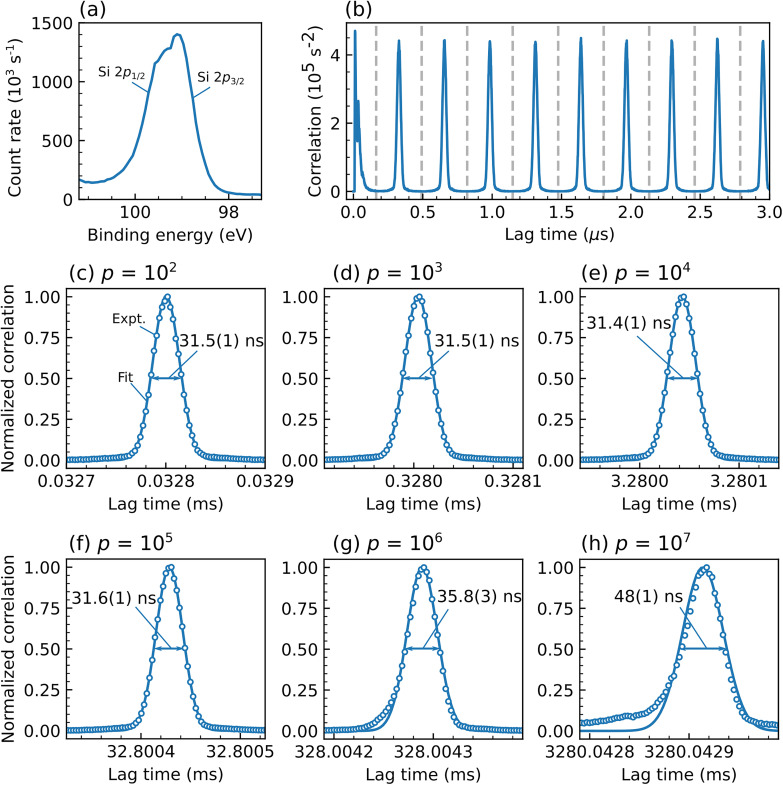
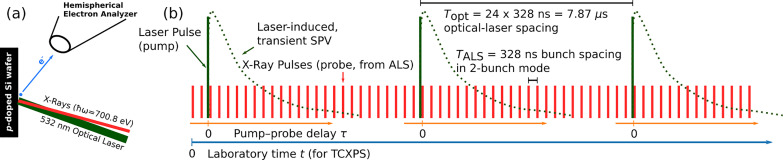
We present a novel technique to monitor dynamics in interfacial systems through temporal correlations in x-ray photoelectron spectroscopy (XPS) signals. To date, the vast majority of time-resolved x-ray spectroscopy techniques rely on pump-probe schemes, in which the sample is excited out of equilibrium by a pump pulse, and the subsequent dynamics are monitored by probe pulses arriving at a series of well-defined delays relative to the excitation. By definition, this approach is restricted to processes that can either directly or indirectly be initiated by light. It cannot access spontaneous dynamics or the microscopic fluctuations of ensembles in chemical or thermal equilibrium. Enabling this capability requires measurements to be performed in real (laboratory) time with high temporal resolution and, ultimately, without the need for a well-defined trigger event. The time-correlation XPS technique presented here is a first step toward this goal. The correlation-based technique is implemented by extending an existing optical-laser pump/multiple x-ray probe setup by the capability to record the kinetic energy and absolute time of arrival of every detected photoelectron. The method is benchmarked by monitoring energy-dependent, periodic signal modulations in a prototypical time-resolved XPS experiment on photoinduced surface-photovoltage dynamics in silicon, using both conventional pump-probe data acquisition, and the new technique based on laboratory time. The two measurements lead to the same result. The findings provide a critical milestone toward the overarching goal of studying equilibrium dynamics at surfaces and interfaces through time correlation-based XPS measurements.



 京公网安备 11010802042870号
京ICP备2023020795号-1
京公网安备 11010802042870号
京ICP备2023020795号-1

 分享
分享
 求助内容:
求助内容: 应助结果提醒方式:
 扫码关注我们
