Antonija Marjanovic, Carlos J Ramírez-Palacios, Marcelo F Masman, Jeroen Drenth, Marleen Otzen, Siewert-Jan Marrink, Dick B Janssen
{"title":"Thermostable D-amino acid decarboxylases derived from Thermotoga maritima diaminopimelate decarboxylase.","authors":"Antonija Marjanovic, Carlos J Ramírez-Palacios, Marcelo F Masman, Jeroen Drenth, Marleen Otzen, Siewert-Jan Marrink, Dick B Janssen","doi":"10.1093/protein/gzab016","DOIUrl":null,"url":null,"abstract":"<p><p>Diaminopimelate decarboxylases (DAPDCs) are highly selective enzymes that catalyze the common final step in different lysine biosynthetic pathways, i.e. the conversion of meso-diaminopimelate (DAP) to L-lysine. We examined the modification of the substrate specificity of the thermostable decarboxylase from Thermotoga maritima with the aim to introduce activity with 2-aminopimelic acid (2-APA) since its decarboxylation leads to 6-aminocaproic acid (6-ACA), a building block for the synthesis of nylon-6. Structure-based mutagenesis of the distal carboxylate binding site resulted in a set of enzyme variants with new activities toward different D-amino acids. One of the mutants (E315T) had lost most of its activity toward DAP and primarily acted as a 2-APA decarboxylase. We next used computational modeling to explain the observed shift in catalytic activities of the mutants. The results suggest that predictive computational protocols can support the redesign of the catalytic properties of this class of decarboxylating PLP-dependent enzymes.</p>","PeriodicalId":2,"journal":{"name":"ACS Applied Bio Materials","volume":" ","pages":""},"PeriodicalIF":4.7000,"publicationDate":"2021-02-15","publicationTypes":"Journal Article","fieldsOfStudy":null,"isOpenAccess":false,"openAccessPdf":"https://www.ncbi.nlm.nih.gov/pmc/articles/PMC8277567/pdf/","citationCount":"3","resultStr":null,"platform":"Semanticscholar","paperid":null,"PeriodicalName":"ACS Applied Bio Materials","FirstCategoryId":"99","ListUrlMain":"https://doi.org/10.1093/protein/gzab016","RegionNum":0,"RegionCategory":null,"ArticlePicture":[],"TitleCN":null,"AbstractTextCN":null,"PMCID":null,"EPubDate":"","PubModel":"","JCR":"Q2","JCRName":"MATERIALS SCIENCE, BIOMATERIALS","Score":null,"Total":0}
引用次数: 3
Abstract
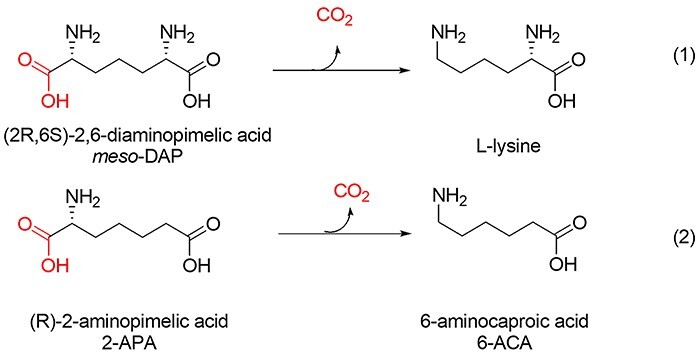
Diaminopimelate decarboxylases (DAPDCs) are highly selective enzymes that catalyze the common final step in different lysine biosynthetic pathways, i.e. the conversion of meso-diaminopimelate (DAP) to L-lysine. We examined the modification of the substrate specificity of the thermostable decarboxylase from Thermotoga maritima with the aim to introduce activity with 2-aminopimelic acid (2-APA) since its decarboxylation leads to 6-aminocaproic acid (6-ACA), a building block for the synthesis of nylon-6. Structure-based mutagenesis of the distal carboxylate binding site resulted in a set of enzyme variants with new activities toward different D-amino acids. One of the mutants (E315T) had lost most of its activity toward DAP and primarily acted as a 2-APA decarboxylase. We next used computational modeling to explain the observed shift in catalytic activities of the mutants. The results suggest that predictive computational protocols can support the redesign of the catalytic properties of this class of decarboxylating PLP-dependent enzymes.
期刊介绍:
ACS Applied Bio Materials is an interdisciplinary journal publishing original research covering all aspects of biomaterials and biointerfaces including and beyond the traditional biosensing, biomedical and therapeutic applications.
The journal is devoted to reports of new and original experimental and theoretical research of an applied nature that integrates knowledge in the areas of materials, engineering, physics, bioscience, and chemistry into important bio applications. The journal is specifically interested in work that addresses the relationship between structure and function and assesses the stability and degradation of materials under relevant environmental and biological conditions.




 京公网安备 11010802042870号
京ICP备2023020795号-1
京公网安备 11010802042870号
京ICP备2023020795号-1

 分享
分享
 求助内容:
求助内容: 应助结果提醒方式:
 扫码关注我们
