Danial Mehranfard, Gabriela Perez, Andres Rodriguez, Julia M Ladna, Christopher T Neagra, Benjamin Goldstein, Timothy Carroll, Alice Tran, Malav Trivedi, Robert C Speth
{"title":"Alterations in Gene Expression of Renin-Angiotensin System Components and Related Proteins in Colorectal Cancer.","authors":"Danial Mehranfard, Gabriela Perez, Andres Rodriguez, Julia M Ladna, Christopher T Neagra, Benjamin Goldstein, Timothy Carroll, Alice Tran, Malav Trivedi, Robert C Speth","doi":"10.1155/2021/9987115","DOIUrl":null,"url":null,"abstract":"<p><strong>Materials and methods: </strong>Quantitative expression of the RNA of these 17 genes in normal and cancerous tissues obtained using chip arrays from the public functional genomics data repository, Gene Expression Omnibus (GEO) application, was compared statistically.</p><p><strong>Results: </strong>Expression of four genes, <i>AGT</i> (angiotensinogen), <i>ENPEP</i> (aminopeptidase A) <i>MME</i> (neprilysin), and <i>PREP</i> (prolyl endopeptidase), was significantly upregulated in CRC specimens. Expression of <i>REN</i> (renin), <i>THOP</i> (thimet oligopeptidase), <i>NLN</i> (neurolysin), <i>PRCP</i> (prolyl carboxypeptidase), <i>ANPEP</i> (aminopeptidase N), and <i>MAS1</i> (Mas receptor) was downregulated in CRC specimens.</p><p><strong>Conclusions: </strong>Presuming gene expression parallel protein expression, these results suggest that increased production of the angiotensinogen precursor of angiotensin (ANG) peptides, with the reduction of the enzymes that metabolize it to ANG II, can lead to accumulation of angiotensinogen in CRC tissues. Downregulation of <i>THOP</i>, <i>NLN</i>, <i>PRCP</i>, and <i>MAS1</i> gene expression, whose proteins contribute to the ACE2/ANG 1-7/Mas axis, suggests that reduced activity of this RAS branch could be permissive for oncogenicity. Components of the RAS may be potential therapeutic targets for treatment of CRC.</p>","PeriodicalId":2,"journal":{"name":"ACS Applied Bio Materials","volume":" ","pages":"9987115"},"PeriodicalIF":4.7000,"publicationDate":"2021-07-05","publicationTypes":"Journal Article","fieldsOfStudy":null,"isOpenAccess":false,"openAccessPdf":"https://www.ncbi.nlm.nih.gov/pmc/articles/PMC8277508/pdf/","citationCount":"0","resultStr":null,"platform":"Semanticscholar","paperid":null,"PeriodicalName":"ACS Applied Bio Materials","FirstCategoryId":"3","ListUrlMain":"https://doi.org/10.1155/2021/9987115","RegionNum":0,"RegionCategory":null,"ArticlePicture":[],"TitleCN":null,"AbstractTextCN":null,"PMCID":null,"EPubDate":"2021/1/1 0:00:00","PubModel":"eCollection","JCR":"Q2","JCRName":"MATERIALS SCIENCE, BIOMATERIALS","Score":null,"Total":0}
引用次数: 0
Abstract
Materials and methods: Quantitative expression of the RNA of these 17 genes in normal and cancerous tissues obtained using chip arrays from the public functional genomics data repository, Gene Expression Omnibus (GEO) application, was compared statistically.
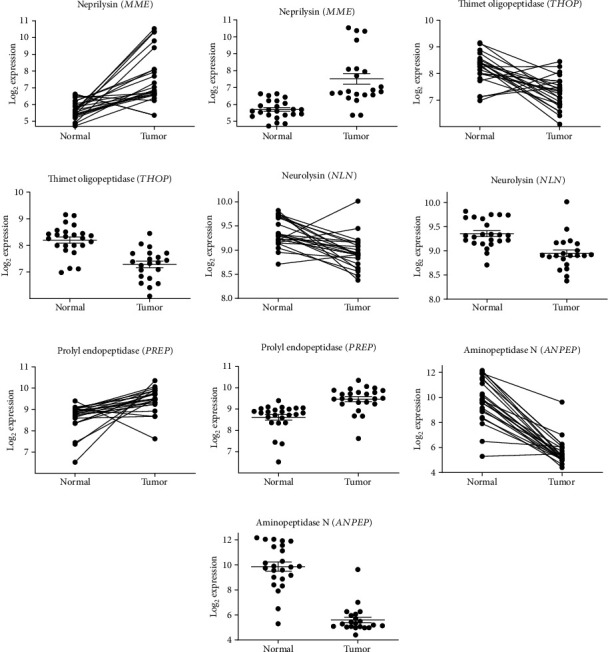
Results: Expression of four genes, AGT (angiotensinogen), ENPEP (aminopeptidase A) MME (neprilysin), and PREP (prolyl endopeptidase), was significantly upregulated in CRC specimens. Expression of REN (renin), THOP (thimet oligopeptidase), NLN (neurolysin), PRCP (prolyl carboxypeptidase), ANPEP (aminopeptidase N), and MAS1 (Mas receptor) was downregulated in CRC specimens.
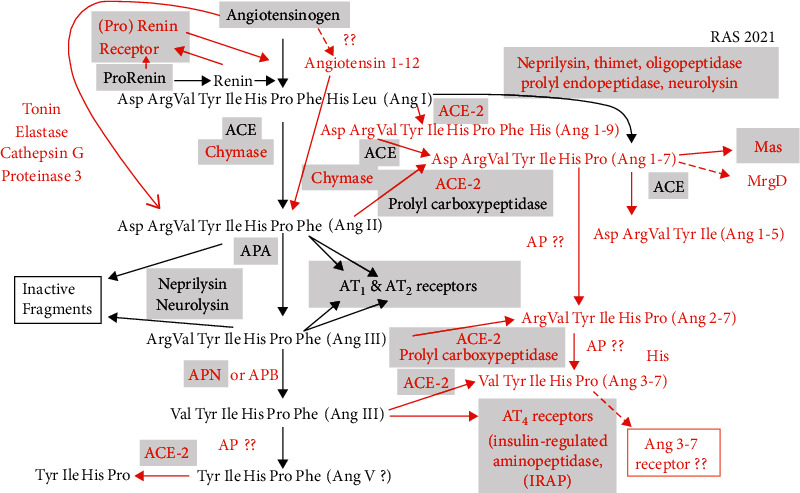
Conclusions: Presuming gene expression parallel protein expression, these results suggest that increased production of the angiotensinogen precursor of angiotensin (ANG) peptides, with the reduction of the enzymes that metabolize it to ANG II, can lead to accumulation of angiotensinogen in CRC tissues. Downregulation of THOP, NLN, PRCP, and MAS1 gene expression, whose proteins contribute to the ACE2/ANG 1-7/Mas axis, suggests that reduced activity of this RAS branch could be permissive for oncogenicity. Components of the RAS may be potential therapeutic targets for treatment of CRC.
期刊介绍:
ACS Applied Bio Materials is an interdisciplinary journal publishing original research covering all aspects of biomaterials and biointerfaces including and beyond the traditional biosensing, biomedical and therapeutic applications.
The journal is devoted to reports of new and original experimental and theoretical research of an applied nature that integrates knowledge in the areas of materials, engineering, physics, bioscience, and chemistry into important bio applications. The journal is specifically interested in work that addresses the relationship between structure and function and assesses the stability and degradation of materials under relevant environmental and biological conditions.





 京公网安备 11010802042870号
京ICP备2023020795号-1
京公网安备 11010802042870号
京ICP备2023020795号-1

 分享
分享
 求助内容:
求助内容: 应助结果提醒方式:
 扫码关注我们
