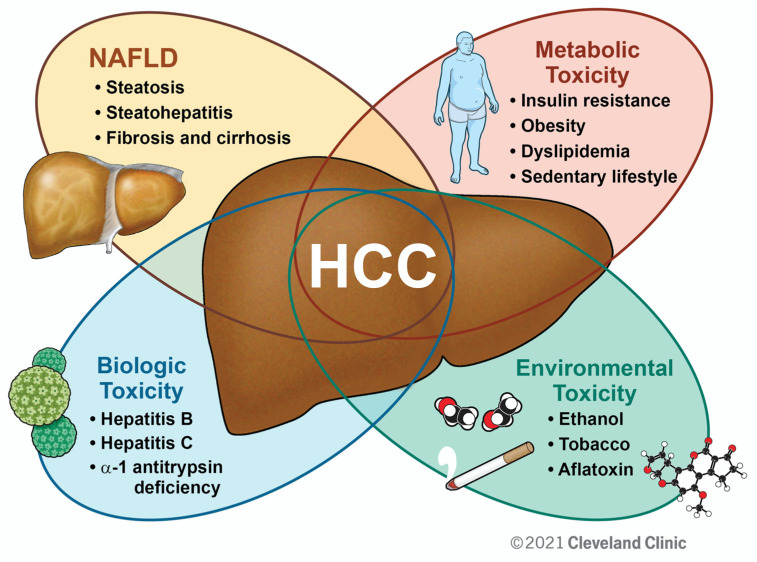
{"title":"Abnormal Metabolism in the Progression of Nonalcoholic Fatty Liver Disease to Hepatocellular Carcinoma: Mechanistic Insights to Chemoprevention.","authors":"Danny Orabi, Nathan A Berger, J Mark Brown","doi":"10.3390/cancers13143473","DOIUrl":null,"url":null,"abstract":"<p><p>Nonalcoholic fatty liver disease (NAFLD) is on the rise and becoming a major contributor to the development of hepatocellular carcinoma (HCC). Reasons for this include the rise in obesity and metabolic syndrome in contrast to the marked advances in prevention and treatment strategies of viral HCC. These shifts are expected to rapidly propel this trend even further in the coming decades, with NAFLD on course to become the leading etiology of end-stage liver disease and HCC. No Food and Drug Administration (FDA)-approved medications are currently available for the treatment of NAFLD, and advances are desperately needed. Numerous medications with varying mechanisms of action targeting liver steatosis and fibrosis are being investigated including peroxisome proliferator-activated receptor (PPAR) agonists and farnesoid X receptor (FXR) agonists. Additionally, drugs targeting components of metabolic syndrome, such as antihyperglycemics, have been found to affect NAFLD progression and are now being considered in the treatment of these patients. As NAFLD drug discovery continues, special attention should be given to their relationship to HCC. Several mechanisms in the pathogenesis of NAFLD have been implicated in hepatocarcinogenesis, and therapies aimed at NAFLD may additionally harbor independent antitumorigenic potential. This approach may provide novel prevention and treatment strategies.</p>","PeriodicalId":4,"journal":{"name":"ACS Applied Energy Materials","volume":" ","pages":""},"PeriodicalIF":5.5000,"publicationDate":"2021-07-11","publicationTypes":"Journal Article","fieldsOfStudy":null,"isOpenAccess":false,"openAccessPdf":"https://www.ncbi.nlm.nih.gov/pmc/articles/PMC8307710/pdf/","citationCount":"0","resultStr":null,"platform":"Semanticscholar","paperid":null,"PeriodicalName":"ACS Applied Energy Materials","FirstCategoryId":"3","ListUrlMain":"https://doi.org/10.3390/cancers13143473","RegionNum":3,"RegionCategory":"材料科学","ArticlePicture":[],"TitleCN":null,"AbstractTextCN":null,"PMCID":null,"EPubDate":"","PubModel":"","JCR":"Q2","JCRName":"CHEMISTRY, PHYSICAL","Score":null,"Total":0}
引用次数: 0
Abstract
Nonalcoholic fatty liver disease (NAFLD) is on the rise and becoming a major contributor to the development of hepatocellular carcinoma (HCC). Reasons for this include the rise in obesity and metabolic syndrome in contrast to the marked advances in prevention and treatment strategies of viral HCC. These shifts are expected to rapidly propel this trend even further in the coming decades, with NAFLD on course to become the leading etiology of end-stage liver disease and HCC. No Food and Drug Administration (FDA)-approved medications are currently available for the treatment of NAFLD, and advances are desperately needed. Numerous medications with varying mechanisms of action targeting liver steatosis and fibrosis are being investigated including peroxisome proliferator-activated receptor (PPAR) agonists and farnesoid X receptor (FXR) agonists. Additionally, drugs targeting components of metabolic syndrome, such as antihyperglycemics, have been found to affect NAFLD progression and are now being considered in the treatment of these patients. As NAFLD drug discovery continues, special attention should be given to their relationship to HCC. Several mechanisms in the pathogenesis of NAFLD have been implicated in hepatocarcinogenesis, and therapies aimed at NAFLD may additionally harbor independent antitumorigenic potential. This approach may provide novel prevention and treatment strategies.
期刊介绍:
ACS Applied Energy Materials is an interdisciplinary journal publishing original research covering all aspects of materials, engineering, chemistry, physics and biology relevant to energy conversion and storage. The journal is devoted to reports of new and original experimental and theoretical research of an applied nature that integrate knowledge in the areas of materials, engineering, physics, bioscience, and chemistry into important energy applications.




 京公网安备 11010802042870号
京ICP备2023020795号-1
京公网安备 11010802042870号
京ICP备2023020795号-1

 分享
分享
 求助内容:
求助内容: 应助结果提醒方式:
 扫码关注我们
