Fariborz Moazzami, Sareh Shirzadi, Mohammad Mehdi Shokouhi, Yasamin Ghahramani
{"title":"Surgical Treatment of a Dens Invagination Type (І) in a Maxillary Lateral Incisor with 6-Year Follow-Up.","authors":"Fariborz Moazzami, Sareh Shirzadi, Mohammad Mehdi Shokouhi, Yasamin Ghahramani","doi":"10.30476/DENTJODS.2020.84938.1109","DOIUrl":null,"url":null,"abstract":"<p><p>Dens invagination is a developmental anomaly that requires specific treatment approaches. The invagination is enamel-lined in the crown of the tooth truly negligible, and usually there is no extension on the level of the external amelocemental junction. A well ending surgical root canal treatment of an invaginated tooth with a retrograde filling is presented in this case report. Periapical radiographic examination, after 3 months and 6 years of follow-up, showed periapical healing with osseous formation .</p>","PeriodicalId":73702,"journal":{"name":"Journal of dentistry (Shiraz, Iran)","volume":"22 2","pages":"149-152"},"PeriodicalIF":0.0000,"publicationDate":"2021-06-01","publicationTypes":"Journal Article","fieldsOfStudy":null,"isOpenAccess":false,"openAccessPdf":"https://www.ncbi.nlm.nih.gov/pmc/articles/PMC8206600/pdf/","citationCount":"0","resultStr":null,"platform":"Semanticscholar","paperid":null,"PeriodicalName":"Journal of dentistry (Shiraz, Iran)","FirstCategoryId":"1085","ListUrlMain":"https://doi.org/10.30476/DENTJODS.2020.84938.1109","RegionNum":0,"RegionCategory":null,"ArticlePicture":[],"TitleCN":null,"AbstractTextCN":null,"PMCID":null,"EPubDate":"","PubModel":"","JCR":"","JCRName":"","Score":null,"Total":0}
引用次数: 0
Abstract
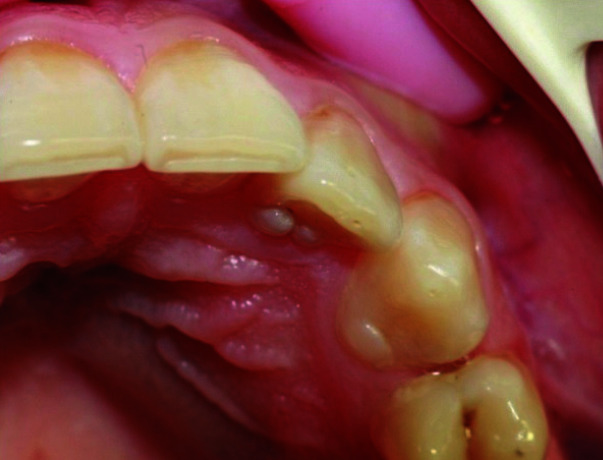
Dens invagination is a developmental anomaly that requires specific treatment approaches. The invagination is enamel-lined in the crown of the tooth truly negligible, and usually there is no extension on the level of the external amelocemental junction. A well ending surgical root canal treatment of an invaginated tooth with a retrograde filling is presented in this case report. Periapical radiographic examination, after 3 months and 6 years of follow-up, showed periapical healing with osseous formation .





 京公网安备 11010802042870号
京ICP备2023020795号-1
京公网安备 11010802042870号
京ICP备2023020795号-1

 分享
分享

 求助内容:
求助内容: 应助结果提醒方式:
 扫码关注我们
