Sanjukta N Bose, Joseph L Greenstein, James C Fackler, Sridevi V Sarma, Raimond L Winslow, Melania M Bembea
{"title":"Early Prediction of Multiple Organ Dysfunction in the Pediatric Intensive Care Unit.","authors":"Sanjukta N Bose, Joseph L Greenstein, James C Fackler, Sridevi V Sarma, Raimond L Winslow, Melania M Bembea","doi":"10.3389/fped.2021.711104","DOIUrl":null,"url":null,"abstract":"<p><p><b>Objective:</b> The objective of the study is to build models for early prediction of risk for developing multiple organ dysfunction (MOD) in pediatric intensive care unit (PICU) patients. <b>Design:</b> The design of the study is a retrospective observational cohort study. <b>Setting:</b> The setting of the study is at a single academic PICU at the Johns Hopkins Hospital, Baltimore, MD. <b>Patients:</b> The patients included in the study were <18 years of age admitted to the PICU between July 2014 and October 2015. <b>Measurements and main results:</b> Organ dysfunction labels were generated every minute from preceding 24-h time windows using the International Pediatric Sepsis Consensus Conference (IPSCC) and Proulx et al. MOD criteria. Early MOD prediction models were built using four machine learning methods: random forest, XGBoost, GLMBoost, and Lasso-GLM. An optimal threshold learned from training data was used to detect high-risk alert events (HRAs). The early prediction models from all methods achieved an area under the receiver operating characteristics curve ≥0.91 for both IPSCC and Proulx criteria. The best performance in terms of maximum F1-score was achieved with random forest (sensitivity: 0.72, positive predictive value: 0.70, F1-score: 0.71) and XGBoost (sensitivity: 0.8, positive predictive value: 0.81, F1-score: 0.81) for IPSCC and Proulx criteria, respectively. The median early warning time was 22.7 h for random forest and 37 h for XGBoost models for IPSCC and Proulx criteria, respectively. Applying spectral clustering on risk-score trajectories over 24 h following early warning provided a high-risk group with ≥0.93 positive predictive value. <b>Conclusions:</b> Early predictions from risk-based patient monitoring could provide more than 22 h of lead time for MOD onset, with ≥0.93 positive predictive value for a high-risk group identified pre-MOD.</p>","PeriodicalId":2,"journal":{"name":"ACS Applied Bio Materials","volume":" ","pages":"711104"},"PeriodicalIF":4.7000,"publicationDate":"2021-08-16","publicationTypes":"Journal Article","fieldsOfStudy":null,"isOpenAccess":false,"openAccessPdf":"https://www.ncbi.nlm.nih.gov/pmc/articles/PMC8415553/pdf/","citationCount":"0","resultStr":null,"platform":"Semanticscholar","paperid":null,"PeriodicalName":"ACS Applied Bio Materials","FirstCategoryId":"3","ListUrlMain":"https://doi.org/10.3389/fped.2021.711104","RegionNum":0,"RegionCategory":null,"ArticlePicture":[],"TitleCN":null,"AbstractTextCN":null,"PMCID":null,"EPubDate":"2021/1/1 0:00:00","PubModel":"eCollection","JCR":"Q2","JCRName":"MATERIALS SCIENCE, BIOMATERIALS","Score":null,"Total":0}
引用次数: 0
Abstract
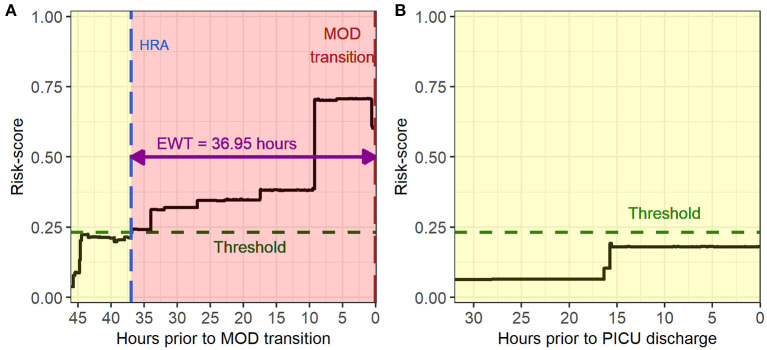
Objective: The objective of the study is to build models for early prediction of risk for developing multiple organ dysfunction (MOD) in pediatric intensive care unit (PICU) patients. Design: The design of the study is a retrospective observational cohort study. Setting: The setting of the study is at a single academic PICU at the Johns Hopkins Hospital, Baltimore, MD. Patients: The patients included in the study were <18 years of age admitted to the PICU between July 2014 and October 2015. Measurements and main results: Organ dysfunction labels were generated every minute from preceding 24-h time windows using the International Pediatric Sepsis Consensus Conference (IPSCC) and Proulx et al. MOD criteria. Early MOD prediction models were built using four machine learning methods: random forest, XGBoost, GLMBoost, and Lasso-GLM. An optimal threshold learned from training data was used to detect high-risk alert events (HRAs). The early prediction models from all methods achieved an area under the receiver operating characteristics curve ≥0.91 for both IPSCC and Proulx criteria. The best performance in terms of maximum F1-score was achieved with random forest (sensitivity: 0.72, positive predictive value: 0.70, F1-score: 0.71) and XGBoost (sensitivity: 0.8, positive predictive value: 0.81, F1-score: 0.81) for IPSCC and Proulx criteria, respectively. The median early warning time was 22.7 h for random forest and 37 h for XGBoost models for IPSCC and Proulx criteria, respectively. Applying spectral clustering on risk-score trajectories over 24 h following early warning provided a high-risk group with ≥0.93 positive predictive value. Conclusions: Early predictions from risk-based patient monitoring could provide more than 22 h of lead time for MOD onset, with ≥0.93 positive predictive value for a high-risk group identified pre-MOD.
期刊介绍:
ACS Applied Bio Materials is an interdisciplinary journal publishing original research covering all aspects of biomaterials and biointerfaces including and beyond the traditional biosensing, biomedical and therapeutic applications.
The journal is devoted to reports of new and original experimental and theoretical research of an applied nature that integrates knowledge in the areas of materials, engineering, physics, bioscience, and chemistry into important bio applications. The journal is specifically interested in work that addresses the relationship between structure and function and assesses the stability and degradation of materials under relevant environmental and biological conditions.




 京公网安备 11010802042870号
京ICP备2023020795号-1
京公网安备 11010802042870号
京ICP备2023020795号-1

 分享
分享
 求助内容:
求助内容: 应助结果提醒方式:
 扫码关注我们
