{"title":"A new era has begun: Treatment of atopic dermatitis with biologics.","authors":"Dora Stölzl, Stephan Weidinger, Katharina Drerup","doi":"10.5414/ALX02259E","DOIUrl":null,"url":null,"abstract":"<p><p>The era of biologics for the treatment of moderate-to-severe atopic dermatitis (AD) began in 2017 with the approval of dupilumab, a monoclonal antibody that binds to the α-subunit of the interleukin IL-4 receptor. Until then, only conventional immunosuppressants were available for systemic treatment, of which only cyclosporine is approved for the treatment of severe AD. In the meantime, the therapeutic landscape of AD has been changing rapidly, and additional biologics have been developed which target IL-13, the IL-31 receptor, OX40, and OX40L, among others. Many of these substances have already shown promising results in phase 1, 2, and in some cases also phase 3 trials. In June 2021, tralokinumab, an IL-13 antibody, has been approved in Europe for the treatment of moderate-to-severe AD in adults. In addition to antibody-based therapies, \"small molecules\" that, e.g., inhibit Janus kinases enrich the armamentarium of systemic AD therapies. With all these agents, not only will many more targeted therapies become available, but also will the complex and heterogeneous pathophysiological processes of this disease be better understood.</p>","PeriodicalId":7485,"journal":{"name":"Allergologie Select","volume":"5 ","pages":"265-273"},"PeriodicalIF":0.0000,"publicationDate":"2021-08-27","publicationTypes":"Journal Article","fieldsOfStudy":null,"isOpenAccess":false,"openAccessPdf":"https://www.ncbi.nlm.nih.gov/pmc/articles/PMC8439107/pdf/","citationCount":"8","resultStr":null,"platform":"Semanticscholar","paperid":null,"PeriodicalName":"Allergologie Select","FirstCategoryId":"1085","ListUrlMain":"https://doi.org/10.5414/ALX02259E","RegionNum":0,"RegionCategory":null,"ArticlePicture":[],"TitleCN":null,"AbstractTextCN":null,"PMCID":null,"EPubDate":"2021/1/1 0:00:00","PubModel":"eCollection","JCR":"","JCRName":"","Score":null,"Total":0}
引用次数: 8
Abstract
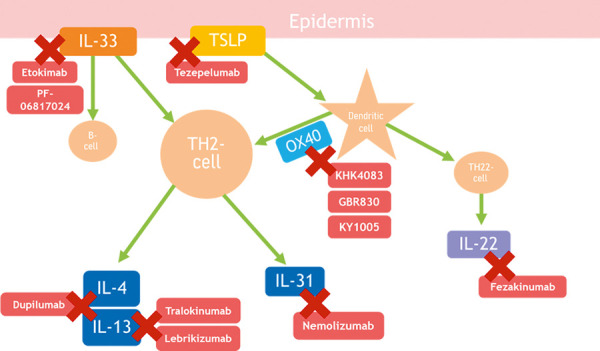
The era of biologics for the treatment of moderate-to-severe atopic dermatitis (AD) began in 2017 with the approval of dupilumab, a monoclonal antibody that binds to the α-subunit of the interleukin IL-4 receptor. Until then, only conventional immunosuppressants were available for systemic treatment, of which only cyclosporine is approved for the treatment of severe AD. In the meantime, the therapeutic landscape of AD has been changing rapidly, and additional biologics have been developed which target IL-13, the IL-31 receptor, OX40, and OX40L, among others. Many of these substances have already shown promising results in phase 1, 2, and in some cases also phase 3 trials. In June 2021, tralokinumab, an IL-13 antibody, has been approved in Europe for the treatment of moderate-to-severe AD in adults. In addition to antibody-based therapies, "small molecules" that, e.g., inhibit Janus kinases enrich the armamentarium of systemic AD therapies. With all these agents, not only will many more targeted therapies become available, but also will the complex and heterogeneous pathophysiological processes of this disease be better understood.



 京公网安备 11010802042870号
京ICP备2023020795号-1
京公网安备 11010802042870号
京ICP备2023020795号-1

 分享
分享

 求助内容:
求助内容: 应助结果提醒方式:
 扫码关注我们
