The Mediterranean diet and dietary approach to stop hypertension (DASH)-style diet are differently associated with lipid profile in a large sample of Iranian adults: a cross-sectional study of Shahedieh cohort.
{"title":"The Mediterranean diet and dietary approach to stop hypertension (DASH)-style diet are differently associated with lipid profile in a large sample of Iranian adults: a cross-sectional study of Shahedieh cohort.","authors":"Monireh Panbehkar-Jouybari, Mehdi Mollahosseini, Amin Salehi-Abargouei, Hossein Fallahzadeh, Masoud Mirzaei, Mahdieh Hosseinzadeh","doi":"10.1186/s12902-021-00856-w","DOIUrl":null,"url":null,"abstract":"<p><strong>Background: </strong>The association between the Mediterranean diet (MED) or dietary approach to stop hypertension (DASH) and cardiovascular disease (CVD) risk factors is well-documented. Nevertheless, a consistent relationship with the Middle East population has yet to be known. Thus, we aimed to investigate the association between DASH/MED and blood lipids in Iranian adults.</p><p><strong>Methods: </strong>Four thousand seven hundred forty participants, aged 35-70 years (mean: 50.0) participated in the Shahedieh cohort study in Yazd, Iran, were followed from 2016 until now. Participants provided dietary and blood lipid data through a validated semi-quantitative food frequency questionnaire, and blood samples were taken after a fasted state. We used binary logistic regression to examine the association between DASH/MED scores and blood lipids.</p><p><strong>Results: </strong>In the participants who ingested a DASH-like diet the third vs. the first tertile of total cholesterol (TC), triglyceride (TG), low-density lipoprotein (LDL) levels, and LDL/HDL (high-density lipoprotein) ratio reduced significantly (P < 0.01). While in the participants who ingested the MED-like diet the HDL level increased significantly( 52.8 ± 12. 3 vs. 51.6 ± 11.6, P < 0.01). In Binary logistic regression, higher adherence to the DASH diet showed 19 % lower odds of high TC level (OR: 0.81; 95 %CI: 0.69-0.95) and 18 % lower odds of high LDL/HDL ratio (OR: 0.82; 95 %CI: 0.70-0.96). Besides, high adherence to the MED diet was associated with lower odds of LDL/HDL ratio (OR: 0.85; 95 %CI: 0.72-0.99).</p><p><strong>Conclusions: </strong>Our findings suggest that TC, TG, LDL, LDL/HDL ratio, and HDL improved in participants who ingested a DASH-like diet and the LDL/HDL ratio improved in participants who ingested MED-like diet and, subsequently they might have a protective effect on CVDs risk. Further epidemiological studies are needed to confirm our findings.</p>","PeriodicalId":9152,"journal":{"name":"BMC Endocrine Disorders","volume":" ","pages":"192"},"PeriodicalIF":3.3000,"publicationDate":"2021-09-22","publicationTypes":"Journal Article","fieldsOfStudy":null,"isOpenAccess":false,"openAccessPdf":"https://www.ncbi.nlm.nih.gov/pmc/articles/PMC8456584/pdf/","citationCount":"7","resultStr":null,"platform":"Semanticscholar","paperid":null,"PeriodicalName":"BMC Endocrine Disorders","FirstCategoryId":"3","ListUrlMain":"https://doi.org/10.1186/s12902-021-00856-w","RegionNum":3,"RegionCategory":"医学","ArticlePicture":[],"TitleCN":null,"AbstractTextCN":null,"PMCID":null,"EPubDate":"","PubModel":"","JCR":"Q3","JCRName":"ENDOCRINOLOGY & METABOLISM","Score":null,"Total":0}
引用次数: 7
Abstract
Background: The association between the Mediterranean diet (MED) or dietary approach to stop hypertension (DASH) and cardiovascular disease (CVD) risk factors is well-documented. Nevertheless, a consistent relationship with the Middle East population has yet to be known. Thus, we aimed to investigate the association between DASH/MED and blood lipids in Iranian adults.
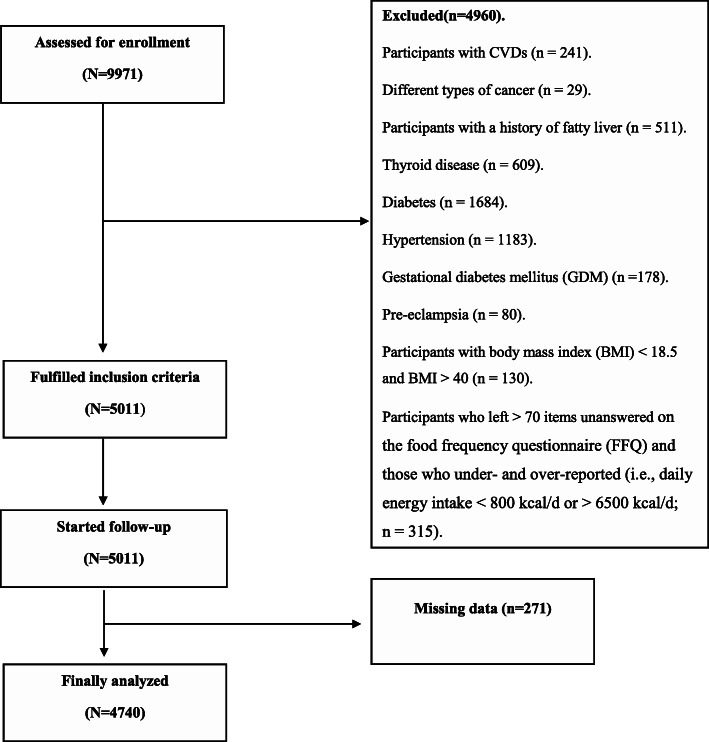
Methods: Four thousand seven hundred forty participants, aged 35-70 years (mean: 50.0) participated in the Shahedieh cohort study in Yazd, Iran, were followed from 2016 until now. Participants provided dietary and blood lipid data through a validated semi-quantitative food frequency questionnaire, and blood samples were taken after a fasted state. We used binary logistic regression to examine the association between DASH/MED scores and blood lipids.
Results: In the participants who ingested a DASH-like diet the third vs. the first tertile of total cholesterol (TC), triglyceride (TG), low-density lipoprotein (LDL) levels, and LDL/HDL (high-density lipoprotein) ratio reduced significantly (P < 0.01). While in the participants who ingested the MED-like diet the HDL level increased significantly( 52.8 ± 12. 3 vs. 51.6 ± 11.6, P < 0.01). In Binary logistic regression, higher adherence to the DASH diet showed 19 % lower odds of high TC level (OR: 0.81; 95 %CI: 0.69-0.95) and 18 % lower odds of high LDL/HDL ratio (OR: 0.82; 95 %CI: 0.70-0.96). Besides, high adherence to the MED diet was associated with lower odds of LDL/HDL ratio (OR: 0.85; 95 %CI: 0.72-0.99).
Conclusions: Our findings suggest that TC, TG, LDL, LDL/HDL ratio, and HDL improved in participants who ingested a DASH-like diet and the LDL/HDL ratio improved in participants who ingested MED-like diet and, subsequently they might have a protective effect on CVDs risk. Further epidemiological studies are needed to confirm our findings.
期刊介绍:
BMC Endocrine Disorders is an open access, peer-reviewed journal that considers articles on all aspects of the prevention, diagnosis and management of endocrine disorders, as well as related molecular genetics, pathophysiology, and epidemiology.



 京公网安备 11010802042870号
京ICP备2023020795号-1
京公网安备 11010802042870号
京ICP备2023020795号-1

 分享
分享
 求助内容:
求助内容: 应助结果提醒方式:
 扫码关注我们
