Michael J Braus, Robert Swader, George Petry, Thea Whitman
{"title":"Affordable Diffusion Microchamber Array Designs for Isolating Microbes in Classrooms and Laboratories.","authors":"Michael J Braus, Robert Swader, George Petry, Thea Whitman","doi":"10.1128/jmbe.00131-21","DOIUrl":null,"url":null,"abstract":"<p><p>Diffusion microchamber array (DMA) devices have provided contemporary microbiologists with a successful alternative to the century-old plating method using petri dishes to isolate and cultivate environmental bacteria. The \"ichip\" DMA device, developed by the research group of Slava Epstein, is exemplary of this technology, using membranes to culture rare or otherwise nonmodel bacterial taxa, whereby the target cells are nourished by environmental medium across the separating membrane. However, DMA devices have not sufficiently infiltrated the university-level microbiology curriculum, and the size and shape of the ichip make the device challenging for use by students. The following work provides guidance in the creation and use of a suite of DMA devices called \"iplates,\" which are ichip-like tools for use in microbiology education. An iplate mimics the shape and size of a 96-well plate, making it a simpler, more affordable, and customizable design for the isolation and incubation of bacteria and other microorganisms using fresh environmental media. Iplates and their many customizations are intended to enable teachers, students, and researchers to isolate, grow, and analyze the widest possible diversity of microorganisms, complementing standard plating methods. We offer additional tips and tools to help instructors and students get started creating DMA devices to meet their unique needs and research interests.</p>","PeriodicalId":46416,"journal":{"name":"Journal of Microbiology & Biology Education","volume":" ","pages":""},"PeriodicalIF":1.5000,"publicationDate":"2021-06-30","publicationTypes":"Journal Article","fieldsOfStudy":null,"isOpenAccess":false,"openAccessPdf":"https://ftp.ncbi.nlm.nih.gov/pub/pmc/oa_pdf/b2/8d/jmbe.00131-21.PMC8442034.pdf","citationCount":"0","resultStr":null,"platform":"Semanticscholar","paperid":null,"PeriodicalName":"Journal of Microbiology & Biology Education","FirstCategoryId":"1085","ListUrlMain":"https://doi.org/10.1128/jmbe.00131-21","RegionNum":0,"RegionCategory":null,"ArticlePicture":[],"TitleCN":null,"AbstractTextCN":null,"PMCID":null,"EPubDate":"2021/1/1 0:00:00","PubModel":"eCollection","JCR":"Q2","JCRName":"EDUCATION, SCIENTIFIC DISCIPLINES","Score":null,"Total":0}
引用次数: 0
Abstract
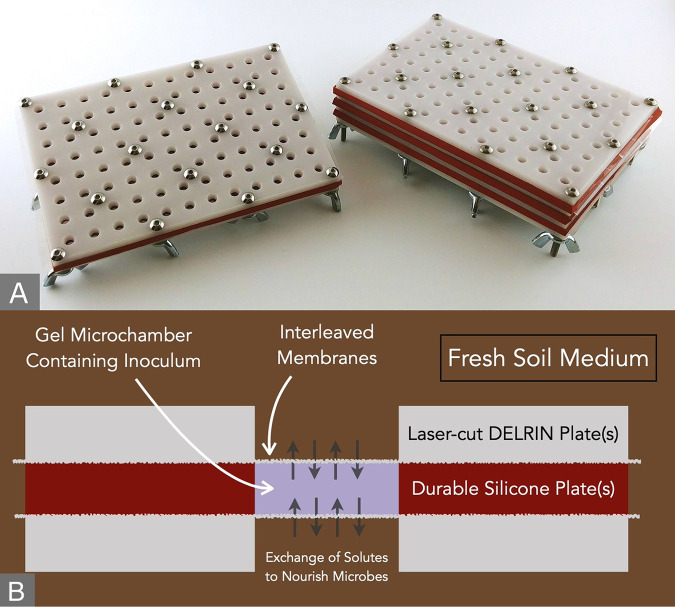
Diffusion microchamber array (DMA) devices have provided contemporary microbiologists with a successful alternative to the century-old plating method using petri dishes to isolate and cultivate environmental bacteria. The "ichip" DMA device, developed by the research group of Slava Epstein, is exemplary of this technology, using membranes to culture rare or otherwise nonmodel bacterial taxa, whereby the target cells are nourished by environmental medium across the separating membrane. However, DMA devices have not sufficiently infiltrated the university-level microbiology curriculum, and the size and shape of the ichip make the device challenging for use by students. The following work provides guidance in the creation and use of a suite of DMA devices called "iplates," which are ichip-like tools for use in microbiology education. An iplate mimics the shape and size of a 96-well plate, making it a simpler, more affordable, and customizable design for the isolation and incubation of bacteria and other microorganisms using fresh environmental media. Iplates and their many customizations are intended to enable teachers, students, and researchers to isolate, grow, and analyze the widest possible diversity of microorganisms, complementing standard plating methods. We offer additional tips and tools to help instructors and students get started creating DMA devices to meet their unique needs and research interests.




 京公网安备 11010802042870号
京ICP备2023020795号-1
京公网安备 11010802042870号
京ICP备2023020795号-1

 分享
分享
 求助内容:
求助内容: 应助结果提醒方式:
 扫码关注我们
