Dose escalated simultaneous integrated boost of gross nodal disease in gynecologic cancers: a multi-institutional retrospective analysis and review of the literature.
Garrett Lee Jensen, Megan Ann Mezera, Salman Hasan, Kendall Pye Hammonds, Gregory Peter Swanson, Moataz Nier El-Ghamry
{"title":"Dose escalated simultaneous integrated boost of gross nodal disease in gynecologic cancers: a multi-institutional retrospective analysis and review of the literature.","authors":"Garrett Lee Jensen, Megan Ann Mezera, Salman Hasan, Kendall Pye Hammonds, Gregory Peter Swanson, Moataz Nier El-Ghamry","doi":"10.3857/roj.2020.00948","DOIUrl":null,"url":null,"abstract":"<p><strong>Purpose: </strong>Typical doses of 45-50.4 Gy used to treat regional nodes have demonstrated inadequate control of gross nodal disease (GND) in gynecologic cancer, and accelerated repopulation may limit the efficacy of a sequential boost. We reviewed outcomes of patients treated with a simultaneous integrated boost (SIB) at 2.25 Gy per fraction to positron emission tomography (PET) avid GND to evaluate toxicity and tumor control using this dose-escalated regimen.</p><p><strong>Materials and methods: </strong>A total of 83 patients with gynecologic cancer and PET avid inguinal, pelvic, or para-aortic lymphadenopathy were treated using intensity-modulated radiation therapy (IMRT) with SIB. Primary cancers were mostly cervical (51%) and endometrial (34%), and included patients who received concurrent chemotherapy (59%) and/or brachytherapy boost (78%).</p><p><strong>Results: </strong>Median follow-up from radiation completion was 12.6 months (range, 2.7 to 92.9 months). Median dose to elective lymphatics was 50.4 Gy (range, 45 to 50.4 Gy) at 1.8 Gy/fraction. Median SIB dose and volume were 63 Gy (range, 56.3 to 63 Gy) and 72.8 mL (range, 6.8 to 1,134 mL) at 2-2.25 Gy/fraction. Nodal control was 97.6% in the SIB area while 90.4% in the low dose area (p = 0.013). SIB radiotherapy (RT) field failure-free, non-SIB RT field failure-free, and out of RT field failure-free survival at 4 years were 98%, 86%, and 51%, respectively. Acute and late grade ≥3 genitourinary toxicity rates were 0%. Acute and late grade ≥3 gastrointestinal toxicity rates were 7.2% and 12.0%, respectively.</p><p><strong>Conclusion: </strong>Dose escalated SIB to PET avid adenopathy results in excellent local control with acceptable toxicity.</p>","PeriodicalId":46572,"journal":{"name":"Radiation Oncology Journal","volume":"39 3","pages":"219-230"},"PeriodicalIF":2.2000,"publicationDate":"2021-09-01","publicationTypes":"Journal Article","fieldsOfStudy":null,"isOpenAccess":false,"openAccessPdf":"https://ftp.ncbi.nlm.nih.gov/pub/pmc/oa_pdf/1b/bd/roj-2020-00948.PMC8497864.pdf","citationCount":"0","resultStr":null,"platform":"Semanticscholar","paperid":null,"PeriodicalName":"Radiation Oncology Journal","FirstCategoryId":"1085","ListUrlMain":"https://doi.org/10.3857/roj.2020.00948","RegionNum":0,"RegionCategory":null,"ArticlePicture":[],"TitleCN":null,"AbstractTextCN":null,"PMCID":null,"EPubDate":"2021/7/13 0:00:00","PubModel":"Epub","JCR":"Q3","JCRName":"ONCOLOGY","Score":null,"Total":0}
引用次数: 0
Abstract
Purpose: Typical doses of 45-50.4 Gy used to treat regional nodes have demonstrated inadequate control of gross nodal disease (GND) in gynecologic cancer, and accelerated repopulation may limit the efficacy of a sequential boost. We reviewed outcomes of patients treated with a simultaneous integrated boost (SIB) at 2.25 Gy per fraction to positron emission tomography (PET) avid GND to evaluate toxicity and tumor control using this dose-escalated regimen.
Materials and methods: A total of 83 patients with gynecologic cancer and PET avid inguinal, pelvic, or para-aortic lymphadenopathy were treated using intensity-modulated radiation therapy (IMRT) with SIB. Primary cancers were mostly cervical (51%) and endometrial (34%), and included patients who received concurrent chemotherapy (59%) and/or brachytherapy boost (78%).
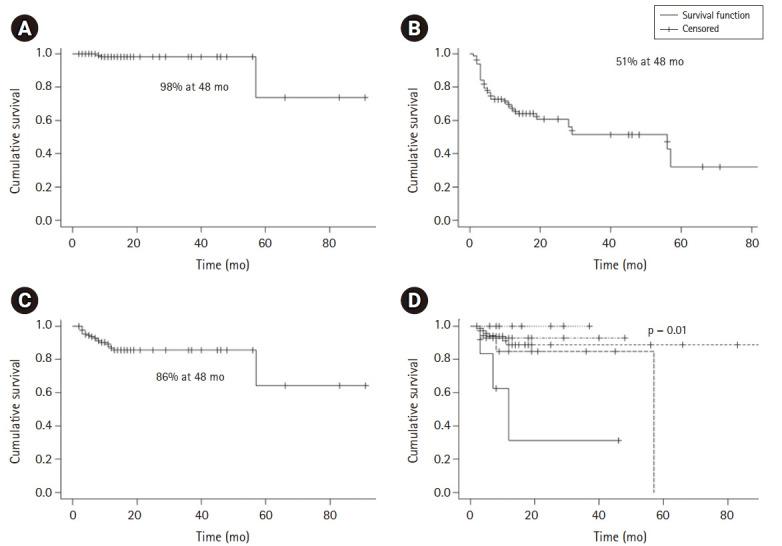
Results: Median follow-up from radiation completion was 12.6 months (range, 2.7 to 92.9 months). Median dose to elective lymphatics was 50.4 Gy (range, 45 to 50.4 Gy) at 1.8 Gy/fraction. Median SIB dose and volume were 63 Gy (range, 56.3 to 63 Gy) and 72.8 mL (range, 6.8 to 1,134 mL) at 2-2.25 Gy/fraction. Nodal control was 97.6% in the SIB area while 90.4% in the low dose area (p = 0.013). SIB radiotherapy (RT) field failure-free, non-SIB RT field failure-free, and out of RT field failure-free survival at 4 years were 98%, 86%, and 51%, respectively. Acute and late grade ≥3 genitourinary toxicity rates were 0%. Acute and late grade ≥3 gastrointestinal toxicity rates were 7.2% and 12.0%, respectively.
Conclusion: Dose escalated SIB to PET avid adenopathy results in excellent local control with acceptable toxicity.





 京公网安备 11010802042870号
京ICP备2023020795号-1
京公网安备 11010802042870号
京ICP备2023020795号-1

 分享
分享
 求助内容:
求助内容: 应助结果提醒方式:
 扫码关注我们
