{"title":"Synchronization in epidemic growth and the impossibility of selective containment","authors":"Jan C Budich;Emil J Bergholtz","doi":"10.1093/imammb/dqab013","DOIUrl":null,"url":null,"abstract":"Containment, aiming to prevent the epidemic stage of community-spreading altogether, and mitigation, aiming to merely ‘flatten the curve’ of a wide-ranged outbreak, constitute two qualitatively different approaches to combating an epidemic through non-pharmaceutical interventions. Here, we study a simple model of epidemic dynamics separating the population into two groups, namely a low-risk group and a high-risk group, for which different strategies are pursued. Due to synchronization effects, we find that maintaining a slower epidemic growth behaviour for the high-risk group is unstable against any finite coupling between the two groups. More precisely, the density of infected individuals in the two groups qualitatively evolves very similarly, apart from a small time delay and an overall scaling factor quantifying the coupling between the groups. Hence, selective containment of the epidemic in a targeted (high-risk) group is practically impossible whenever the surrounding society implements a mitigated community-spreading. We relate our general findings to the ongoing COVID-19 pandemic.","PeriodicalId":94130,"journal":{"name":"Mathematical medicine and biology : a journal of the IMA","volume":"38 4","pages":"467-473"},"PeriodicalIF":1.5000,"publicationDate":"2021-09-01","publicationTypes":"Journal Article","fieldsOfStudy":null,"isOpenAccess":false,"openAccessPdf":"https://ieeexplore.ieee.org/stamp/stamp.jsp?tp=&arnumber=9686632","citationCount":"0","resultStr":null,"platform":"Semanticscholar","paperid":null,"PeriodicalName":"Mathematical medicine and biology : a journal of the IMA","FirstCategoryId":"1085","ListUrlMain":"https://ieeexplore.ieee.org/document/9686632/","RegionNum":0,"RegionCategory":null,"ArticlePicture":[],"TitleCN":null,"AbstractTextCN":null,"PMCID":null,"EPubDate":"","PubModel":"","JCR":"","JCRName":"","Score":null,"Total":0}
引用次数: 0
Abstract
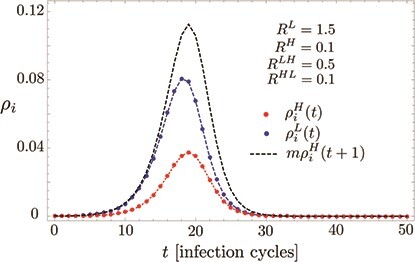
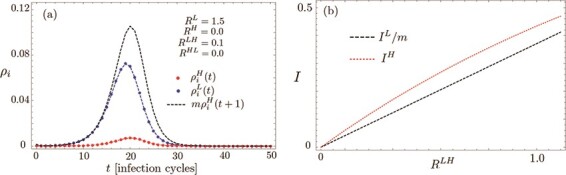
Containment, aiming to prevent the epidemic stage of community-spreading altogether, and mitigation, aiming to merely ‘flatten the curve’ of a wide-ranged outbreak, constitute two qualitatively different approaches to combating an epidemic through non-pharmaceutical interventions. Here, we study a simple model of epidemic dynamics separating the population into two groups, namely a low-risk group and a high-risk group, for which different strategies are pursued. Due to synchronization effects, we find that maintaining a slower epidemic growth behaviour for the high-risk group is unstable against any finite coupling between the two groups. More precisely, the density of infected individuals in the two groups qualitatively evolves very similarly, apart from a small time delay and an overall scaling factor quantifying the coupling between the groups. Hence, selective containment of the epidemic in a targeted (high-risk) group is practically impossible whenever the surrounding society implements a mitigated community-spreading. We relate our general findings to the ongoing COVID-19 pandemic.



 京公网安备 11010802042870号
京ICP备2023020795号-1
京公网安备 11010802042870号
京ICP备2023020795号-1

 分享
分享

 求助内容:
求助内容: 应助结果提醒方式:
 扫码关注我们
