Circular RNA CNOT2 knockdown regulates twist family BHLH transcription factor via targeting microRNA 409-3p to prevent breast cancer invasion, migration and epithelial-mesenchymal transition.
{"title":"Circular RNA CNOT2 knockdown regulates twist family BHLH transcription factor via targeting microRNA 409-3p to prevent breast cancer invasion, migration and epithelial-mesenchymal transition.","authors":"QunXue Su, Hao Shen, Bei Gu, Ning Zhu","doi":"10.1080/21655979.2021.1974805","DOIUrl":null,"url":null,"abstract":"<p><p>Numerous studies have manifested that cicular RNA (circRNA) is closely associated with the development of breast cancer (BC), but the specific mechanism has not been fully clarified. The purpose of this study was to investigate the effect of circCNOT2 on BC invasion, migration and epithelial mesenchymal transition (EMT) and its potential molecular mechanism. The results assured that circCNOT2 and Twist Family BHLH Transcription Factor (TWIST1) were elevated in BC, while microrNA (miR)-409-3p was reduced. CircCNOT2 was positively correlated with TWIST1 and negatively correlated with miR-409-3p. Elevated circCNOT2 is associated with poor prognosis of BC. Knockdown circCNOT2 or augmented miR-409-3p could promote apoptosis but repress proliferation, invasion, migration and EMT of BC cells. In addition, overexpression of circCNOT2 or TWIST1 accelerated BC invasion, migration and EMT, which could be reversed by simultaneous transfection of miR-409-3p-mimic. Further dual luciferase reporting and RNA-pull down assay clarified that circCNOT2 acted as a competing endogenous RNA of miR-409-3p to mediate TWIST1 expression. In conclusion, the results of this study suggest that circCNOT2 affects the biological behavior of BC via regulating the miR-409-3p/TWIST1 axis, and may be applied as a potential therapeutic target for BC later.</p>","PeriodicalId":4,"journal":{"name":"ACS Applied Energy Materials","volume":" ","pages":"9058-9069"},"PeriodicalIF":5.5000,"publicationDate":"2021-12-01","publicationTypes":"Journal Article","fieldsOfStudy":null,"isOpenAccess":false,"openAccessPdf":"https://www.ncbi.nlm.nih.gov/pmc/articles/PMC8806471/pdf/","citationCount":"0","resultStr":null,"platform":"Semanticscholar","paperid":null,"PeriodicalName":"ACS Applied Energy Materials","FirstCategoryId":"99","ListUrlMain":"https://doi.org/10.1080/21655979.2021.1974805","RegionNum":3,"RegionCategory":"材料科学","ArticlePicture":[],"TitleCN":null,"AbstractTextCN":null,"PMCID":null,"EPubDate":"","PubModel":"","JCR":"Q2","JCRName":"CHEMISTRY, PHYSICAL","Score":null,"Total":0}
引用次数: 0
Abstract
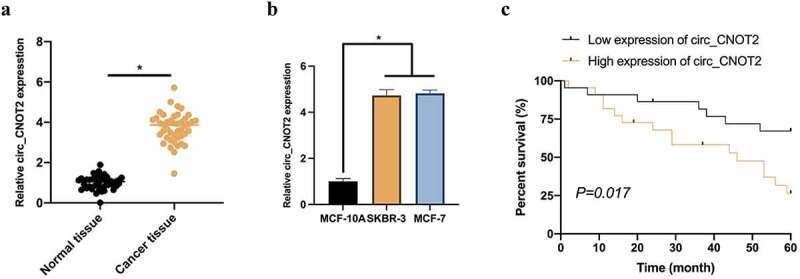
Numerous studies have manifested that cicular RNA (circRNA) is closely associated with the development of breast cancer (BC), but the specific mechanism has not been fully clarified. The purpose of this study was to investigate the effect of circCNOT2 on BC invasion, migration and epithelial mesenchymal transition (EMT) and its potential molecular mechanism. The results assured that circCNOT2 and Twist Family BHLH Transcription Factor (TWIST1) were elevated in BC, while microrNA (miR)-409-3p was reduced. CircCNOT2 was positively correlated with TWIST1 and negatively correlated with miR-409-3p. Elevated circCNOT2 is associated with poor prognosis of BC. Knockdown circCNOT2 or augmented miR-409-3p could promote apoptosis but repress proliferation, invasion, migration and EMT of BC cells. In addition, overexpression of circCNOT2 or TWIST1 accelerated BC invasion, migration and EMT, which could be reversed by simultaneous transfection of miR-409-3p-mimic. Further dual luciferase reporting and RNA-pull down assay clarified that circCNOT2 acted as a competing endogenous RNA of miR-409-3p to mediate TWIST1 expression. In conclusion, the results of this study suggest that circCNOT2 affects the biological behavior of BC via regulating the miR-409-3p/TWIST1 axis, and may be applied as a potential therapeutic target for BC later.
期刊介绍:
ACS Applied Energy Materials is an interdisciplinary journal publishing original research covering all aspects of materials, engineering, chemistry, physics and biology relevant to energy conversion and storage. The journal is devoted to reports of new and original experimental and theoretical research of an applied nature that integrate knowledge in the areas of materials, engineering, physics, bioscience, and chemistry into important energy applications.





 京公网安备 11010802042870号
京ICP备2023020795号-1
京公网安备 11010802042870号
京ICP备2023020795号-1

 分享
分享
 求助内容:
求助内容: 应助结果提醒方式:
 扫码关注我们
