{"title":"A crystal-processing machine using a deep-ultraviolet laser: application to long-wavelength native SAD experiments.","authors":"Yoshiaki Kawano, Masahide Hikita, Naohiro Matsugaki, Masaki Yamamoto, Toshiya Senda","doi":"10.1107/S2053230X2101339X","DOIUrl":null,"url":null,"abstract":"<p><p>While native SAD phasing is a promising method for next-generation macromolecular crystallography, it requires the collection of high-quality diffraction data using long-wavelength X-rays. The crystal itself and the noncrystalline medium around the crystal can cause background noise during long-wavelength X-ray data collection, hampering native SAD phasing. Optimizing the crystal size and shape or removing noncrystalline sample portions have thus been considered to be effective means of improving the data quality. A crystal-processing machine that uses a deep-UV laser has been developed. The machine utilizes the pulsed UV laser soft ablation (PULSA) technique, which generates less heat than methods using infrared or visible lasers. Since protein crystals are sensitive to heat damage, PULSA is an appropriate method to process them. Integration of a high-speed Galvano scanner and a high-precision goniometer enables protein crystals to be shaped precisely and efficiently. Application of this crystal-processing machine to a long-wavelength X-ray diffraction experiment significantly improved the diffraction data quality and thereby increased the success rate in experimental phasing using anomalous diffraction from atoms.</p>","PeriodicalId":7029,"journal":{"name":"Acta crystallographica. Section F, Structural biology communications","volume":" ","pages":"88-95"},"PeriodicalIF":1.1000,"publicationDate":"2022-02-01","publicationTypes":"Journal Article","fieldsOfStudy":null,"isOpenAccess":false,"openAccessPdf":"https://www.ncbi.nlm.nih.gov/pmc/articles/PMC8805218/pdf/","citationCount":"0","resultStr":null,"platform":"Semanticscholar","paperid":null,"PeriodicalName":"Acta crystallographica. Section F, Structural biology communications","FirstCategoryId":"99","ListUrlMain":"https://doi.org/10.1107/S2053230X2101339X","RegionNum":4,"RegionCategory":"生物学","ArticlePicture":[],"TitleCN":null,"AbstractTextCN":null,"PMCID":null,"EPubDate":"2022/1/27 0:00:00","PubModel":"Epub","JCR":"Q4","JCRName":"BIOCHEMICAL RESEARCH METHODS","Score":null,"Total":0}
引用次数: 0
Abstract
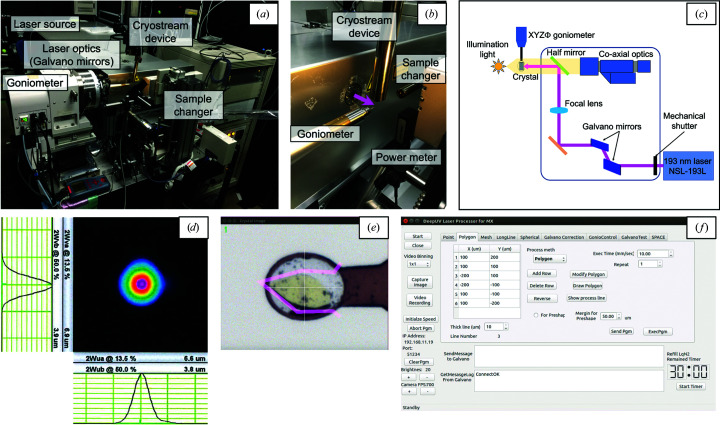
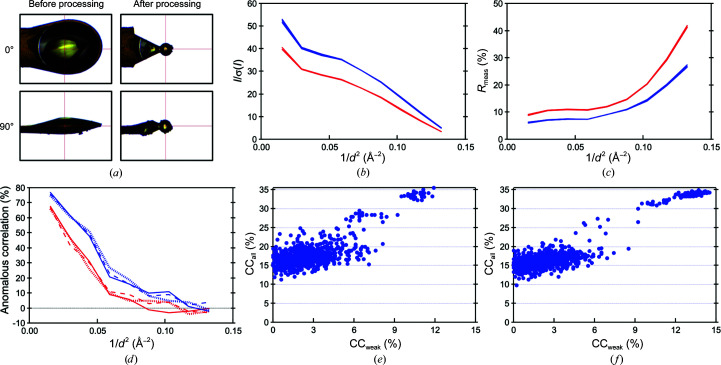
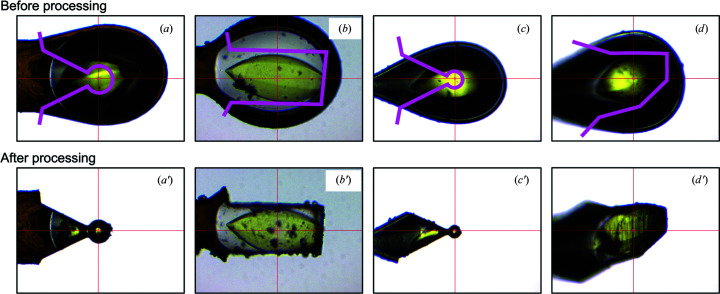
While native SAD phasing is a promising method for next-generation macromolecular crystallography, it requires the collection of high-quality diffraction data using long-wavelength X-rays. The crystal itself and the noncrystalline medium around the crystal can cause background noise during long-wavelength X-ray data collection, hampering native SAD phasing. Optimizing the crystal size and shape or removing noncrystalline sample portions have thus been considered to be effective means of improving the data quality. A crystal-processing machine that uses a deep-UV laser has been developed. The machine utilizes the pulsed UV laser soft ablation (PULSA) technique, which generates less heat than methods using infrared or visible lasers. Since protein crystals are sensitive to heat damage, PULSA is an appropriate method to process them. Integration of a high-speed Galvano scanner and a high-precision goniometer enables protein crystals to be shaped precisely and efficiently. Application of this crystal-processing machine to a long-wavelength X-ray diffraction experiment significantly improved the diffraction data quality and thereby increased the success rate in experimental phasing using anomalous diffraction from atoms.
期刊介绍:
Acta Crystallographica Section F is a rapid structural biology communications journal.
Articles on any aspect of structural biology, including structures determined using high-throughput methods or from iterative studies such as those used in the pharmaceutical industry, are welcomed by the journal.
The journal offers the option of open access, and all communications benefit from unlimited free use of colour illustrations and no page charges. Authors are encouraged to submit multimedia content for publication with their articles.
Acta Cryst. F has a dedicated online tool called publBio that is designed to make the preparation and submission of articles easier for authors.



 京公网安备 11010802042870号
京ICP备2023020795号-1
京公网安备 11010802042870号
京ICP备2023020795号-1

 分享
分享
 求助内容:
求助内容: 应助结果提醒方式:
 扫码关注我们
