Hans-Rudolf Weiss, Manuel Lay, Tamisha Best-Gittens, Marc Moramarco, Mario Jimeranez
{"title":"Conservative treatment of a scoliosis patient after two heart surgeries in early childhood - A case report.","authors":"Hans-Rudolf Weiss, Manuel Lay, Tamisha Best-Gittens, Marc Moramarco, Mario Jimeranez","doi":"10.4102/sajp.v77i2.1588","DOIUrl":null,"url":null,"abstract":"<p><strong>Introduction: </strong>This is a case report of a juvenile female patient with scoliosis following two heart surgeries for congenital heart disease (CHD).</p><p><strong>Patient presentation management and outcome: </strong>Initially, the premenarchial female was 9 years old and had a Tanner stage 2-3 with a single thoracic curve of 65° Cobb. Because of the high risk for progression, immediate brace treatment was proposed as the father declined surgery. The patient received intensive treatment according to the Schroth Best Practice® programme and a Gensingen Brace® designed for large thoracic curves. Over the 18 months following the initial visit, she received two additional braces. As a result, the progression of the main curve was prevented. The patient continues to maintain an improved cosmetic result and is currently at a Risser 2.</p><p><strong>Conclusion: </strong>Surgery performed for CHD in rare cases may lead to stiff spinal deformity as a consequence of that surgery. Progression of a severe and stiff curve was prevented during the most vulnerable phase of the pubertal growth spurt with an improved clinical result. Therefore, we assume that the patient may have a normal life in adulthood with minor restrictions only. Supported by pattern-specific high correction exercises and braces, these typical single thoracic curves can be re-compensated to a more balanced appearance, less prone to progression in adulthood.</p><p><strong>Clinical implications: </strong>Because of the relative high risks of spinal fusion and the long-term unknowns of such an intervention, high-impact conservative treatment should be implemented first before surgical correction is considered.</p>","PeriodicalId":44180,"journal":{"name":"South African Journal of Physiotherapy","volume":"77 2","pages":"1588"},"PeriodicalIF":1.2000,"publicationDate":"2021-11-30","publicationTypes":"Journal Article","fieldsOfStudy":null,"isOpenAccess":false,"openAccessPdf":"https://www.ncbi.nlm.nih.gov/pmc/articles/PMC8661293/pdf/","citationCount":"0","resultStr":null,"platform":"Semanticscholar","paperid":null,"PeriodicalName":"South African Journal of Physiotherapy","FirstCategoryId":"1085","ListUrlMain":"https://doi.org/10.4102/sajp.v77i2.1588","RegionNum":0,"RegionCategory":null,"ArticlePicture":[],"TitleCN":null,"AbstractTextCN":null,"PMCID":null,"EPubDate":"2021/1/1 0:00:00","PubModel":"eCollection","JCR":"Q4","JCRName":"REHABILITATION","Score":null,"Total":0}
引用次数: 0
Abstract
Introduction: This is a case report of a juvenile female patient with scoliosis following two heart surgeries for congenital heart disease (CHD).
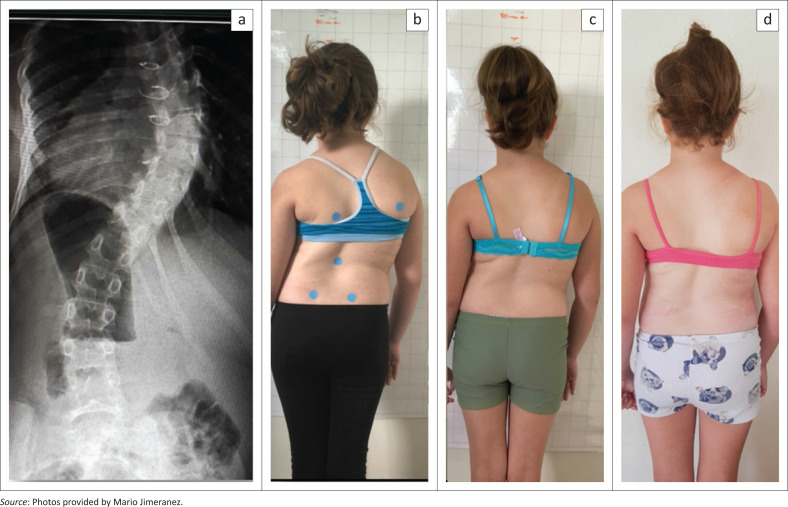
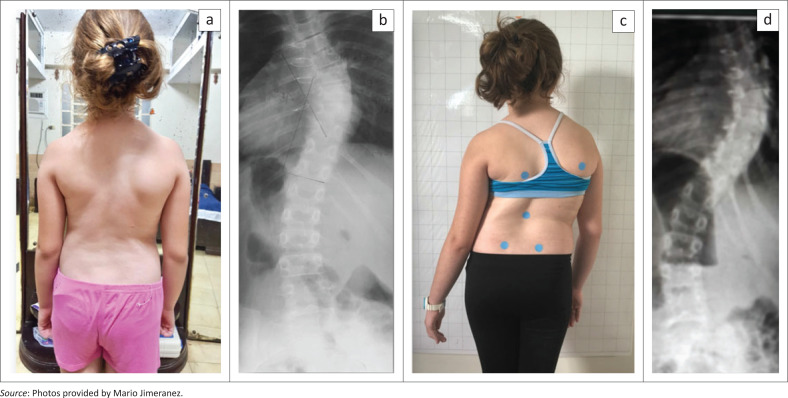
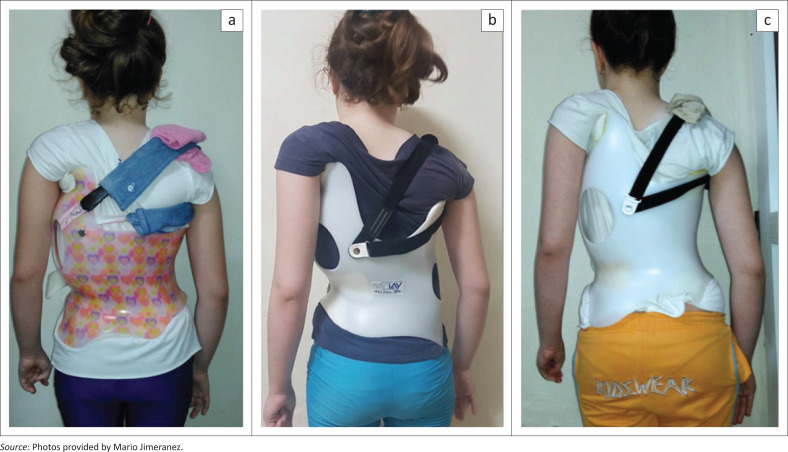
Patient presentation management and outcome: Initially, the premenarchial female was 9 years old and had a Tanner stage 2-3 with a single thoracic curve of 65° Cobb. Because of the high risk for progression, immediate brace treatment was proposed as the father declined surgery. The patient received intensive treatment according to the Schroth Best Practice® programme and a Gensingen Brace® designed for large thoracic curves. Over the 18 months following the initial visit, she received two additional braces. As a result, the progression of the main curve was prevented. The patient continues to maintain an improved cosmetic result and is currently at a Risser 2.
Conclusion: Surgery performed for CHD in rare cases may lead to stiff spinal deformity as a consequence of that surgery. Progression of a severe and stiff curve was prevented during the most vulnerable phase of the pubertal growth spurt with an improved clinical result. Therefore, we assume that the patient may have a normal life in adulthood with minor restrictions only. Supported by pattern-specific high correction exercises and braces, these typical single thoracic curves can be re-compensated to a more balanced appearance, less prone to progression in adulthood.
Clinical implications: Because of the relative high risks of spinal fusion and the long-term unknowns of such an intervention, high-impact conservative treatment should be implemented first before surgical correction is considered.
简介:这是一个病例报告的青少年女性患者脊柱侧凸后两次心脏手术先天性心脏病(CHD)。患者表现处理和结果:最初,该女性为9岁,Tanner期2-3,单胸弯曲65°Cobb。由于进展的高风险,父亲拒绝手术,建议立即支架治疗。患者根据Schroth Best Practice®方案和Gensingen Brace®接受强化治疗,该支架专为大胸弯曲设计。在第一次就诊后的18个月里,她又装了两个牙套。结果,主曲线的前进被阻止了。患者继续保持改善的美容效果,目前在Risser 2。结论:在少数情况下,冠心病的手术可能导致脊柱僵硬畸形。在青春期生长突增的最脆弱阶段,防止了严重和僵硬曲线的进展,改善了临床结果。因此,我们假设患者在成年后可能有一个正常的生活,只有轻微的限制。在特定模式的高度矫正练习和支架的支持下,这些典型的单胸弯曲可以重新补偿为更平衡的外观,在成年期不太容易发展。临床意义:由于脊柱融合的风险相对较高,且这种干预措施的长期未知,在考虑手术矫正之前,应首先实施高强度保守治疗。




 京公网安备 11010802042870号
京ICP备2023020795号-1
京公网安备 11010802042870号
京ICP备2023020795号-1

 分享
分享
 求助内容:
求助内容: 应助结果提醒方式:
 扫码关注我们
