{"title":"Descriptive analysis of adverse drug reaction reports for hypersensitivity reactions stratified in relation to different beta-lactam antibiotics.","authors":"Diana Dubrall, Maike Schulz, Matthias Schmid, Bernhardt Sachs","doi":"10.5414/ALX02189E","DOIUrl":null,"url":null,"abstract":"<p><p>β-lactam antibiotics (BLA) are commonly reported to induce hypersensitivity reactions. However, β-lactam antibiotic-stratified analyses are rare. In the presented study, β-lactam antibiotic associated hypersensitivity reactions were analyzed in the European adverse drug reaction (ADR) database. 923, 38, 222, and 99 hypersensitivity reports for penicillins and first-, second- and third-generation cephalosporins were reported. Differences with regard to demographical parameters, seriousness and types of hypersensitivity reactions, as well as in the number of hypersensitivity reports per outpatient prescriptions were observed between the different β-lactam antibiotics. The number of ADR reports classified as serious was higher for all generations of cephalosporins compared to penicillins. Additionally, anaphylactic reactions were more often reported for first- and second-generation cephalosporins compared to third-generation cephalosporins and penicillins, while bullous reactions were more often reported for first- and third-generation cephalosporins as opposed to second-generation cephalosporins and penicillins. The observed differences may be caused by differences between β-lactam antibiotics and their routes of administration (oral, intravenous), the patient populations, or the reporting of ADRs. Due to the methodological limitations of ADR database analysis, no conclusions can be drawn whether and to what extent the aforementioned factors influenced our results.</p>","PeriodicalId":7485,"journal":{"name":"Allergologie Select","volume":" ","pages":"42-60"},"PeriodicalIF":0.0000,"publicationDate":"2022-02-03","publicationTypes":"Journal Article","fieldsOfStudy":null,"isOpenAccess":false,"openAccessPdf":"https://www.ncbi.nlm.nih.gov/pmc/articles/PMC8822522/pdf/","citationCount":"0","resultStr":null,"platform":"Semanticscholar","paperid":null,"PeriodicalName":"Allergologie Select","FirstCategoryId":"1085","ListUrlMain":"https://doi.org/10.5414/ALX02189E","RegionNum":0,"RegionCategory":null,"ArticlePicture":[],"TitleCN":null,"AbstractTextCN":null,"PMCID":null,"EPubDate":"2022/1/1 0:00:00","PubModel":"eCollection","JCR":"","JCRName":"","Score":null,"Total":0}
引用次数: 0
Abstract
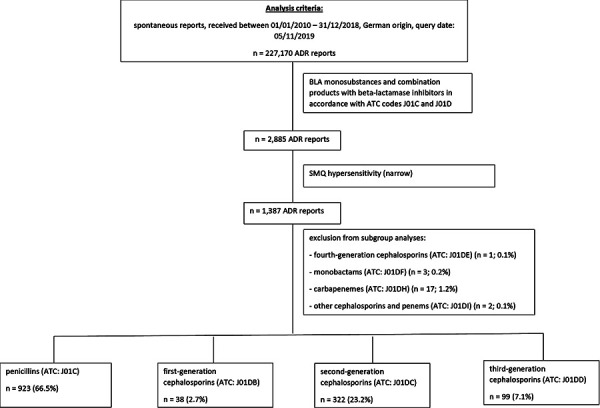
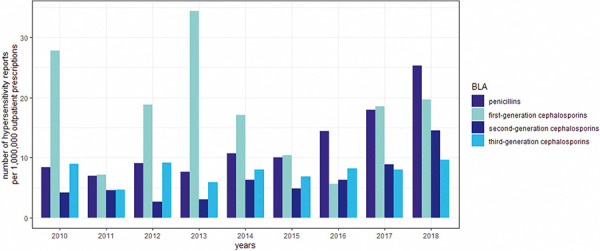
β-lactam antibiotics (BLA) are commonly reported to induce hypersensitivity reactions. However, β-lactam antibiotic-stratified analyses are rare. In the presented study, β-lactam antibiotic associated hypersensitivity reactions were analyzed in the European adverse drug reaction (ADR) database. 923, 38, 222, and 99 hypersensitivity reports for penicillins and first-, second- and third-generation cephalosporins were reported. Differences with regard to demographical parameters, seriousness and types of hypersensitivity reactions, as well as in the number of hypersensitivity reports per outpatient prescriptions were observed between the different β-lactam antibiotics. The number of ADR reports classified as serious was higher for all generations of cephalosporins compared to penicillins. Additionally, anaphylactic reactions were more often reported for first- and second-generation cephalosporins compared to third-generation cephalosporins and penicillins, while bullous reactions were more often reported for first- and third-generation cephalosporins as opposed to second-generation cephalosporins and penicillins. The observed differences may be caused by differences between β-lactam antibiotics and their routes of administration (oral, intravenous), the patient populations, or the reporting of ADRs. Due to the methodological limitations of ADR database analysis, no conclusions can be drawn whether and to what extent the aforementioned factors influenced our results.



 京公网安备 11010802042870号
京ICP备2023020795号-1
京公网安备 11010802042870号
京ICP备2023020795号-1

 分享
分享

 求助内容:
求助内容: 应助结果提醒方式:
 扫码关注我们
