{"title":"Transmission Jeopardy of Adenomatosis Polyposis Coli and Methylenetetrahydrofolate Reductase in Colorectal Cancer.","authors":"Younis Mohd, Parvinder Kumar, Haripriya Kuchi Bhotla, Arun Meyyazhagan, Balamuralikrishnan Balasubramanian, Mithun Kumar Ramesh Kumar, Manikantan Pappusamy, Karthick Kumar Alagamuthu, Antonio Orlacchio, Sasikala Keshavarao, Palanisamy Sampathkumar, Vijaya Anand Arumugam","doi":"10.1155/2021/7010706","DOIUrl":null,"url":null,"abstract":"<p><p>Colorectal cancer (CRC) is one of the globally prevalent and virulent types of cancer with a distinct alteration in chromosomes. Often, any alterations in the adenomatosis polyposis coli (APC), a tumor suppressor gene, and methylenetetrahydrofolate reductase (MTHFR) gene are related to surmise colorectal cancer significantly. In this study, we have investigated chromosomal and gene variants to discern a new-fangled gene and its expression in the southern populations of India by primarily spotting the screened APC and MTHFR variants in CRC patients. An equal number of CRC patients and healthy control subjects (<i>n</i> = 65) were evaluated to observe a chromosomal alteration in the concerted and singular manner for APC and MTHFR genotypes using standard protocols. The increasing prognosis was observed in persons with higher alcoholism and smoking (<i>P</i> < 0.05) with frequent alterations in chromosomes 1, 5, 12, 13, 15, 17, 18, 21, and 22. The APC Asp 1822Val and MTHFR C677T genotypes provided significant results, while the variant alleles of this polymorphism were linked with an elevated risk of CRC. Chromosomal alterations can be the major cause in inducing carcinogenic outcomes in CRCs and can drive to extreme pathological states.</p>","PeriodicalId":2,"journal":{"name":"ACS Applied Bio Materials","volume":" ","pages":"7010706"},"PeriodicalIF":4.7000,"publicationDate":"2021-12-10","publicationTypes":"Journal Article","fieldsOfStudy":null,"isOpenAccess":false,"openAccessPdf":"https://www.ncbi.nlm.nih.gov/pmc/articles/PMC8683247/pdf/","citationCount":"0","resultStr":null,"platform":"Semanticscholar","paperid":null,"PeriodicalName":"ACS Applied Bio Materials","FirstCategoryId":"3","ListUrlMain":"https://doi.org/10.1155/2021/7010706","RegionNum":0,"RegionCategory":null,"ArticlePicture":[],"TitleCN":null,"AbstractTextCN":null,"PMCID":null,"EPubDate":"2021/1/1 0:00:00","PubModel":"eCollection","JCR":"Q2","JCRName":"MATERIALS SCIENCE, BIOMATERIALS","Score":null,"Total":0}
引用次数: 0
Abstract
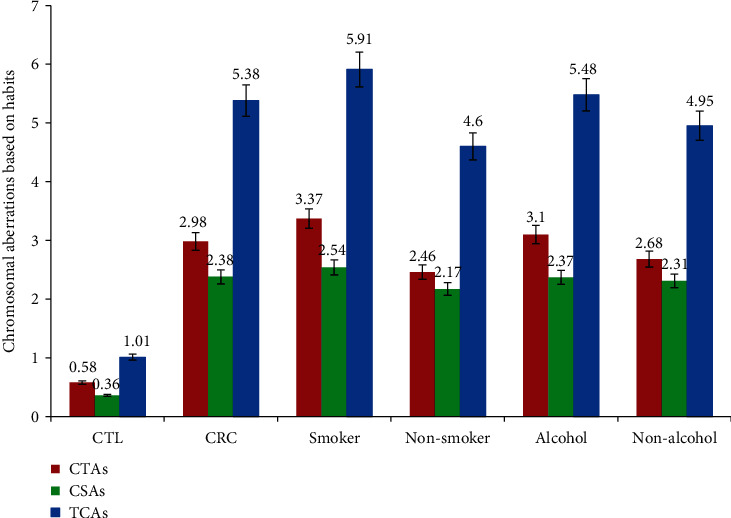
Colorectal cancer (CRC) is one of the globally prevalent and virulent types of cancer with a distinct alteration in chromosomes. Often, any alterations in the adenomatosis polyposis coli (APC), a tumor suppressor gene, and methylenetetrahydrofolate reductase (MTHFR) gene are related to surmise colorectal cancer significantly. In this study, we have investigated chromosomal and gene variants to discern a new-fangled gene and its expression in the southern populations of India by primarily spotting the screened APC and MTHFR variants in CRC patients. An equal number of CRC patients and healthy control subjects (n = 65) were evaluated to observe a chromosomal alteration in the concerted and singular manner for APC and MTHFR genotypes using standard protocols. The increasing prognosis was observed in persons with higher alcoholism and smoking (P < 0.05) with frequent alterations in chromosomes 1, 5, 12, 13, 15, 17, 18, 21, and 22. The APC Asp 1822Val and MTHFR C677T genotypes provided significant results, while the variant alleles of this polymorphism were linked with an elevated risk of CRC. Chromosomal alterations can be the major cause in inducing carcinogenic outcomes in CRCs and can drive to extreme pathological states.
期刊介绍:
ACS Applied Bio Materials is an interdisciplinary journal publishing original research covering all aspects of biomaterials and biointerfaces including and beyond the traditional biosensing, biomedical and therapeutic applications.
The journal is devoted to reports of new and original experimental and theoretical research of an applied nature that integrates knowledge in the areas of materials, engineering, physics, bioscience, and chemistry into important bio applications. The journal is specifically interested in work that addresses the relationship between structure and function and assesses the stability and degradation of materials under relevant environmental and biological conditions.




 京公网安备 11010802042870号
京ICP备2023020795号-1
京公网安备 11010802042870号
京ICP备2023020795号-1

 分享
分享
 求助内容:
求助内容: 应助结果提醒方式:
 扫码关注我们
