Hee Yeon Yang, Han-Wool Park, Soo Jin Kim, Jae-Min Hong, Tae Whan Kim, Do Hwan Kim and Jung Ah Lim
{"title":"Intense pulsed light induced crystallization of a liquid-crystalline polymer semiconductor for efficient production of flexible thin-film transistors†","authors":"Hee Yeon Yang, Han-Wool Park, Soo Jin Kim, Jae-Min Hong, Tae Whan Kim, Do Hwan Kim and Jung Ah Lim","doi":"10.1039/C5CP06989K","DOIUrl":null,"url":null,"abstract":"<p >Here we demonstrated the split-second crystallization of a liquid-crystalline conjugated polymer semiconductor induced by irradiation with intense pulsed white light (IPWL) for the efficient improvement of electrical properties of flexible thin film transistors. A few seconds of IPWL irradiation of poly(didodecylquaterthiophene-<em>alt</em>-didodecylbithiazole) (PQTBTz-C12) thin films generated heat energy through the photo-thermal effect, leading to the crystallization of PQTBTz-C12 and formation of nodule-like nanostructures. The IPWL-induced crystallization of PQTBTz-C12 resulted in a threefold improvement in the field-effect mobility of thin film transistors compared to as-prepared devices. The conformational change of the PQTBTz-C12 chains was found to be strongly related to the irradiation fluence. As a proof-of-concept, the IPWL treatment was successfully applied to the PQTBTz-C12 layer in flexible transistors based on plastic substrates. The performance of these flexible devices was significantly improved after only 0.6 s of IPWL treatment, without deformation of the plastic substrate.</p>","PeriodicalId":99,"journal":{"name":"Physical Chemistry Chemical Physics","volume":" 6","pages":" 4627-4634"},"PeriodicalIF":2.9000,"publicationDate":"2016-01-22","publicationTypes":"Journal Article","fieldsOfStudy":null,"isOpenAccess":false,"openAccessPdf":"https://sci-hub-pdf.com/10.1039/C5CP06989K","citationCount":"5","resultStr":null,"platform":"Semanticscholar","paperid":null,"PeriodicalName":"Physical Chemistry Chemical Physics","FirstCategoryId":"92","ListUrlMain":"https://pubs.rsc.org/en/content/articlelanding/2016/cp/c5cp06989k","RegionNum":3,"RegionCategory":"化学","ArticlePicture":[],"TitleCN":null,"AbstractTextCN":null,"PMCID":null,"EPubDate":"","PubModel":"","JCR":"Q3","JCRName":"CHEMISTRY, PHYSICAL","Score":null,"Total":0}
引用次数: 5
Abstract
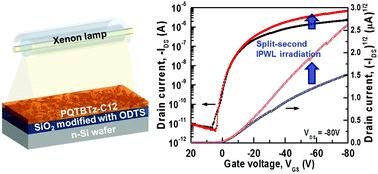
Here we demonstrated the split-second crystallization of a liquid-crystalline conjugated polymer semiconductor induced by irradiation with intense pulsed white light (IPWL) for the efficient improvement of electrical properties of flexible thin film transistors. A few seconds of IPWL irradiation of poly(didodecylquaterthiophene-alt-didodecylbithiazole) (PQTBTz-C12) thin films generated heat energy through the photo-thermal effect, leading to the crystallization of PQTBTz-C12 and formation of nodule-like nanostructures. The IPWL-induced crystallization of PQTBTz-C12 resulted in a threefold improvement in the field-effect mobility of thin film transistors compared to as-prepared devices. The conformational change of the PQTBTz-C12 chains was found to be strongly related to the irradiation fluence. As a proof-of-concept, the IPWL treatment was successfully applied to the PQTBTz-C12 layer in flexible transistors based on plastic substrates. The performance of these flexible devices was significantly improved after only 0.6 s of IPWL treatment, without deformation of the plastic substrate.
期刊介绍:
Physical Chemistry Chemical Physics (PCCP) is an international journal co-owned by 19 physical chemistry and physics societies from around the world. This journal publishes original, cutting-edge research in physical chemistry, chemical physics and biophysical chemistry. To be suitable for publication in PCCP, articles must include significant innovation and/or insight into physical chemistry; this is the most important criterion that reviewers and Editors will judge against when evaluating submissions.
The journal has a broad scope and welcomes contributions spanning experiment, theory, computation and data science. Topical coverage includes spectroscopy, dynamics, kinetics, statistical mechanics, thermodynamics, electrochemistry, catalysis, surface science, quantum mechanics, quantum computing and machine learning. Interdisciplinary research areas such as polymers and soft matter, materials, nanoscience, energy, surfaces/interfaces, and biophysical chemistry are welcomed if they demonstrate significant innovation and/or insight into physical chemistry. Joined experimental/theoretical studies are particularly appreciated when complementary and based on up-to-date approaches.




 京公网安备 11010802042870号
京ICP备2023020795号-1
京公网安备 11010802042870号
京ICP备2023020795号-1

 分享
分享
 求助内容:
求助内容: 应助结果提醒方式:
 扫码关注我们
