{"title":"Reassessing Diabetes and APOE Genotype as Potential Interacting Risk Factors for Alzheimer's Disease.","authors":"Kaushik Ravipati, Yunxiao Chen, Joseph R Manns","doi":"10.1177/15333175211070912","DOIUrl":null,"url":null,"abstract":"<p><p><b>Objective:</b> To assess whether diabetes alone or in association with Apolipoprotein E (APOE) ε4 genotype increases the risk of Alzheimer's Disease (AD) diagnosis. <b>Methods:</b> A retrospective cohort study of 33,456 participants from the National Alzheimer's Coordinating Center database. <b>Results:</b> Participants with one or two APOE ε4 alleles had 2.71 (CI:2.55-2.88) and 9.37 (CI:8.14-10.78) times higher odds of AD diagnosis, respectively, relative to those with zero ε4 alleles. In contrast, diabetic participants showed 1.07 (CI:0.96-1.18) times higher odds of AD relative to nondiabetics. Diabetes did not exacerbate the odds of AD in APOE ε4 carriers. APOE ε4 carriage was correlated with declines in long-term memory and verbal fluency, which were strongly correlated with conversion to AD. However, diabetes was correlated with working memory decline, which had a relatively weak correlation with AD. <b>Conclusions:</b> Unlike APOE ε4, there was little evidence that diabetes was a risk factor for AD.</p>","PeriodicalId":2,"journal":{"name":"ACS Applied Bio Materials","volume":" ","pages":"15333175211070912"},"PeriodicalIF":4.7000,"publicationDate":"2022-01-01","publicationTypes":"Journal Article","fieldsOfStudy":null,"isOpenAccess":false,"openAccessPdf":"https://www.ncbi.nlm.nih.gov/pmc/articles/PMC10623968/pdf/","citationCount":"0","resultStr":null,"platform":"Semanticscholar","paperid":null,"PeriodicalName":"ACS Applied Bio Materials","FirstCategoryId":"3","ListUrlMain":"https://doi.org/10.1177/15333175211070912","RegionNum":0,"RegionCategory":null,"ArticlePicture":[],"TitleCN":null,"AbstractTextCN":null,"PMCID":null,"EPubDate":"","PubModel":"","JCR":"Q2","JCRName":"MATERIALS SCIENCE, BIOMATERIALS","Score":null,"Total":0}
引用次数: 0
Abstract
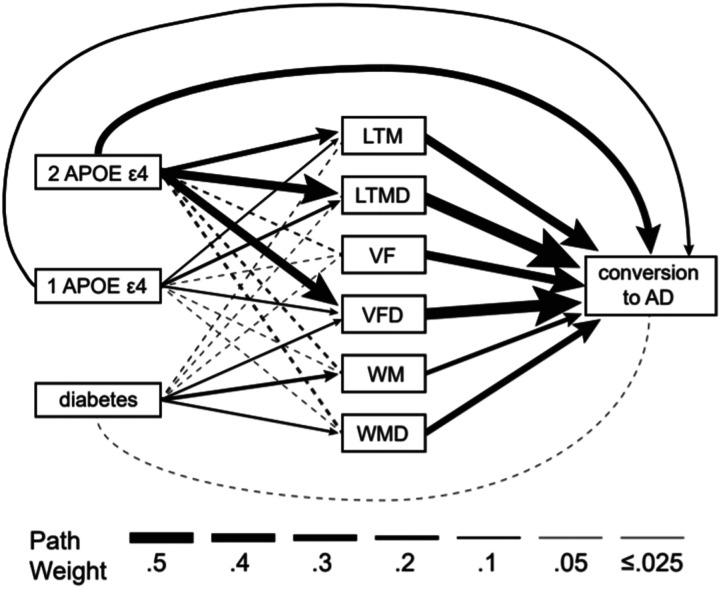
Objective: To assess whether diabetes alone or in association with Apolipoprotein E (APOE) ε4 genotype increases the risk of Alzheimer's Disease (AD) diagnosis. Methods: A retrospective cohort study of 33,456 participants from the National Alzheimer's Coordinating Center database. Results: Participants with one or two APOE ε4 alleles had 2.71 (CI:2.55-2.88) and 9.37 (CI:8.14-10.78) times higher odds of AD diagnosis, respectively, relative to those with zero ε4 alleles. In contrast, diabetic participants showed 1.07 (CI:0.96-1.18) times higher odds of AD relative to nondiabetics. Diabetes did not exacerbate the odds of AD in APOE ε4 carriers. APOE ε4 carriage was correlated with declines in long-term memory and verbal fluency, which were strongly correlated with conversion to AD. However, diabetes was correlated with working memory decline, which had a relatively weak correlation with AD. Conclusions: Unlike APOE ε4, there was little evidence that diabetes was a risk factor for AD.
期刊介绍:
ACS Applied Bio Materials is an interdisciplinary journal publishing original research covering all aspects of biomaterials and biointerfaces including and beyond the traditional biosensing, biomedical and therapeutic applications.
The journal is devoted to reports of new and original experimental and theoretical research of an applied nature that integrates knowledge in the areas of materials, engineering, physics, bioscience, and chemistry into important bio applications. The journal is specifically interested in work that addresses the relationship between structure and function and assesses the stability and degradation of materials under relevant environmental and biological conditions.





 京公网安备 11010802042870号
京ICP备2023020795号-1
京公网安备 11010802042870号
京ICP备2023020795号-1

 分享
分享
 求助内容:
求助内容: 应助结果提醒方式:
 扫码关注我们
