Natasja G de Groot, Nanine de Groot, Annemiek J M de Vos-Rouweler, Annet Louwerse, Jesse Bruijnesteijn, Ronald E Bontrop
{"title":"Dynamic evolution of Mhc haplotypes in cynomolgus macaques of different geographic origins.","authors":"Natasja G de Groot, Nanine de Groot, Annemiek J M de Vos-Rouweler, Annet Louwerse, Jesse Bruijnesteijn, Ronald E Bontrop","doi":"10.1007/s00251-021-01249-y","DOIUrl":null,"url":null,"abstract":"<p><p>The major histocompatibility complex (MHC) plays a key role in immune defense, and the Mhc genes of cynomolgus macaque display a high degree of polymorphism. Based on their geographic distribution, different populations of cynomolgus macaques are recognized. Here we present the characterization of the Mhc class I and II repertoire of a large pedigreed group of cynomolgus macaques originating from the mainland north of the isthmus of Kra (N = 42). Segregation analyses resulted in the definition of 81 unreported Mafa-A/B/DRB/DQ/DP haplotypes, which include 32 previously unknown DRB regions. In addition, we report 13 newly defined Mafa-A/B/DRB/DQ/DP haplotypes in a group of cynomolgus macaques originating from the mainland south of the isthmus of Kra/Maritime Southeast Asia (N = 16). A relatively high level of sharing of Mafa-A (51%) and Mafa-B (40%) lineage groups is observed between the populations native to the north and the south of isthmus of Kra. At the allelic level, however, the Mafa-A/B haplotypes seem to be characteristic of a population. An overall comparison of all currently known data revealed that each geographic population has its own specific combinations of Mhc class I and II haplotypes. This illustrates the dynamic evolution of the cynomolgus macaque Mhc region, which was most likely generated by recombination and maintained by selection due to the differential pathogenic pressures encountered in different geographic areas.</p>","PeriodicalId":2,"journal":{"name":"ACS Applied Bio Materials","volume":" ","pages":"409-429"},"PeriodicalIF":4.7000,"publicationDate":"2022-08-01","publicationTypes":"Journal Article","fieldsOfStudy":null,"isOpenAccess":false,"openAccessPdf":"https://www.ncbi.nlm.nih.gov/pmc/articles/PMC8792142/pdf/","citationCount":"0","resultStr":null,"platform":"Semanticscholar","paperid":null,"PeriodicalName":"ACS Applied Bio Materials","FirstCategoryId":"3","ListUrlMain":"https://doi.org/10.1007/s00251-021-01249-y","RegionNum":0,"RegionCategory":null,"ArticlePicture":[],"TitleCN":null,"AbstractTextCN":null,"PMCID":null,"EPubDate":"2022/1/27 0:00:00","PubModel":"Epub","JCR":"Q2","JCRName":"MATERIALS SCIENCE, BIOMATERIALS","Score":null,"Total":0}
引用次数: 0
Abstract
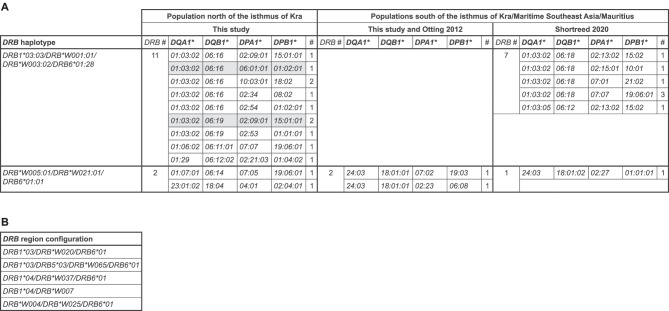
The major histocompatibility complex (MHC) plays a key role in immune defense, and the Mhc genes of cynomolgus macaque display a high degree of polymorphism. Based on their geographic distribution, different populations of cynomolgus macaques are recognized. Here we present the characterization of the Mhc class I and II repertoire of a large pedigreed group of cynomolgus macaques originating from the mainland north of the isthmus of Kra (N = 42). Segregation analyses resulted in the definition of 81 unreported Mafa-A/B/DRB/DQ/DP haplotypes, which include 32 previously unknown DRB regions. In addition, we report 13 newly defined Mafa-A/B/DRB/DQ/DP haplotypes in a group of cynomolgus macaques originating from the mainland south of the isthmus of Kra/Maritime Southeast Asia (N = 16). A relatively high level of sharing of Mafa-A (51%) and Mafa-B (40%) lineage groups is observed between the populations native to the north and the south of isthmus of Kra. At the allelic level, however, the Mafa-A/B haplotypes seem to be characteristic of a population. An overall comparison of all currently known data revealed that each geographic population has its own specific combinations of Mhc class I and II haplotypes. This illustrates the dynamic evolution of the cynomolgus macaque Mhc region, which was most likely generated by recombination and maintained by selection due to the differential pathogenic pressures encountered in different geographic areas.
期刊介绍:
ACS Applied Bio Materials is an interdisciplinary journal publishing original research covering all aspects of biomaterials and biointerfaces including and beyond the traditional biosensing, biomedical and therapeutic applications.
The journal is devoted to reports of new and original experimental and theoretical research of an applied nature that integrates knowledge in the areas of materials, engineering, physics, bioscience, and chemistry into important bio applications. The journal is specifically interested in work that addresses the relationship between structure and function and assesses the stability and degradation of materials under relevant environmental and biological conditions.






 京公网安备 11010802042870号
京ICP备2023020795号-1
京公网安备 11010802042870号
京ICP备2023020795号-1

 分享
分享
 求助内容:
求助内容: 应助结果提醒方式:
 扫码关注我们
