{"title":"Combining fMRI and Eye-tracking for the Study of Social Cognition.","authors":"Kristin Marie Rusch","doi":"10.1177/26331055211065497","DOIUrl":null,"url":null,"abstract":"<p><p>The study of social cognition with functional magnetic resonance imaging (fMRI) affords the use of complex stimulus material. Visual attention to distinct aspects of these stimuli can result in the involvement of remarkably different neural systems. Usually, the influence of gaze on neural signal is either disregarded or dealt with by controlling gaze of participants through instructions or tasks. However, behavioral restrictions like this limit the study's ecological validity. Thus, it would be preferable if participants freely look at the stimuli while their gaze traces are measured. Yet several impediments hamper a combination of fMRI and eye-tracking. In our recent work on neural Theory of Mind processes in alexithymia, we propose a simple way of integrating dwell time on specific stimulus features into general linear models of fMRI data. By parametrically modeling fixations, we were able to distinguish neural processes asssociated with specific stimulus features looked at. Here, I discuss opportunities and obstacles of this approach in more detail. My goal is to motivate a wider use of parametric models - usually implemented in common fMRI software packages - to combine fMRI and eye-tracking data.</p>","PeriodicalId":36527,"journal":{"name":"Neuroscience Insights","volume":" ","pages":"26331055211065497"},"PeriodicalIF":2.6000,"publicationDate":"2021-12-16","publicationTypes":"Journal Article","fieldsOfStudy":null,"isOpenAccess":false,"openAccessPdf":"https://ftp.ncbi.nlm.nih.gov/pub/pmc/oa_pdf/c9/c0/10.1177_26331055211065497.PMC8689432.pdf","citationCount":"1","resultStr":null,"platform":"Semanticscholar","paperid":null,"PeriodicalName":"Neuroscience Insights","FirstCategoryId":"1085","ListUrlMain":"https://doi.org/10.1177/26331055211065497","RegionNum":0,"RegionCategory":null,"ArticlePicture":[],"TitleCN":null,"AbstractTextCN":null,"PMCID":null,"EPubDate":"2021/1/1 0:00:00","PubModel":"eCollection","JCR":"Q2","JCRName":"NEUROSCIENCES","Score":null,"Total":0}
引用次数: 1
Abstract
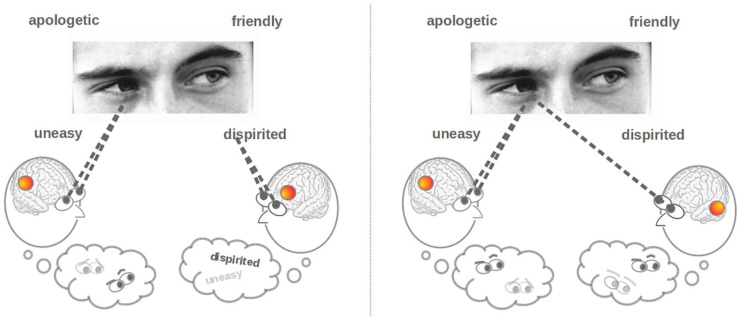
The study of social cognition with functional magnetic resonance imaging (fMRI) affords the use of complex stimulus material. Visual attention to distinct aspects of these stimuli can result in the involvement of remarkably different neural systems. Usually, the influence of gaze on neural signal is either disregarded or dealt with by controlling gaze of participants through instructions or tasks. However, behavioral restrictions like this limit the study's ecological validity. Thus, it would be preferable if participants freely look at the stimuli while their gaze traces are measured. Yet several impediments hamper a combination of fMRI and eye-tracking. In our recent work on neural Theory of Mind processes in alexithymia, we propose a simple way of integrating dwell time on specific stimulus features into general linear models of fMRI data. By parametrically modeling fixations, we were able to distinguish neural processes asssociated with specific stimulus features looked at. Here, I discuss opportunities and obstacles of this approach in more detail. My goal is to motivate a wider use of parametric models - usually implemented in common fMRI software packages - to combine fMRI and eye-tracking data.





 京公网安备 11010802042870号
京ICP备2023020795号-1
京公网安备 11010802042870号
京ICP备2023020795号-1

 分享
分享
 求助内容:
求助内容: 应助结果提醒方式:
 扫码关注我们
