{"title":"The sense of taste: Development, regeneration, and dysfunction.","authors":"Linda A Barlow","doi":"10.1002/wsbm.1547","DOIUrl":null,"url":null,"abstract":"<p><p>Gustation or the sense of taste is a primary sense, which functions as a gatekeeper for substances that enter the body. Animals, including humans, ingest foods that contain appetitive taste stimuli, including those that have sweet, moderately salty and umami (glutamate) components, and tend to avoid bitter-tasting items, as many bitter compounds are toxic. Taste is mediated by clusters of heterogeneous taste receptors cells (TRCs) organized as taste buds on the tongue, and these convey taste information from the oral cavity to higher order brain centers via the gustatory sensory neurons of the seventh and ninth cranial ganglia. One remarkable aspect of taste is that taste perception is mostly uninterrupted throughout life yet TRCs within buds are constantly renewed; every 1-2 months all taste cells have been steadily replaced. In the past decades we have learned a substantial amount about the cellular and molecular regulation of taste bud cell renewal, and how taste buds are initially established during embryogenesis. Here I review more recent findings pertaining to taste development and regeneration, as well as discuss potential mechanisms underlying taste dysfunction that often occurs with disease or its treatment. This article is categorized under: Infectious Diseases > Stem Cells and Development Cancer > Stem Cells and Development Neurological Diseases > Stem Cells and Development.</p>","PeriodicalId":4,"journal":{"name":"ACS Applied Energy Materials","volume":" ","pages":"e1547"},"PeriodicalIF":5.5000,"publicationDate":"2022-05-01","publicationTypes":"Journal Article","fieldsOfStudy":null,"isOpenAccess":false,"openAccessPdf":"https://www.ncbi.nlm.nih.gov/pmc/articles/PMC11152580/pdf/","citationCount":"0","resultStr":null,"platform":"Semanticscholar","paperid":null,"PeriodicalName":"ACS Applied Energy Materials","FirstCategoryId":"3","ListUrlMain":"https://doi.org/10.1002/wsbm.1547","RegionNum":3,"RegionCategory":"材料科学","ArticlePicture":[],"TitleCN":null,"AbstractTextCN":null,"PMCID":null,"EPubDate":"2021/11/30 0:00:00","PubModel":"Epub","JCR":"Q2","JCRName":"CHEMISTRY, PHYSICAL","Score":null,"Total":0}
引用次数: 0
Abstract
Gustation or the sense of taste is a primary sense, which functions as a gatekeeper for substances that enter the body. Animals, including humans, ingest foods that contain appetitive taste stimuli, including those that have sweet, moderately salty and umami (glutamate) components, and tend to avoid bitter-tasting items, as many bitter compounds are toxic. Taste is mediated by clusters of heterogeneous taste receptors cells (TRCs) organized as taste buds on the tongue, and these convey taste information from the oral cavity to higher order brain centers via the gustatory sensory neurons of the seventh and ninth cranial ganglia. One remarkable aspect of taste is that taste perception is mostly uninterrupted throughout life yet TRCs within buds are constantly renewed; every 1-2 months all taste cells have been steadily replaced. In the past decades we have learned a substantial amount about the cellular and molecular regulation of taste bud cell renewal, and how taste buds are initially established during embryogenesis. Here I review more recent findings pertaining to taste development and regeneration, as well as discuss potential mechanisms underlying taste dysfunction that often occurs with disease or its treatment. This article is categorized under: Infectious Diseases > Stem Cells and Development Cancer > Stem Cells and Development Neurological Diseases > Stem Cells and Development.
期刊介绍:
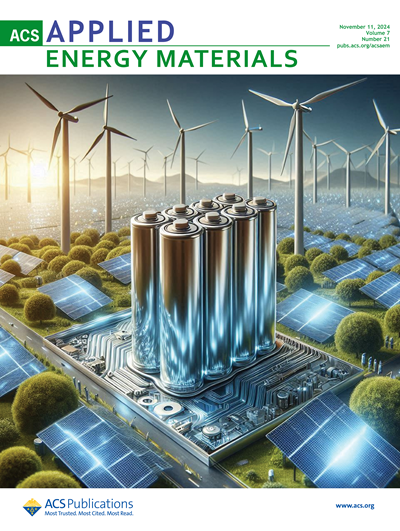
ACS Applied Energy Materials is an interdisciplinary journal publishing original research covering all aspects of materials, engineering, chemistry, physics and biology relevant to energy conversion and storage. The journal is devoted to reports of new and original experimental and theoretical research of an applied nature that integrate knowledge in the areas of materials, engineering, physics, bioscience, and chemistry into important energy applications.



 京公网安备 11010802042870号
京ICP备2023020795号-1
京公网安备 11010802042870号
京ICP备2023020795号-1

 分享
分享
 求助内容:
求助内容: 应助结果提醒方式:
 扫码关注我们
