{"title":"Multimorbidity and catastrophic health expenditure among patients with diabetes in China: a nationwide population-based study.","authors":"Yu Fu, Mingsheng Chen, Lei Si","doi":"10.1136/bmjgh-2021-007714","DOIUrl":null,"url":null,"abstract":"<p><strong>Introduction: </strong>Multimorbidity is common among patients with diabetes and can lead to catastrophic health expenditure (CHE) for their families. This study aims to investigate the prevalence of multimorbidity and CHE among people with diabetes in China, and the association between multimorbidity and CHE and whether this is influenced by socioeconomic status and health insurance type.</p><p><strong>Methods: </strong>A national survey was conducted in China in 2013 that included 8471 people aged ≥18 years who were living with diabetes. The concentration curve and concentration index were used to measure socioeconomic-related inequalities. Factors influencing CHE and the impact of multimorbidity on CHE according to socioeconomic status and health insurance type were examined by logistic regression.</p><p><strong>Results: </strong>There were 5524 (65.2%) diabetes patients with multimorbidity. The prevalence of CHE was 56.6%, with a concentration index of -0.030 (95% CI -0.035 to -0.026). For each additional chronic disease, the probability of CHE increased by 39% (OR=1.39, 95% CI 1.31 to 1.47). Factors that were positively associated (p<0.05) with CHE included older age; male sex; lower educational level; being retired, unemployed or jobless; being a non-smoker and non-drinker; having had no physical examination; lower socioeconomic status; being in an impoverished family; and residing in the central or western regions. Among participants with Urban Employee Basic Medical Insurance, Urban Resident Basic Medical Insurance, and New Rural Cooperative Medical Scheme, the probability of CHE increased by 32% (OR=1.32, 95% CI 1.23 to 1.43), 43% (OR=1.43, 95% CI 1.24 to 1.65) and 47% (OR=1.47, 95% CI 1.33 to 1.63), respectively, with each additional chronic disease. The association between multimorbidity and CHE was observed across all health insurance types irrespective of socioeconomic status.</p><p><strong>Conclusions: </strong>Multimorbidity affects about two-thirds of Chinese patients with diabetes. Current health insurance schemes offer limited protection against CHE to patients' families.</p>","PeriodicalId":9137,"journal":{"name":"BMJ Global Health","volume":" ","pages":""},"PeriodicalIF":6.1000,"publicationDate":"2022-02-01","publicationTypes":"Journal Article","fieldsOfStudy":null,"isOpenAccess":false,"openAccessPdf":"https://ftp.ncbi.nlm.nih.gov/pub/pmc/oa_pdf/05/e5/bmjgh-2021-007714.PMC8830259.pdf","citationCount":"15","resultStr":null,"platform":"Semanticscholar","paperid":null,"PeriodicalName":"BMJ Global Health","FirstCategoryId":"3","ListUrlMain":"https://doi.org/10.1136/bmjgh-2021-007714","RegionNum":2,"RegionCategory":"医学","ArticlePicture":[],"TitleCN":null,"AbstractTextCN":null,"PMCID":null,"EPubDate":"","PubModel":"","JCR":"Q1","JCRName":"PUBLIC, ENVIRONMENTAL & OCCUPATIONAL HEALTH","Score":null,"Total":0}
引用次数: 15
Abstract
Introduction: Multimorbidity is common among patients with diabetes and can lead to catastrophic health expenditure (CHE) for their families. This study aims to investigate the prevalence of multimorbidity and CHE among people with diabetes in China, and the association between multimorbidity and CHE and whether this is influenced by socioeconomic status and health insurance type.
Methods: A national survey was conducted in China in 2013 that included 8471 people aged ≥18 years who were living with diabetes. The concentration curve and concentration index were used to measure socioeconomic-related inequalities. Factors influencing CHE and the impact of multimorbidity on CHE according to socioeconomic status and health insurance type were examined by logistic regression.
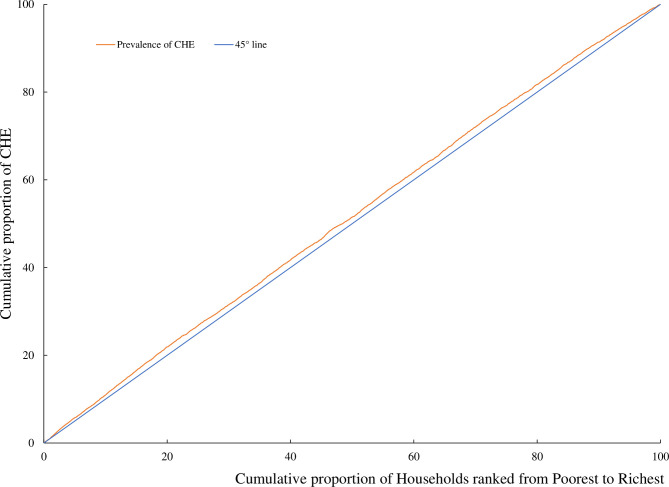
Results: There were 5524 (65.2%) diabetes patients with multimorbidity. The prevalence of CHE was 56.6%, with a concentration index of -0.030 (95% CI -0.035 to -0.026). For each additional chronic disease, the probability of CHE increased by 39% (OR=1.39, 95% CI 1.31 to 1.47). Factors that were positively associated (p<0.05) with CHE included older age; male sex; lower educational level; being retired, unemployed or jobless; being a non-smoker and non-drinker; having had no physical examination; lower socioeconomic status; being in an impoverished family; and residing in the central or western regions. Among participants with Urban Employee Basic Medical Insurance, Urban Resident Basic Medical Insurance, and New Rural Cooperative Medical Scheme, the probability of CHE increased by 32% (OR=1.32, 95% CI 1.23 to 1.43), 43% (OR=1.43, 95% CI 1.24 to 1.65) and 47% (OR=1.47, 95% CI 1.33 to 1.63), respectively, with each additional chronic disease. The association between multimorbidity and CHE was observed across all health insurance types irrespective of socioeconomic status.
Conclusions: Multimorbidity affects about two-thirds of Chinese patients with diabetes. Current health insurance schemes offer limited protection against CHE to patients' families.
期刊介绍:
BMJ Global Health is an online Open Access journal from BMJ that focuses on publishing high-quality peer-reviewed content pertinent to individuals engaged in global health, including policy makers, funders, researchers, clinicians, and frontline healthcare workers. The journal encompasses all facets of global health, with a special emphasis on submissions addressing underfunded areas such as non-communicable diseases (NCDs). It welcomes research across all study phases and designs, from study protocols to phase I trials to meta-analyses, including small or specialized studies. The journal also encourages opinionated discussions on controversial topics.





 京公网安备 11010802042870号
京ICP备2023020795号-1
京公网安备 11010802042870号
京ICP备2023020795号-1

 分享
分享
 求助内容:
求助内容: 应助结果提醒方式:
 扫码关注我们
