João R Inácio, Sriraag Balaji Srinivasan, Terrence D Ruddy, Robert A deKemp, Frank Rybicki, Rob S Beanlands, Benjamin J W Chow, Girish Dwivedi
{"title":"Static CT myocardial perfusion imaging: image quality, artifacts including distribution and diagnostic performance compared to <sup>82</sup>Rb PET.","authors":"João R Inácio, Sriraag Balaji Srinivasan, Terrence D Ruddy, Robert A deKemp, Frank Rybicki, Rob S Beanlands, Benjamin J W Chow, Girish Dwivedi","doi":"10.1186/s41824-021-00118-x","DOIUrl":null,"url":null,"abstract":"<p><strong>Background: </strong>Rubidium-82 positron emission tomography (<sup>82</sup>Rb PET) MPI is considered a noninvasive reference standard for the assessment of myocardial perfusion in coronary artery disease (CAD) patients. Our main goal was to compare the diagnostic performance of static rest/ vasodilator stress CT myocardial perfusion imaging (CT-MPI) to stress/ rest <sup>82</sup>Rb PET-MPI for the identification of myocardial ischemia.</p><p><strong>Methods: </strong>Forty-four patients with suspected or diagnosed CAD underwent both static CT-MPI and <sup>82</sup>Rb PET-MPI at rest and during pharmacological stress. The extent and severity of perfusion defects on PET-MPI were assessed to obtain summed stress score, summed rest score, and summed difference score. The extent and severity of perfusion defects on CT-MPI was visually assessed using the same grading scale. CT-MPI was compared with PET-MPI as the gold standard on a per-territory and a per-patient basis.</p><p><strong>Results: </strong>On a per-patient basis, there was moderate agreement between CT-MPI and PET-MPI with a weighted 0.49 for detection of stress induced perfusion abnormalities. Using PET-MPI as a reference, static CT-MPI had 89% sensitivity (SS), 58% specificity (SP), 71% accuracy (AC), 88% negative predictive value (NPV), and 59% positive predictive value (PPV) to diagnose stress-rest perfusion deficits on a per-patient basis. On a per-territory analysis, CT-MPI had 73% SS, 65% SP, 67% AC, 90.8% NPV, and 34% PPV to diagnose perfusion deficits.</p><p><strong>Conclusions: </strong>CT-MPI has high sensitivity and good overall accuracy for the diagnosis of functionally significant CAD using <sup>82</sup>Rb PET-MPI as the reference standard. CT-MPI may play an important role in assessing the functional significance of CAD especially in combination with CCTA.</p>","PeriodicalId":36160,"journal":{"name":"European Journal of Hybrid Imaging","volume":" ","pages":"1"},"PeriodicalIF":1.2000,"publicationDate":"2022-01-04","publicationTypes":"Journal Article","fieldsOfStudy":null,"isOpenAccess":false,"openAccessPdf":"https://www.ncbi.nlm.nih.gov/pmc/articles/PMC8724508/pdf/","citationCount":"1","resultStr":null,"platform":"Semanticscholar","paperid":null,"PeriodicalName":"European Journal of Hybrid Imaging","FirstCategoryId":"1085","ListUrlMain":"https://doi.org/10.1186/s41824-021-00118-x","RegionNum":0,"RegionCategory":null,"ArticlePicture":[],"TitleCN":null,"AbstractTextCN":null,"PMCID":null,"EPubDate":"","PubModel":"","JCR":"Q3","JCRName":"RADIOLOGY, NUCLEAR MEDICINE & MEDICAL IMAGING","Score":null,"Total":0}
引用次数: 1
Abstract
Background: Rubidium-82 positron emission tomography (82Rb PET) MPI is considered a noninvasive reference standard for the assessment of myocardial perfusion in coronary artery disease (CAD) patients. Our main goal was to compare the diagnostic performance of static rest/ vasodilator stress CT myocardial perfusion imaging (CT-MPI) to stress/ rest 82Rb PET-MPI for the identification of myocardial ischemia.
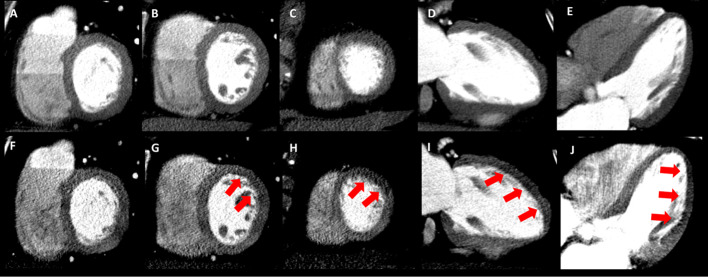
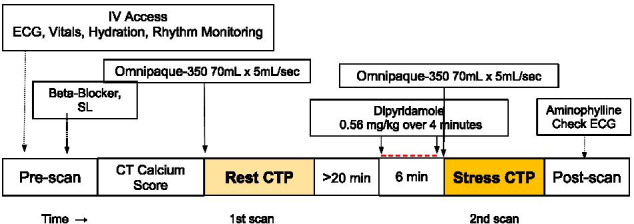
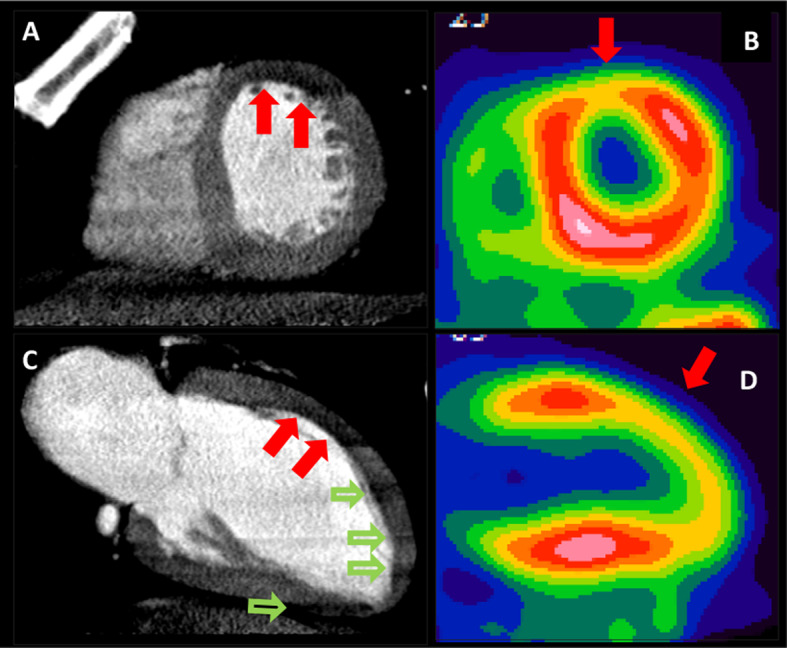
Methods: Forty-four patients with suspected or diagnosed CAD underwent both static CT-MPI and 82Rb PET-MPI at rest and during pharmacological stress. The extent and severity of perfusion defects on PET-MPI were assessed to obtain summed stress score, summed rest score, and summed difference score. The extent and severity of perfusion defects on CT-MPI was visually assessed using the same grading scale. CT-MPI was compared with PET-MPI as the gold standard on a per-territory and a per-patient basis.
Results: On a per-patient basis, there was moderate agreement between CT-MPI and PET-MPI with a weighted 0.49 for detection of stress induced perfusion abnormalities. Using PET-MPI as a reference, static CT-MPI had 89% sensitivity (SS), 58% specificity (SP), 71% accuracy (AC), 88% negative predictive value (NPV), and 59% positive predictive value (PPV) to diagnose stress-rest perfusion deficits on a per-patient basis. On a per-territory analysis, CT-MPI had 73% SS, 65% SP, 67% AC, 90.8% NPV, and 34% PPV to diagnose perfusion deficits.
Conclusions: CT-MPI has high sensitivity and good overall accuracy for the diagnosis of functionally significant CAD using 82Rb PET-MPI as the reference standard. CT-MPI may play an important role in assessing the functional significance of CAD especially in combination with CCTA.



 京公网安备 11010802042870号
京ICP备2023020795号-1
京公网安备 11010802042870号
京ICP备2023020795号-1

 分享
分享
 求助内容:
求助内容: 应助结果提醒方式:
 扫码关注我们
