{"title":"Efficiently sparse listing of classes of optimal cophylogeny reconciliations.","authors":"Yishu Wang, Arnaud Mary, Marie-France Sagot, Blerina Sinaimeri","doi":"10.1186/s13015-022-00206-y","DOIUrl":null,"url":null,"abstract":"<p><strong>Background: </strong>Cophylogeny reconciliation is a powerful method for analyzing host-parasite (or host-symbiont) co-evolution. It models co-evolution as an optimization problem where the set of all optimal solutions may represent different biological scenarios which thus need to be analyzed separately. Despite the significant research done in the area, few approaches have addressed the problem of helping the biologist deal with the often huge space of optimal solutions.</p><p><strong>Results: </strong>In this paper, we propose a new approach to tackle this problem. We introduce three different criteria under which two solutions may be considered biologically equivalent, and then we propose polynomial-delay algorithms that enumerate only one representative per equivalence class (without listing all the solutions).</p><p><strong>Conclusions: </strong>Our results are of both theoretical and practical importance. Indeed, as shown by the experiments, we are able to significantly reduce the space of optimal solutions while still maintaining important biological information about the whole space.</p>","PeriodicalId":50823,"journal":{"name":"Algorithms for Molecular Biology","volume":" ","pages":"2"},"PeriodicalIF":1.7000,"publicationDate":"2022-02-15","publicationTypes":"Journal Article","fieldsOfStudy":null,"isOpenAccess":false,"openAccessPdf":"https://www.ncbi.nlm.nih.gov/pmc/articles/PMC8845303/pdf/","citationCount":"0","resultStr":null,"platform":"Semanticscholar","paperid":null,"PeriodicalName":"Algorithms for Molecular Biology","FirstCategoryId":"99","ListUrlMain":"https://doi.org/10.1186/s13015-022-00206-y","RegionNum":4,"RegionCategory":"生物学","ArticlePicture":[],"TitleCN":null,"AbstractTextCN":null,"PMCID":null,"EPubDate":"","PubModel":"","JCR":"Q4","JCRName":"BIOCHEMICAL RESEARCH METHODS","Score":null,"Total":0}
引用次数: 0
Abstract
Background: Cophylogeny reconciliation is a powerful method for analyzing host-parasite (or host-symbiont) co-evolution. It models co-evolution as an optimization problem where the set of all optimal solutions may represent different biological scenarios which thus need to be analyzed separately. Despite the significant research done in the area, few approaches have addressed the problem of helping the biologist deal with the often huge space of optimal solutions.
Results: In this paper, we propose a new approach to tackle this problem. We introduce three different criteria under which two solutions may be considered biologically equivalent, and then we propose polynomial-delay algorithms that enumerate only one representative per equivalence class (without listing all the solutions).
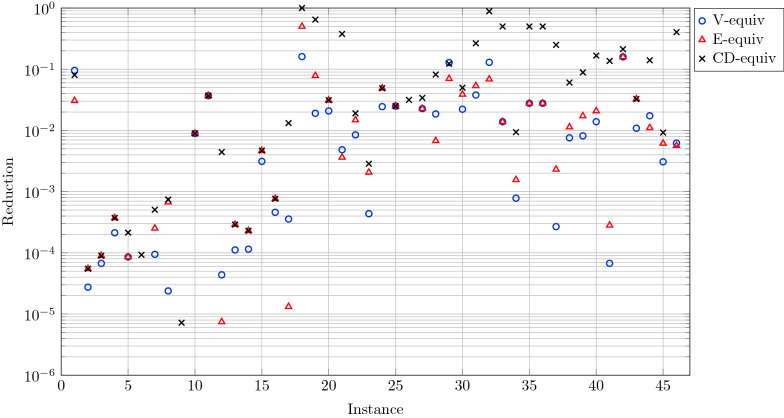
Conclusions: Our results are of both theoretical and practical importance. Indeed, as shown by the experiments, we are able to significantly reduce the space of optimal solutions while still maintaining important biological information about the whole space.
期刊介绍:
Algorithms for Molecular Biology publishes articles on novel algorithms for biological sequence and structure analysis, phylogeny reconstruction, and combinatorial algorithms and machine learning.
Areas of interest include but are not limited to: algorithms for RNA and protein structure analysis, gene prediction and genome analysis, comparative sequence analysis and alignment, phylogeny, gene expression, machine learning, and combinatorial algorithms.
Where appropriate, manuscripts should describe applications to real-world data. However, pure algorithm papers are also welcome if future applications to biological data are to be expected, or if they address complexity or approximation issues of novel computational problems in molecular biology. Articles about novel software tools will be considered for publication if they contain some algorithmically interesting aspects.




 京公网安备 11010802042870号
京ICP备2023020795号-1
京公网安备 11010802042870号
京ICP备2023020795号-1

 分享
分享
 求助内容:
求助内容: 应助结果提醒方式:
 扫码关注我们
