Mohammed El-Khateeb, Yousef Khader, Anwer Batieha, Hashem Jaddou, Dana Hyassat, Nahla Khawaja, Mousa Abujbara, Kamel Ajlouni
{"title":"Vitamin D deficiency and associated factors in Jordan.","authors":"Mohammed El-Khateeb, Yousef Khader, Anwer Batieha, Hashem Jaddou, Dana Hyassat, Nahla Khawaja, Mousa Abujbara, Kamel Ajlouni","doi":"10.1177/2050312119876151","DOIUrl":null,"url":null,"abstract":"<p><strong>Background: </strong>In Jordan, many studies reported various rates of vitamin D deficiency and insufficiency among different groups. This study aimed to determine the prevalence of low vitamin D level among Jordanian adults and determine its association with selected variables.</p><p><strong>Methods: </strong>The vitamin D level was assessed in a national representative sample of 4056 subjects aged >17 years. The study involved face-to-face interviews with the subjects and measurement of serum 25(OH)D. Low vitamin D level was defined as 25(OH)D < 30 ng/mL. Deficiency was defined as 25(OH)D < 20 ng/mL, and insufficiency was defined as 25(OH)D level of 20-30 ng/mL.</p><p><strong>Results: </strong>The overall prevalence of low vitamin D status (25(OH)D < 30 ng/mL) was 89.7%, with higher prevalence in males (92.4%) than in females (88.6%). Vitamin D was sufficient in 7.6% of males, insufficient in 38.4% of males, and deficient in 54% of males. Among females, vitamin D was insufficient in 10.1% and deficient in 78.5%. The prevalence of vitamin D deficiency was much higher in females than in males (<i>p</i> = 0.001). The only variables that were significantly associated with low level of vitamin D were gender, age, obesity, and employment.</p><p><strong>Conclusion: </strong>The prevalence of low vitamin D level is extremely high in Jordan. Age, gender, obesity, and unemployment were associated with low levels of vitamin D. Health authorities in Jordan need to increase the level of awareness about vitamin D deficiency and its prevention, particularly among women.</p>","PeriodicalId":21398,"journal":{"name":"SAGE Open Medicine","volume":"7 ","pages":"2050312119876151"},"PeriodicalIF":2.1000,"publicationDate":"2019-09-13","publicationTypes":"Journal Article","fieldsOfStudy":null,"isOpenAccess":false,"openAccessPdf":"https://sci-hub-pdf.com/10.1177/2050312119876151","citationCount":"22","resultStr":null,"platform":"Semanticscholar","paperid":null,"PeriodicalName":"SAGE Open Medicine","FirstCategoryId":"1085","ListUrlMain":"https://doi.org/10.1177/2050312119876151","RegionNum":0,"RegionCategory":null,"ArticlePicture":[],"TitleCN":null,"AbstractTextCN":null,"PMCID":null,"EPubDate":"2019/1/1 0:00:00","PubModel":"eCollection","JCR":"Q2","JCRName":"MEDICINE, GENERAL & INTERNAL","Score":null,"Total":0}
引用次数: 22
Abstract
Background: In Jordan, many studies reported various rates of vitamin D deficiency and insufficiency among different groups. This study aimed to determine the prevalence of low vitamin D level among Jordanian adults and determine its association with selected variables.
Methods: The vitamin D level was assessed in a national representative sample of 4056 subjects aged >17 years. The study involved face-to-face interviews with the subjects and measurement of serum 25(OH)D. Low vitamin D level was defined as 25(OH)D < 30 ng/mL. Deficiency was defined as 25(OH)D < 20 ng/mL, and insufficiency was defined as 25(OH)D level of 20-30 ng/mL.
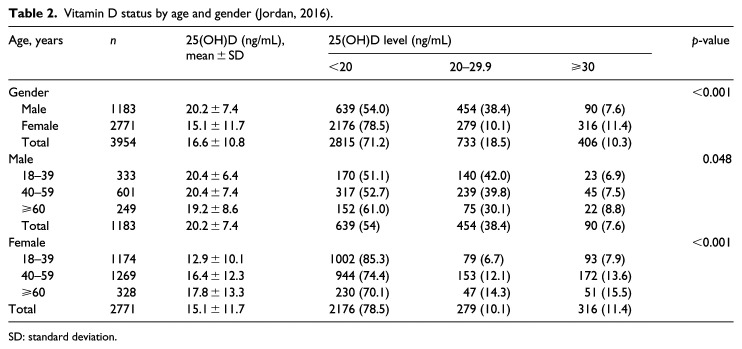
Results: The overall prevalence of low vitamin D status (25(OH)D < 30 ng/mL) was 89.7%, with higher prevalence in males (92.4%) than in females (88.6%). Vitamin D was sufficient in 7.6% of males, insufficient in 38.4% of males, and deficient in 54% of males. Among females, vitamin D was insufficient in 10.1% and deficient in 78.5%. The prevalence of vitamin D deficiency was much higher in females than in males (p = 0.001). The only variables that were significantly associated with low level of vitamin D were gender, age, obesity, and employment.
Conclusion: The prevalence of low vitamin D level is extremely high in Jordan. Age, gender, obesity, and unemployment were associated with low levels of vitamin D. Health authorities in Jordan need to increase the level of awareness about vitamin D deficiency and its prevention, particularly among women.
背景:在约旦,许多研究报告了不同人群中维生素D缺乏和不足的不同比率。本研究旨在确定约旦成年人中维生素D水平低的患病率,并确定其与选定变量的关系。方法:对4056名年龄>17岁的全国代表性样本进行维生素D水平评估。该研究包括与受试者面对面访谈和测定血清25(OH)D。低维生素D水平被定义为25(OH)D。结果:低维生素D状态的总体患病率(25(OH)D p = 0.001)。与低维生素D水平显著相关的唯一变量是性别、年龄、肥胖和就业。结论:约旦维生素D水平偏低的发生率极高。年龄、性别、肥胖和失业与维生素D水平低有关。约旦卫生当局需要提高特别是妇女对维生素D缺乏症及其预防的认识水平。





 京公网安备 11010802042870号
京ICP备2023020795号-1
京公网安备 11010802042870号
京ICP备2023020795号-1

 分享
分享
 求助内容:
求助内容: 应助结果提醒方式:
 扫码关注我们
