A Review of Coronaviruses Associated With Kawasaki Disease: Possible Implications for Pathogenesis of the Multisystem Inflammatory Syndrome Associated With COVID-19.
Fatima Farrukh Shahbaz, Russell Seth Martins, Abdullah Umair, Ronika Devi Ukrani, Kausar Jabeen, M Rizwan Sohail, Erum Khan
{"title":"A Review of Coronaviruses Associated With Kawasaki Disease: Possible Implications for Pathogenesis of the Multisystem Inflammatory Syndrome Associated With COVID-19.","authors":"Fatima Farrukh Shahbaz, Russell Seth Martins, Abdullah Umair, Ronika Devi Ukrani, Kausar Jabeen, M Rizwan Sohail, Erum Khan","doi":"10.1177/11795565221075319","DOIUrl":null,"url":null,"abstract":"<p><p>Multisystem Inflammatory Syndrome in Children (MIS-C), representing a new entity in the spectrum of manifestations of COVID-19, bears symptomatic resemblance with Kawasaki Disease (KD). This review explores the possible associations between KD and the human coronaviruses and discusses the pathophysiological similarities between KD and MIS-C and proposes implications for the pathogenesis of MIS-C in COVID-19. Since 2005, when a case-control study demonstrated the association of a strain of human coronavirus with KD, several studies have provided evidence regarding the association of different strains of the human coronaviruses with KD. Thus, the emergence of the KD-like disease MIS-C in COVID-19 may not be an unprecedented phenomenon. KD and MIS-C share a range of similarities in pathophysiology and possibly even genetics. Both share features of a cytokine storm, leading to a systemic inflammatory response and oxidative stress that may cause vasculitis and precipitate multi-organ failure. Moreover, antibody-dependent enhancement, a phenomenon demonstrated in previous coronaviruses, and the possible superantigenic behavior of SARS-CoV-2, possibly may also contribute toward the pathogenesis of MIS-C. Lastly, there is some evidence of complement-mediated microvascular injury in COVID-19, as well as of endotheliitis. Genetics may also represent a possible link between MIS-C and KD, with variations in FcγRII and IL-6 genes potentially increasing susceptibility to both conditions. Early detection and treatment are essential for the management of MIS-C in COVID-19. By highlighting the potential pathophysiological mechanisms that contribute to MIS-C, our review holds important implications for diagnostics, management, and further research of this rare manifestation of COVID-19.</p>","PeriodicalId":1,"journal":{"name":"Accounts of Chemical Research","volume":" ","pages":"11795565221075319"},"PeriodicalIF":17.7000,"publicationDate":"2022-02-16","publicationTypes":"Journal Article","fieldsOfStudy":null,"isOpenAccess":false,"openAccessPdf":"https://ftp.ncbi.nlm.nih.gov/pub/pmc/oa_pdf/03/26/10.1177_11795565221075319.PMC8859668.pdf","citationCount":"0","resultStr":null,"platform":"Semanticscholar","paperid":null,"PeriodicalName":"Accounts of Chemical Research","FirstCategoryId":"1085","ListUrlMain":"https://doi.org/10.1177/11795565221075319","RegionNum":1,"RegionCategory":"化学","ArticlePicture":[],"TitleCN":null,"AbstractTextCN":null,"PMCID":null,"EPubDate":"2022/1/1 0:00:00","PubModel":"eCollection","JCR":"Q1","JCRName":"CHEMISTRY, MULTIDISCIPLINARY","Score":null,"Total":0}
引用次数: 0
Abstract
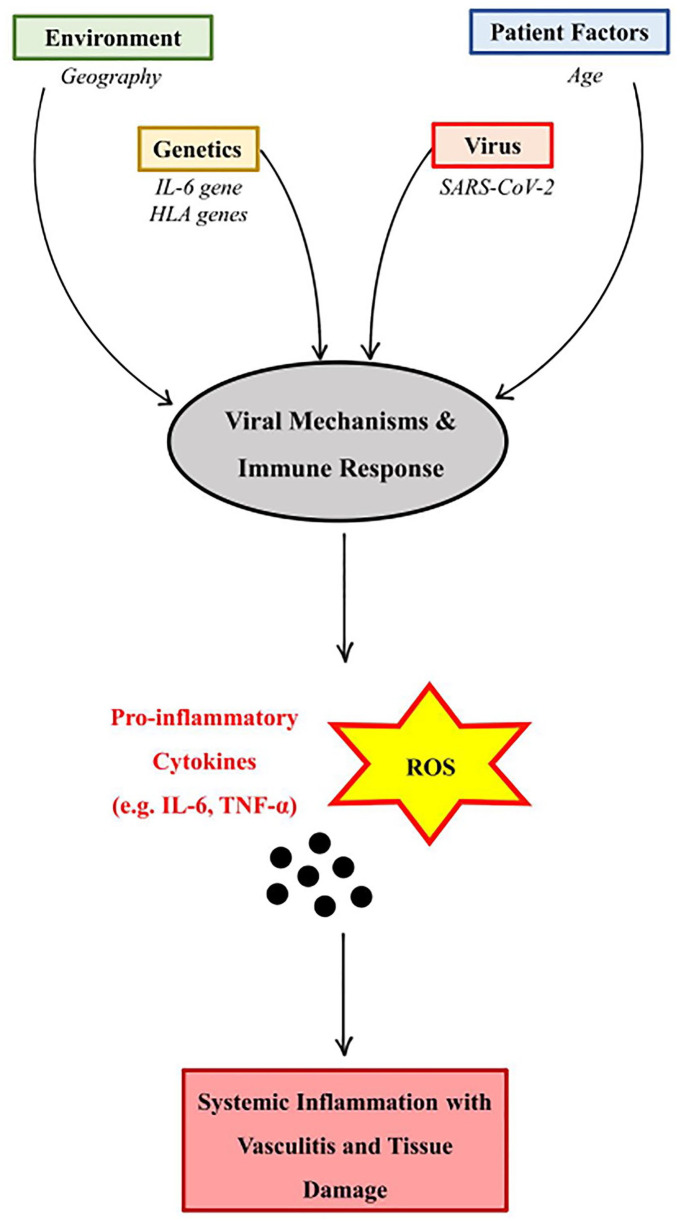
Multisystem Inflammatory Syndrome in Children (MIS-C), representing a new entity in the spectrum of manifestations of COVID-19, bears symptomatic resemblance with Kawasaki Disease (KD). This review explores the possible associations between KD and the human coronaviruses and discusses the pathophysiological similarities between KD and MIS-C and proposes implications for the pathogenesis of MIS-C in COVID-19. Since 2005, when a case-control study demonstrated the association of a strain of human coronavirus with KD, several studies have provided evidence regarding the association of different strains of the human coronaviruses with KD. Thus, the emergence of the KD-like disease MIS-C in COVID-19 may not be an unprecedented phenomenon. KD and MIS-C share a range of similarities in pathophysiology and possibly even genetics. Both share features of a cytokine storm, leading to a systemic inflammatory response and oxidative stress that may cause vasculitis and precipitate multi-organ failure. Moreover, antibody-dependent enhancement, a phenomenon demonstrated in previous coronaviruses, and the possible superantigenic behavior of SARS-CoV-2, possibly may also contribute toward the pathogenesis of MIS-C. Lastly, there is some evidence of complement-mediated microvascular injury in COVID-19, as well as of endotheliitis. Genetics may also represent a possible link between MIS-C and KD, with variations in FcγRII and IL-6 genes potentially increasing susceptibility to both conditions. Early detection and treatment are essential for the management of MIS-C in COVID-19. By highlighting the potential pathophysiological mechanisms that contribute to MIS-C, our review holds important implications for diagnostics, management, and further research of this rare manifestation of COVID-19.
期刊介绍:
Accounts of Chemical Research presents short, concise and critical articles offering easy-to-read overviews of basic research and applications in all areas of chemistry and biochemistry. These short reviews focus on research from the author’s own laboratory and are designed to teach the reader about a research project. In addition, Accounts of Chemical Research publishes commentaries that give an informed opinion on a current research problem. Special Issues online are devoted to a single topic of unusual activity and significance.
Accounts of Chemical Research replaces the traditional article abstract with an article "Conspectus." These entries synopsize the research affording the reader a closer look at the content and significance of an article. Through this provision of a more detailed description of the article contents, the Conspectus enhances the article's discoverability by search engines and the exposure for the research.






 京公网安备 11010802042870号
京ICP备2023020795号-1
京公网安备 11010802042870号
京ICP备2023020795号-1

 分享
分享
 求助内容:
求助内容: 应助结果提醒方式:
 扫码关注我们
