{"title":"Genetic Variability and Population Structure of the Tunisian Sicilo-Sarde Dairy Sheep Breed Inferred from Microsatellites Analysis.","authors":"Yousra Ben Sassi-Zaidy, Aziza Mohamed-Brahmi, Ghada Nouairia, Faouzia Charfi-Cheikhrouha, M'Naouer Djemali, Martino Cassandro","doi":"10.3390/genes13020304","DOIUrl":null,"url":null,"abstract":"<p><p>This study analyzed the genetic variability, inbreeding and population structure of the Tunisian-North African dairy sheep breed, the Sicilo-Sarde (SS), created by crossing the Sarda and Comisana dairy breeds. The level of variability in the SS, considered as an endangered breed after a dramatic decrease, was assessed using 17 microsatellite markers by analyzing the two breed populations sampled from their respective cradles: SS of Beja (SS<sub>B</sub>, <i>n</i> = 27) and SS of Mateur (SS<sub>M</sub>, <i>n</i> = 25). High levels of genetic diversity in SS were revealed, with a total of 212 alleles, a high mean number of alleles (12.47 ± 4.17) and a high average polymorphism information content (PIC) (0.81 ± 0.10). The observed heterozygosity was considerable in SS<sub>B</sub> and SS<sub>M</sub> (0.795 and 0.785, respectively). The inbreeding level measured by the population inbreeding coefficient <i>F<sub>IS</sub></i> is higher in the SS<sub>M</sub> population (0.121) than in the SS<sub>B</sub> population (0.090). The higher genetic diversity level detected in SS<sub>B</sub> reflected the effect of new Italian Sarda genes introduced by intra-uterine artificial insemination recently practiced in this population. The Wilcoxon test and the mode-shift distribution indicated that the SS breed is a non-bottlenecked population. The structural analysis reflected the historical miscegenation practiced during the breed creation and highlighted further ancient miscegenation, which could date back to the first waves of sheep introduction to the western Mediterranean region. Microsatellite markers were successfully applied in the assessment of the genetic variability of SS and should be used in monitoring this variability during the application of conservation strategies.</p>","PeriodicalId":2,"journal":{"name":"ACS Applied Bio Materials","volume":" ","pages":""},"PeriodicalIF":4.7000,"publicationDate":"2022-02-05","publicationTypes":"Journal Article","fieldsOfStudy":null,"isOpenAccess":false,"openAccessPdf":"https://www.ncbi.nlm.nih.gov/pmc/articles/PMC8872596/pdf/","citationCount":"0","resultStr":null,"platform":"Semanticscholar","paperid":null,"PeriodicalName":"ACS Applied Bio Materials","FirstCategoryId":"99","ListUrlMain":"https://doi.org/10.3390/genes13020304","RegionNum":0,"RegionCategory":null,"ArticlePicture":[],"TitleCN":null,"AbstractTextCN":null,"PMCID":null,"EPubDate":"","PubModel":"","JCR":"Q2","JCRName":"MATERIALS SCIENCE, BIOMATERIALS","Score":null,"Total":0}
引用次数: 0
Abstract
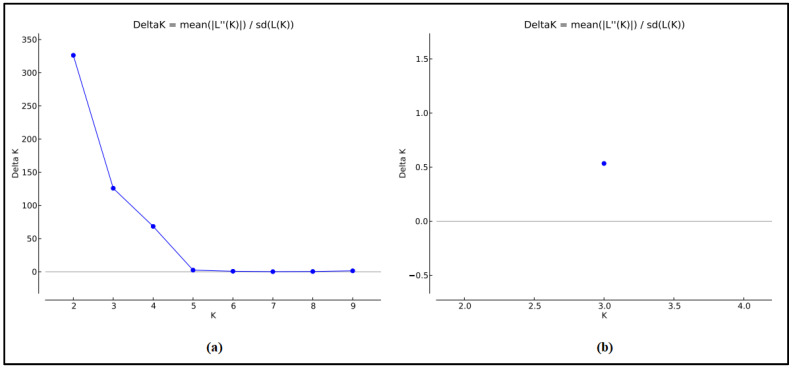
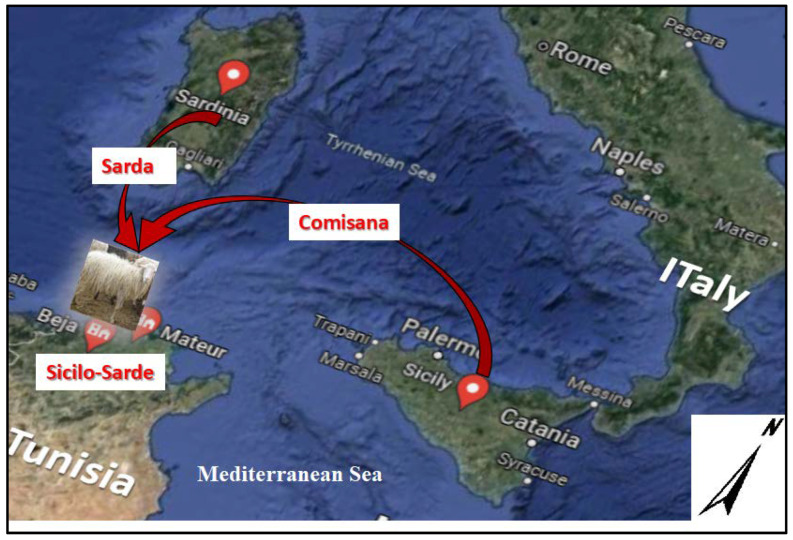
This study analyzed the genetic variability, inbreeding and population structure of the Tunisian-North African dairy sheep breed, the Sicilo-Sarde (SS), created by crossing the Sarda and Comisana dairy breeds. The level of variability in the SS, considered as an endangered breed after a dramatic decrease, was assessed using 17 microsatellite markers by analyzing the two breed populations sampled from their respective cradles: SS of Beja (SSB, n = 27) and SS of Mateur (SSM, n = 25). High levels of genetic diversity in SS were revealed, with a total of 212 alleles, a high mean number of alleles (12.47 ± 4.17) and a high average polymorphism information content (PIC) (0.81 ± 0.10). The observed heterozygosity was considerable in SSB and SSM (0.795 and 0.785, respectively). The inbreeding level measured by the population inbreeding coefficient FIS is higher in the SSM population (0.121) than in the SSB population (0.090). The higher genetic diversity level detected in SSB reflected the effect of new Italian Sarda genes introduced by intra-uterine artificial insemination recently practiced in this population. The Wilcoxon test and the mode-shift distribution indicated that the SS breed is a non-bottlenecked population. The structural analysis reflected the historical miscegenation practiced during the breed creation and highlighted further ancient miscegenation, which could date back to the first waves of sheep introduction to the western Mediterranean region. Microsatellite markers were successfully applied in the assessment of the genetic variability of SS and should be used in monitoring this variability during the application of conservation strategies.
期刊介绍:
ACS Applied Bio Materials is an interdisciplinary journal publishing original research covering all aspects of biomaterials and biointerfaces including and beyond the traditional biosensing, biomedical and therapeutic applications.
The journal is devoted to reports of new and original experimental and theoretical research of an applied nature that integrates knowledge in the areas of materials, engineering, physics, bioscience, and chemistry into important bio applications. The journal is specifically interested in work that addresses the relationship between structure and function and assesses the stability and degradation of materials under relevant environmental and biological conditions.





 京公网安备 11010802042870号
京ICP备2023020795号-1
京公网安备 11010802042870号
京ICP备2023020795号-1

 分享
分享
 求助内容:
求助内容: 应助结果提醒方式:
 扫码关注我们
