Krishnamraju Ankireddy, Amir H. Ghahremani, Blake Martin, Gautam Gupta and Thad Druffel
{"title":"Rapid thermal annealing of CH3NH3PbI3 perovskite thin films by intense pulsed light with aid of diiodomethane additive†","authors":"Krishnamraju Ankireddy, Amir H. Ghahremani, Blake Martin, Gautam Gupta and Thad Druffel","doi":"10.1039/C8TA01237G","DOIUrl":null,"url":null,"abstract":"<p >The organic metal halide perovskite material is capable of high throughput manufacturing <em>via</em> traditional deposition processes used in roll-to-roll, yet thermal annealing post deposition may require long ovens. We report rapid annealed perovskite thin films using intense pulsed light (IPL) to initiate a radiative thermal response that is enabled by an alkyl halide additive that collectively improves the performance of a device processed in an ambient environment from a baseline of 10 to 16.5% efficiency. Previous reports on CH<small><sub>3</sub></small>NH<small><sub>3</sub></small>PbI<small><sub>3</sub></small> perovskite films using IPL processing achieved functional devices in milli-second time scales and are promising for high throughput manufacturing processes under ambient conditions. In this study, we found that the addition of diiodomethane (CH<small><sub>2</sub></small>I<small><sub>2</sub></small>) as an additive to the methylammonium iodide (MAI)/lead iodide (PbI<small><sub>2</sub></small>) precursor ink chemistry and subsequent IPL thermal annealing are inter-dependent. The concentration of CH<small><sub>2</sub></small>I<small><sub>2</sub></small> and IPL processing parameters have a direct effect on the surface morphology of the films and performance within a perovskite solar cell (PSC). The CH<small><sub>2</sub></small>I<small><sub>2</sub></small> dissociates under exposure to ultraviolet (UV) radiation from the IPL source liberating iodine ions in the film, influencing the perovskite formation and reducing the defect states. We anticipate that these results can be utilized to further develop different ink formulations using alkyl halides for the IPL technique to improve the performance of perovskite solar cells processed in ambient conditions.</p>","PeriodicalId":82,"journal":{"name":"Journal of Materials Chemistry A","volume":" 20","pages":" 9378-9383"},"PeriodicalIF":9.5000,"publicationDate":"2018-05-01","publicationTypes":"Journal Article","fieldsOfStudy":null,"isOpenAccess":false,"openAccessPdf":"https://sci-hub-pdf.com/10.1039/C8TA01237G","citationCount":"24","resultStr":null,"platform":"Semanticscholar","paperid":null,"PeriodicalName":"Journal of Materials Chemistry A","FirstCategoryId":"88","ListUrlMain":"https://pubs.rsc.org/en/content/articlelanding/2018/ta/c8ta01237g","RegionNum":2,"RegionCategory":"材料科学","ArticlePicture":[],"TitleCN":null,"AbstractTextCN":null,"PMCID":null,"EPubDate":"","PubModel":"","JCR":"Q1","JCRName":"CHEMISTRY, PHYSICAL","Score":null,"Total":0}
引用次数: 24
Abstract
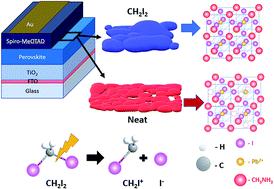
The organic metal halide perovskite material is capable of high throughput manufacturing via traditional deposition processes used in roll-to-roll, yet thermal annealing post deposition may require long ovens. We report rapid annealed perovskite thin films using intense pulsed light (IPL) to initiate a radiative thermal response that is enabled by an alkyl halide additive that collectively improves the performance of a device processed in an ambient environment from a baseline of 10 to 16.5% efficiency. Previous reports on CH3NH3PbI3 perovskite films using IPL processing achieved functional devices in milli-second time scales and are promising for high throughput manufacturing processes under ambient conditions. In this study, we found that the addition of diiodomethane (CH2I2) as an additive to the methylammonium iodide (MAI)/lead iodide (PbI2) precursor ink chemistry and subsequent IPL thermal annealing are inter-dependent. The concentration of CH2I2 and IPL processing parameters have a direct effect on the surface morphology of the films and performance within a perovskite solar cell (PSC). The CH2I2 dissociates under exposure to ultraviolet (UV) radiation from the IPL source liberating iodine ions in the film, influencing the perovskite formation and reducing the defect states. We anticipate that these results can be utilized to further develop different ink formulations using alkyl halides for the IPL technique to improve the performance of perovskite solar cells processed in ambient conditions.
期刊介绍:
The Journal of Materials Chemistry A, B & C covers a wide range of high-quality studies in the field of materials chemistry, with each section focusing on specific applications of the materials studied. Journal of Materials Chemistry A emphasizes applications in energy and sustainability, including topics such as artificial photosynthesis, batteries, and fuel cells. Journal of Materials Chemistry B focuses on applications in biology and medicine, while Journal of Materials Chemistry C covers applications in optical, magnetic, and electronic devices. Example topic areas within the scope of Journal of Materials Chemistry A include catalysis, green/sustainable materials, sensors, and water treatment, among others.



 京公网安备 11010802042870号
京ICP备2023020795号-1
京公网安备 11010802042870号
京ICP备2023020795号-1

 分享
分享
 求助内容:
求助内容: 应助结果提醒方式:
 扫码关注我们
