{"title":"Tolvaptan Improves Contrast-Induced Acute Kidney Injury.","authors":"Chunyang Xu, Xu Huang, Gaoliang Yan, Dong Wang, Meijuan Hu, Chengchun Tang","doi":"10.1155/2022/7435292","DOIUrl":null,"url":null,"abstract":"<p><strong>Objective: </strong>Contrast-induced acute kidney injury (CI-AKI) is a serious side effect of contrast media use. The purpose of this study was to investigate the role and mechanism of tolvaptan (TOL) in CI-AKI.</p><p><strong>Methods: </strong>24 Wistar male rats were randomly divided into 4 groups (<i>n</i> = 6). And a rat model of CI-AKI was established. Then, the blood and urine of rats in each group were collected to detect relevant parameters. HE staining was utilized for the observation of the pathological changes of rat kidney tissues, TUNEL assay for the detection of tubular cell apoptosis, biochemical detection for the confirmation of oxidative stress level in kidney tissues, and western blot for the test of the expression of apoptotic proteins and the Nrf2 signaling pathway-related proteins in kidney tissues.</p><p><strong>Results: </strong>TOL could significantly reduce the serum level of urea nitrogen, creatinine, and neutrophil gelatinase-associated lipocalin and decrease serum Cys-C and urine KIM-1 in CI-AKI rats. The result above meant that TOL could improve kidney injury and reduce tubular cell apoptosis in CI-AKI rats. In addition, TOL contributed to a reduction of oxidative stress level by downregulating myeloperoxidase level and increasing the activities of superoxide dismutase and glutathione peroxidase in the kidney tissue of CI-AKI rats. After the pretreatment of TOL, the expression of proapoptotic proteins cleaved-caspase 3 and BAX, as well as mitochondrial fusion proteins DRP1 and MFN2 was downregulated, while the expression of Bcl-2 and PINK1 was upregulated in the kidney tissue of CI-AKI rats. Further, TOL could activate the Nrf2 signaling pathway, and the Nrf2 inhibitor ML385 reversed the effect of TOL on CI-AKI.</p><p><strong>Conclusion: </strong>TOL can improve CI-AKI by activating the Nrf2/HO-1 signaling pathway, inhibiting oxidative stress response, and reducing tubular cell apoptosis.</p>","PeriodicalId":2,"journal":{"name":"ACS Applied Bio Materials","volume":" ","pages":"7435292"},"PeriodicalIF":4.7000,"publicationDate":"2022-01-30","publicationTypes":"Journal Article","fieldsOfStudy":null,"isOpenAccess":false,"openAccessPdf":"https://www.ncbi.nlm.nih.gov/pmc/articles/PMC8818441/pdf/","citationCount":"0","resultStr":null,"platform":"Semanticscholar","paperid":null,"PeriodicalName":"ACS Applied Bio Materials","FirstCategoryId":"3","ListUrlMain":"https://doi.org/10.1155/2022/7435292","RegionNum":0,"RegionCategory":null,"ArticlePicture":[],"TitleCN":null,"AbstractTextCN":null,"PMCID":null,"EPubDate":"2022/1/1 0:00:00","PubModel":"eCollection","JCR":"Q2","JCRName":"MATERIALS SCIENCE, BIOMATERIALS","Score":null,"Total":0}
引用次数: 0
Abstract
Objective: Contrast-induced acute kidney injury (CI-AKI) is a serious side effect of contrast media use. The purpose of this study was to investigate the role and mechanism of tolvaptan (TOL) in CI-AKI.
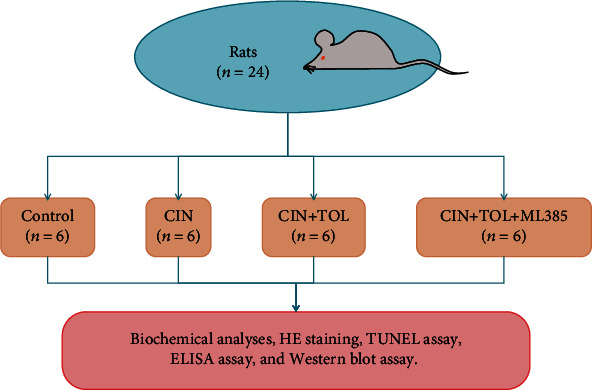
Methods: 24 Wistar male rats were randomly divided into 4 groups (n = 6). And a rat model of CI-AKI was established. Then, the blood and urine of rats in each group were collected to detect relevant parameters. HE staining was utilized for the observation of the pathological changes of rat kidney tissues, TUNEL assay for the detection of tubular cell apoptosis, biochemical detection for the confirmation of oxidative stress level in kidney tissues, and western blot for the test of the expression of apoptotic proteins and the Nrf2 signaling pathway-related proteins in kidney tissues.
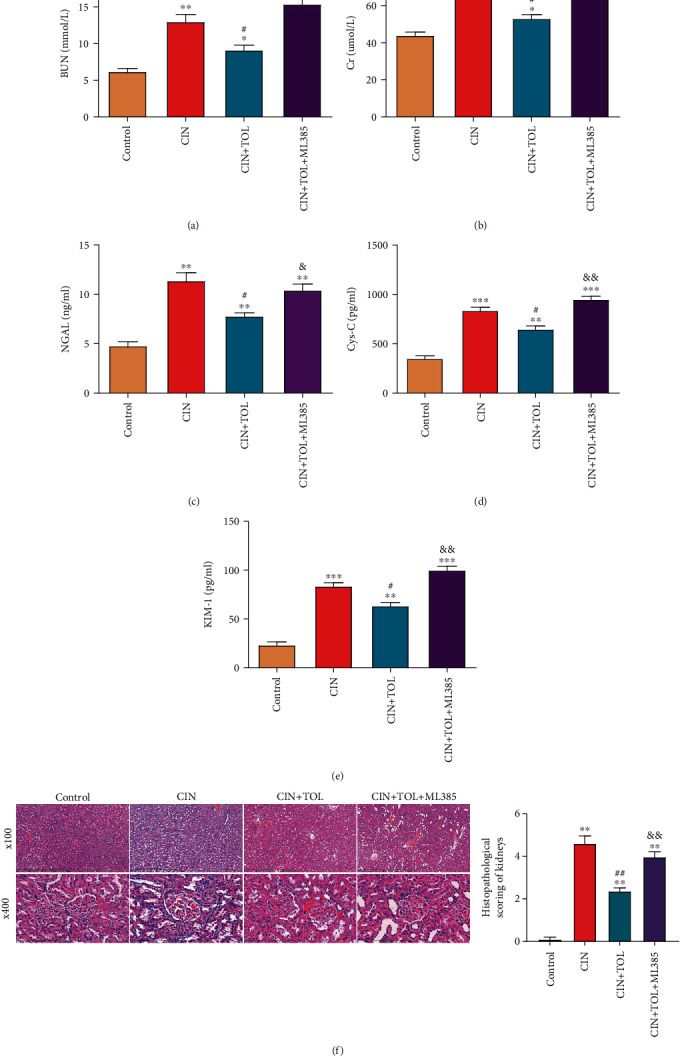
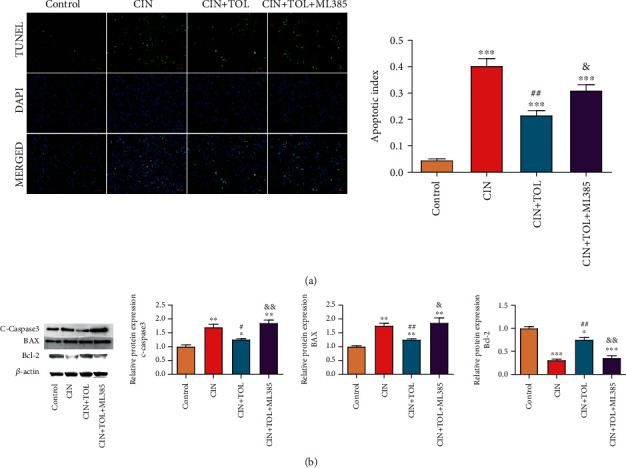
Results: TOL could significantly reduce the serum level of urea nitrogen, creatinine, and neutrophil gelatinase-associated lipocalin and decrease serum Cys-C and urine KIM-1 in CI-AKI rats. The result above meant that TOL could improve kidney injury and reduce tubular cell apoptosis in CI-AKI rats. In addition, TOL contributed to a reduction of oxidative stress level by downregulating myeloperoxidase level and increasing the activities of superoxide dismutase and glutathione peroxidase in the kidney tissue of CI-AKI rats. After the pretreatment of TOL, the expression of proapoptotic proteins cleaved-caspase 3 and BAX, as well as mitochondrial fusion proteins DRP1 and MFN2 was downregulated, while the expression of Bcl-2 and PINK1 was upregulated in the kidney tissue of CI-AKI rats. Further, TOL could activate the Nrf2 signaling pathway, and the Nrf2 inhibitor ML385 reversed the effect of TOL on CI-AKI.
Conclusion: TOL can improve CI-AKI by activating the Nrf2/HO-1 signaling pathway, inhibiting oxidative stress response, and reducing tubular cell apoptosis.
期刊介绍:
ACS Applied Bio Materials is an interdisciplinary journal publishing original research covering all aspects of biomaterials and biointerfaces including and beyond the traditional biosensing, biomedical and therapeutic applications.
The journal is devoted to reports of new and original experimental and theoretical research of an applied nature that integrates knowledge in the areas of materials, engineering, physics, bioscience, and chemistry into important bio applications. The journal is specifically interested in work that addresses the relationship between structure and function and assesses the stability and degradation of materials under relevant environmental and biological conditions.




 京公网安备 11010802042870号
京ICP备2023020795号-1
京公网安备 11010802042870号
京ICP备2023020795号-1

 分享
分享
 求助内容:
求助内容: 应助结果提醒方式:
 扫码关注我们
