Simulations of x-ray absorption spectra for CO desorbing from Ru(0001) with transition-potential and time-dependent density functional theory approaches.
Gabriel L S Rodrigues, Elias Diesen, Johannes Voss, Patrick Norman, Lars G M Pettersson
{"title":"Simulations of x-ray absorption spectra for CO desorbing from Ru(0001) with transition-potential and time-dependent density functional theory approaches.","authors":"Gabriel L S Rodrigues, Elias Diesen, Johannes Voss, Patrick Norman, Lars G M Pettersson","doi":"10.1063/4.0000135","DOIUrl":null,"url":null,"abstract":"<p><p>The desorption of a carbon monoxide molecule from a Ru(0001) surface was studied by means of X-ray Absorption Spectra (XAS) computed with Transition Potential (TP-DFT) and Time Dependent (TD-DFT) DFT methods. By unraveling the evolution of the CO electronic structure upon desorption, we observed that at 2.3 Å from the surface, the CO molecule has already predominantly gas-phase character. While C 1s XAS is quite insensitive to changes in the C-O bond length, the O 1s excitation is very sensitive with the π* coming down in energy upon CO bond stretching, which competes with the increase in orbital energy due to the repulsive interaction with the metallic surface. We show in a systematic way that the TP-DFT method can describe the XAS rather well at the endpoints (chemisorbed and gas phase) but is affected by artificial charge transfer and/or incorrect spin treatment in the transition region in cases like CO, where there are low-lying π* orbitals and large exchange interactions between the core 1s and valence-acceptor π* orbitals. As an alternative, we demonstrate by comparing with experimental data that a linear response approach using TD-DFT employing common exchange-correlation functionals and finite-size clusters can yield a good description of the spectral evolution of the 1s → π* transition with correct spin and gas-to-chemisorbed chemical shifts in good agreement with experiment.</p>","PeriodicalId":74877,"journal":{"name":"","volume":"9 1","pages":"014101"},"PeriodicalIF":0.0,"publicationDate":"2022-01-13","publicationTypes":"Journal Article","fieldsOfStudy":null,"isOpenAccess":false,"openAccessPdf":"https://www.ncbi.nlm.nih.gov/pmc/articles/PMC8759799/pdf/","citationCount":"0","resultStr":null,"platform":"Semanticscholar","paperid":null,"PeriodicalName":"","FirstCategoryId":"101","ListUrlMain":"https://doi.org/10.1063/4.0000135","RegionNum":0,"RegionCategory":null,"ArticlePicture":[],"TitleCN":null,"AbstractTextCN":null,"PMCID":null,"EPubDate":"2022/1/1 0:00:00","PubModel":"eCollection","JCR":"","JCRName":"","Score":null,"Total":0}
引用次数: 0
Abstract
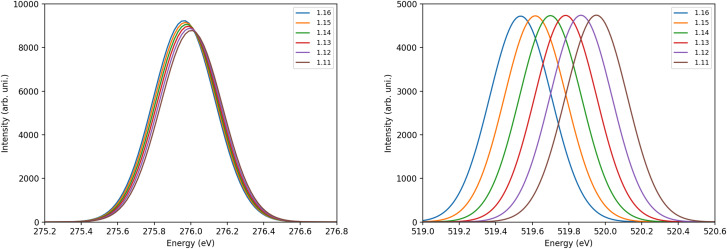
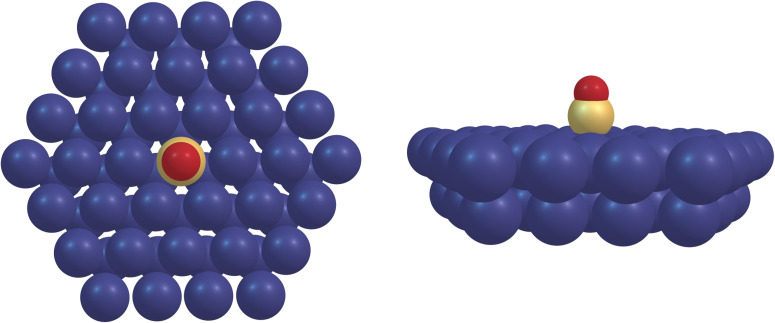
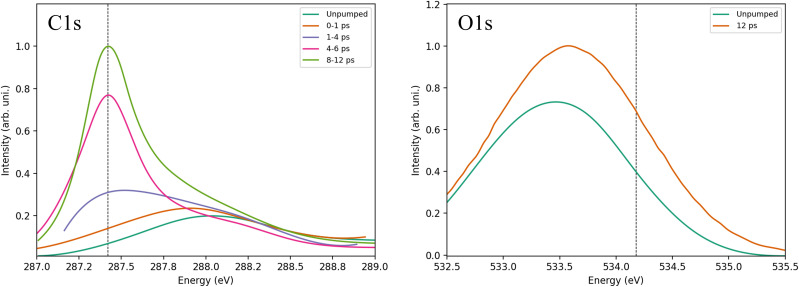
The desorption of a carbon monoxide molecule from a Ru(0001) surface was studied by means of X-ray Absorption Spectra (XAS) computed with Transition Potential (TP-DFT) and Time Dependent (TD-DFT) DFT methods. By unraveling the evolution of the CO electronic structure upon desorption, we observed that at 2.3 Å from the surface, the CO molecule has already predominantly gas-phase character. While C 1s XAS is quite insensitive to changes in the C-O bond length, the O 1s excitation is very sensitive with the π* coming down in energy upon CO bond stretching, which competes with the increase in orbital energy due to the repulsive interaction with the metallic surface. We show in a systematic way that the TP-DFT method can describe the XAS rather well at the endpoints (chemisorbed and gas phase) but is affected by artificial charge transfer and/or incorrect spin treatment in the transition region in cases like CO, where there are low-lying π* orbitals and large exchange interactions between the core 1s and valence-acceptor π* orbitals. As an alternative, we demonstrate by comparing with experimental data that a linear response approach using TD-DFT employing common exchange-correlation functionals and finite-size clusters can yield a good description of the spectral evolution of the 1s → π* transition with correct spin and gas-to-chemisorbed chemical shifts in good agreement with experiment.
用过渡电位和随时间变化的密度泛函理论方法模拟从 Ru(0001) 解吸 CO 的 X 射线吸收光谱。
我们利用过渡势(TP-DFT)和时变(TD-DFT)DFT 方法计算的 X 射线吸收光谱(XAS)研究了一氧化碳分子从 Ru(0001)表面解吸的过程。通过揭示解吸过程中 CO 电子结构的演变,我们观察到在距离表面 2.3 Å 处,CO 分子已经主要具有气相特性。虽然 C 1s XAS 对 C-O 键长度的变化非常不敏感,但 O 1s 激发却非常敏感,在 CO 键伸展时,π* 的能量会下降,这与与金属表面的排斥作用导致的轨道能量增加形成了竞争。我们用系统的方法表明,TP-DFT 方法可以很好地描述端点(化学吸附和气相)的 XAS,但在 CO 等情况下,会受到过渡区人为电荷转移和/或不正确自旋处理的影响,因为在过渡区存在低洼的 π* 轨道以及核心 1s 与价受 π* 轨道之间的大量交换相互作用。作为一种替代方法,我们通过与实验数据的比较证明,利用普通交换相关函数和有限尺寸簇的 TD-DFT 线性响应方法可以很好地描述 1s → π* 转变的光谱演变,其正确的自旋和气体-化合层化学位移与实验结果非常一致。



 京公网安备 11010802042870号
京ICP备2023020795号-1
京公网安备 11010802042870号
京ICP备2023020795号-1

 分享
分享
 求助内容:
求助内容: 应助结果提醒方式:
 扫码关注我们
