{"title":"Analysis of <i>CYP450</i> gene expression and function in white-rot fungus, <i>Lenzites gibbosa</i>, treated with Congo red.","authors":"Jian Zhang, YuJie Chi, Jun Zhang","doi":"10.1080/10520295.2022.2028307","DOIUrl":null,"url":null,"abstract":"<p><p>We investigated the function of cytochrome P450 (<i>CYP450</i>) genes in degradation of the diazo dye, Congo red, by white-rot fungus <i>Lenzites gibbosa</i>. Hyphae treated with Congo red at different times were sequenced to obtain transcription data. <i>CYP450</i> genes in transcriptomes were identified using a gene-encoding protein functional search and analyzed in Cluster of Orthologous Genes, Gene Ontology, Kyoto Encyclopedia of Genes and Genomes Databases. Differentially expressed genes (DEGs) in different groups were analyzed using EdgeR. We present the relation between transcription factors (TFs) and <i>CYP450</i> regulation by analysis of the co-expression network. One hundred sixty <i>CYP450</i> genes obtained by a functional annotation search were related to the oxido-reduction reaction of secondary metabolism, defense mechanism and aromatic compound degradation. The fastest decolorization and the greatest expression of <i>CYP450</i> genes, which were related to the decolorization effect, occurred at 0-3 h. Seven <i>CYP450</i> genes (<i>7522, 6568, 4482, 9118, 10935, 7521</i> and <i>10926</i>) were identified. The key TFs that regulate these genes belong to the zinc finger family. <i>CYP450</i> genes and their products in <i>L. gibbosa</i> participated in degradation of Congo red and stress resistance. We provide a reference value for degradation and decolorization of Congo red.</p>","PeriodicalId":8970,"journal":{"name":"Biotechnic & Histochemistry","volume":"97 7","pages":"519-535"},"PeriodicalIF":1.4000,"publicationDate":"2022-10-01","publicationTypes":"Journal Article","fieldsOfStudy":null,"isOpenAccess":false,"openAccessPdf":"","citationCount":"1","resultStr":null,"platform":"Semanticscholar","paperid":null,"PeriodicalName":"Biotechnic & Histochemistry","FirstCategoryId":"5","ListUrlMain":"https://doi.org/10.1080/10520295.2022.2028307","RegionNum":4,"RegionCategory":"生物学","ArticlePicture":[],"TitleCN":null,"AbstractTextCN":null,"PMCID":null,"EPubDate":"2022/1/24 0:00:00","PubModel":"Epub","JCR":"Q4","JCRName":"BIOTECHNOLOGY & APPLIED MICROBIOLOGY","Score":null,"Total":0}
引用次数: 1
Abstract
We investigated the function of cytochrome P450 (CYP450) genes in degradation of the diazo dye, Congo red, by white-rot fungus Lenzites gibbosa. Hyphae treated with Congo red at different times were sequenced to obtain transcription data. CYP450 genes in transcriptomes were identified using a gene-encoding protein functional search and analyzed in Cluster of Orthologous Genes, Gene Ontology, Kyoto Encyclopedia of Genes and Genomes Databases. Differentially expressed genes (DEGs) in different groups were analyzed using EdgeR. We present the relation between transcription factors (TFs) and CYP450 regulation by analysis of the co-expression network. One hundred sixty CYP450 genes obtained by a functional annotation search were related to the oxido-reduction reaction of secondary metabolism, defense mechanism and aromatic compound degradation. The fastest decolorization and the greatest expression of CYP450 genes, which were related to the decolorization effect, occurred at 0-3 h. Seven CYP450 genes (7522, 6568, 4482, 9118, 10935, 7521 and 10926) were identified. The key TFs that regulate these genes belong to the zinc finger family. CYP450 genes and their products in L. gibbosa participated in degradation of Congo red and stress resistance. We provide a reference value for degradation and decolorization of Congo red.
期刊介绍:
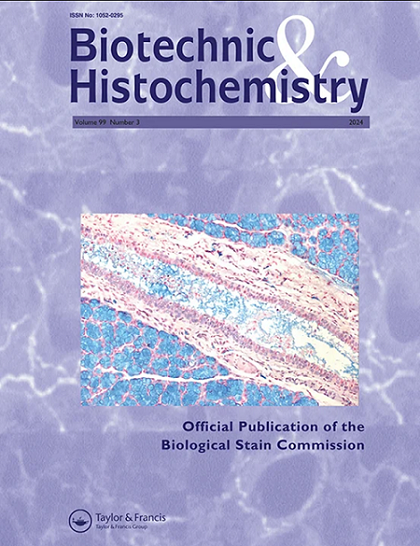
Biotechnic & Histochemistry (formerly Stain technology) is the
official publication of the Biological Stain Commission. The journal has been in continuous publication since 1926.
Biotechnic & Histochemistry is an interdisciplinary journal that embraces all aspects of techniques for visualizing biological processes and entities in cells, tissues and organisms; papers that describe experimental work that employs such investigative methods are appropriate for publication as well.
Papers concerning topics as diverse as applications of histochemistry, immunohistochemistry, in situ hybridization, cytochemical probes, autoradiography, light and electron microscopy, tissue culture, in vivo and in vitro studies, image analysis, cytogenetics, automation or computerization of investigative procedures and other investigative approaches are appropriate for publication regardless of their length. Letters to the Editor and review articles concerning topics of special and current interest also are welcome.



 京公网安备 11010802042870号
京ICP备2023020795号-1
京公网安备 11010802042870号
京ICP备2023020795号-1

 分享
分享
 求助内容:
求助内容: 应助结果提醒方式:
 扫码关注我们
