{"title":"Magnetically Boosted Generation of Intracellular Reactive Oxygen Species toward Magneto-Photodynamic Therapy","authors":"Wubin Wu, Xiaomeng Guo, Chenghu Dai, Zeyang Zhou, Hongxia Sun, Yeteng Zhong, Hua Sheng, Chuang Zhang*, Jiannian Yao","doi":"10.1021/acs.jpcb.2c00143","DOIUrl":null,"url":null,"abstract":"<p >The generation of reactive oxygen species (ROS) in photodynamic therapy (PDT) involves excited-state intermediates with both singlet and triplet spin configurations, which provides possibilities to modulate the ROS production in PDT under an external magnetic field. Here, we present that magnetically modulated ROS production can promote PDT efficacy and develop a magnetic-field-assisted PDT (magneto-PDT) method for effectively and selectively killing cancer cells. The photosensitization reaction between excited-state riboflavin and oxygen molecules is influenced by the applied field, and the overall magnetic field effect (MFE) shows a moderate increase at a low field (<1000 G) and then a boost up to the saturation ~100% at a high field (>1000 G). It is found that the spin precession occurring in radical ion pairs (electron transfer from riboflavin to oxygen) facilitates the O<sub>2</sub><sup>?–</sup> generation at the low field. In comparison, the spin splitting in an encounter complex (energy transfer from riboflavin to oxygen) benefits the production of <sup>1</sup>O<sub>2</sub> species at the high field. The field modulation on the two types of ROS in PDT, i.e., O<sub>2</sub><sup>?–</sup> and <sup>1</sup>O<sub>2</sub>, is also demonstrated in living cells. The magneto-PDT strategy shows the capability to inhibit the proliferation of cancer cells (e.g., HeLa, RBL-2H3, and MCF-7) effectively and selectively, which reveals the potential of using the MFE on chemical reactions in biological applications.</p>","PeriodicalId":60,"journal":{"name":"The Journal of Physical Chemistry B","volume":"126 9","pages":"1895–1903"},"PeriodicalIF":2.9000,"publicationDate":"2022-03-01","publicationTypes":"Journal Article","fieldsOfStudy":null,"isOpenAccess":false,"openAccessPdf":"","citationCount":"3","resultStr":null,"platform":"Semanticscholar","paperid":null,"PeriodicalName":"The Journal of Physical Chemistry B","FirstCategoryId":"1","ListUrlMain":"https://pubs.acs.org/doi/10.1021/acs.jpcb.2c00143","RegionNum":2,"RegionCategory":"化学","ArticlePicture":[],"TitleCN":null,"AbstractTextCN":null,"PMCID":null,"EPubDate":"","PubModel":"","JCR":"Q3","JCRName":"CHEMISTRY, PHYSICAL","Score":null,"Total":0}
引用次数: 3
Abstract
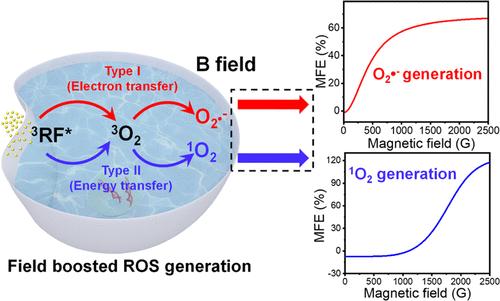
The generation of reactive oxygen species (ROS) in photodynamic therapy (PDT) involves excited-state intermediates with both singlet and triplet spin configurations, which provides possibilities to modulate the ROS production in PDT under an external magnetic field. Here, we present that magnetically modulated ROS production can promote PDT efficacy and develop a magnetic-field-assisted PDT (magneto-PDT) method for effectively and selectively killing cancer cells. The photosensitization reaction between excited-state riboflavin and oxygen molecules is influenced by the applied field, and the overall magnetic field effect (MFE) shows a moderate increase at a low field (<1000 G) and then a boost up to the saturation ~100% at a high field (>1000 G). It is found that the spin precession occurring in radical ion pairs (electron transfer from riboflavin to oxygen) facilitates the O2?– generation at the low field. In comparison, the spin splitting in an encounter complex (energy transfer from riboflavin to oxygen) benefits the production of 1O2 species at the high field. The field modulation on the two types of ROS in PDT, i.e., O2?– and 1O2, is also demonstrated in living cells. The magneto-PDT strategy shows the capability to inhibit the proliferation of cancer cells (e.g., HeLa, RBL-2H3, and MCF-7) effectively and selectively, which reveals the potential of using the MFE on chemical reactions in biological applications.
期刊介绍:
An essential criterion for acceptance of research articles in the journal is that they provide new physical insight. Please refer to the New Physical Insights virtual issue on what constitutes new physical insight. Manuscripts that are essentially reporting data or applications of data are, in general, not suitable for publication in JPC B.



 京公网安备 11010802042870号
京ICP备2023020795号-1
京公网安备 11010802042870号
京ICP备2023020795号-1

 分享
分享

 求助内容:
求助内容: 应助结果提醒方式:
 扫码关注我们
