"If They Give Their Mind to HIV, They Don't Last as Long": An Explanatory Model of HIV Infection in a Limited-Resource Setting Informs Person-Centered Care.
Samantha Stonbraker, Gabriella Sanabria, Silvia Cunto-Amesty, Carmela Alcántara, Ana F Abraído-Lanza, Tawandra Rowell-Cunsolo, Mina Halpern, Suzanne Bakken, Rebecca Schnall, Maureen George
{"title":"\"If They Give Their Mind to HIV, They Don't Last as Long\": An Explanatory Model of HIV Infection in a Limited-Resource Setting Informs Person-Centered Care.","authors":"Samantha Stonbraker, Gabriella Sanabria, Silvia Cunto-Amesty, Carmela Alcántara, Ana F Abraído-Lanza, Tawandra Rowell-Cunsolo, Mina Halpern, Suzanne Bakken, Rebecca Schnall, Maureen George","doi":"10.1177/23333936221097112","DOIUrl":null,"url":null,"abstract":"<p><p>Explanatory models describe individuals' perceptions of their illness experiences, which can guide culturally relevant care. We constructed an explanatory model of the experience of living with human immunodeficiency virus (HIV) in the Dominican Republic. Following qualitative descriptive methodology, we conducted interviews in Spanish using a semi-structured interview guide developed using Kleinman's explanatory model framework. Two bilingual researchers coded interview transcripts following conventional content analysis. We used deductive codes from Kleinman's framework and inductive codes external to the framework to construct the codebook. We arranged codes by shared meaning into categories and constructed themes that reflected shared findings from inductive categories and deductive codes. Twenty-six persons living with HIV participated. They provided rich descriptions of their experiences represented by four cross-cutting themes, which informed the explanatory model. By incorporating this in-depth understanding of patients' illness experiences into care delivery, nurses can cultivate culturally meaningful and trusting patient-centered partnerships that improve health.</p>","PeriodicalId":2,"journal":{"name":"ACS Applied Bio Materials","volume":" ","pages":"23333936221097112"},"PeriodicalIF":4.7000,"publicationDate":"2022-06-13","publicationTypes":"Journal Article","fieldsOfStudy":null,"isOpenAccess":false,"openAccessPdf":"https://ftp.ncbi.nlm.nih.gov/pub/pmc/oa_pdf/9a/20/10.1177_23333936221097112.PMC9203948.pdf","citationCount":"0","resultStr":null,"platform":"Semanticscholar","paperid":null,"PeriodicalName":"ACS Applied Bio Materials","FirstCategoryId":"1085","ListUrlMain":"https://doi.org/10.1177/23333936221097112","RegionNum":0,"RegionCategory":null,"ArticlePicture":[],"TitleCN":null,"AbstractTextCN":null,"PMCID":null,"EPubDate":"2022/1/1 0:00:00","PubModel":"eCollection","JCR":"Q2","JCRName":"MATERIALS SCIENCE, BIOMATERIALS","Score":null,"Total":0}
引用次数: 0
Abstract
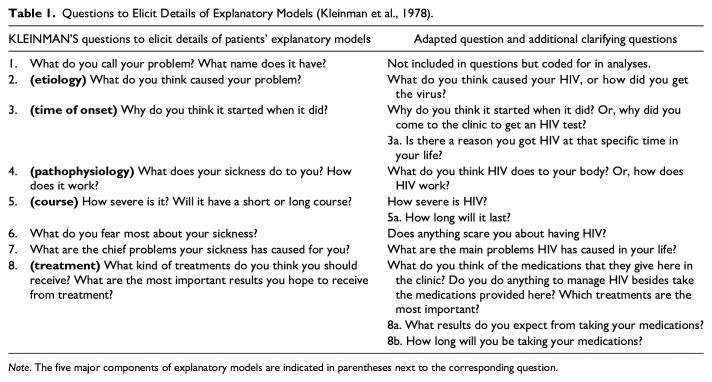
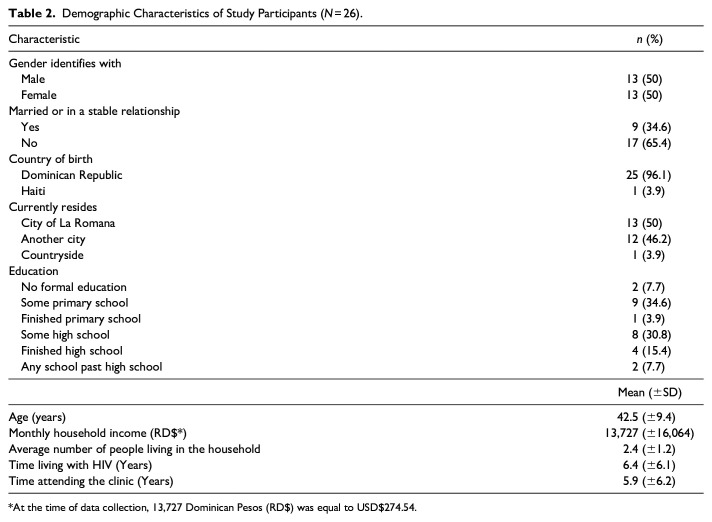
Explanatory models describe individuals' perceptions of their illness experiences, which can guide culturally relevant care. We constructed an explanatory model of the experience of living with human immunodeficiency virus (HIV) in the Dominican Republic. Following qualitative descriptive methodology, we conducted interviews in Spanish using a semi-structured interview guide developed using Kleinman's explanatory model framework. Two bilingual researchers coded interview transcripts following conventional content analysis. We used deductive codes from Kleinman's framework and inductive codes external to the framework to construct the codebook. We arranged codes by shared meaning into categories and constructed themes that reflected shared findings from inductive categories and deductive codes. Twenty-six persons living with HIV participated. They provided rich descriptions of their experiences represented by four cross-cutting themes, which informed the explanatory model. By incorporating this in-depth understanding of patients' illness experiences into care delivery, nurses can cultivate culturally meaningful and trusting patient-centered partnerships that improve health.
期刊介绍:
ACS Applied Bio Materials is an interdisciplinary journal publishing original research covering all aspects of biomaterials and biointerfaces including and beyond the traditional biosensing, biomedical and therapeutic applications.
The journal is devoted to reports of new and original experimental and theoretical research of an applied nature that integrates knowledge in the areas of materials, engineering, physics, bioscience, and chemistry into important bio applications. The journal is specifically interested in work that addresses the relationship between structure and function and assesses the stability and degradation of materials under relevant environmental and biological conditions.





 京公网安备 11010802042870号
京ICP备2023020795号-1
京公网安备 11010802042870号
京ICP备2023020795号-1

 分享
分享
 求助内容:
求助内容: 应助结果提醒方式:
 扫码关注我们
