{"title":"Efficacy and Safety of Ganduqing Granules in Treating the Common Cold: A Multicenter, Randomized, Double-Blind, Placebo-Controlled Trial.","authors":"Yilan Wang, Piao Zhou, Yuxiao Wu, Huaqin Cao, Wenfeng Hao, Fei Wang, Jing Guo","doi":"10.1155/2022/5105503","DOIUrl":null,"url":null,"abstract":"<p><strong>Background: </strong>There is no clear evidence-based medicine that points to the most effective drug treatments for the common cold. In view of its ability to relieve symptoms and shorten the disease course, as well as its minimal side effects, traditional Chinese medicine (TCM) has been widely used to treat the common cold. However, there is a lack of strong evidence to support the clinical efficacy of TCM. This study aimed to evaluate the efficacy and safety of Ganduqing granules in the treatment of the common cold based on the network pharmacology analysis.</p><p><strong>Methods: </strong>In this multicenter, randomized, double-blind, placebo-controlled trial, 60 eligible subjects will be randomly assigned to either the intervention group or the placebo group. The intervention group will be treated with Ganduqing granules, while the placebo group will be treated with placebo. After 5 days of intervention, the efficacy and safety of Ganduqing granules in the treatment of the common cold will be observed. The primary outcome is the time to clearance of all symptoms. The secondary outcomes included the levels of IL-6, TNF-<i>α</i>, SOD, and MDA in the peripheral blood, time to disappearance of primary symptoms and secondary symptoms, clinical symptom remission rate, and change in TCM syndrome score.</p><p><strong>Results: </strong>Sixty participants completed the study. Ganduqing granules showed a greater effect on the time to clearance of all symptoms (<i>P</i> < 0.0001), nasal discharge (<i>P</i>=0.0124), fatigue and lack of strength (<i>P</i>=0.0138), dryness of the pharynx (<i>P</i> < 0.0001), pharyngalgia or dysphagia (<i>P</i> < 0.0001), and expectoration (<i>P</i> < 0.0431) compared with the placebo group. Participants in the intervention group had a greater decrease of IL-6 levels compared with the placebo group (<i>P</i> < 0.007); similar results were observed for the SOD (<i>P</i> < 0.033). However, the change in TNF-<i>α</i> and MDA levels in the intervention group was not significantly different from the placebo group. In addition, participants in the intervention group had a greater decrease of TCM syndrome score compared with the placebo group (<i>P</i> < 0.040).</p><p><strong>Conclusion: </strong>Ganduqing granules could improve common cold symptoms, shorten the disease course, attenuated inflammation and oxidative stress, and provided objective evidence for the efficacy and safety of a Chinese herbal medicine in treating the common cold.</p>","PeriodicalId":12236,"journal":{"name":"Evidence-based Complementary and Alternative Medicine","volume":" ","pages":"5105503"},"PeriodicalIF":0.0000,"publicationDate":"2022-06-09","publicationTypes":"Journal Article","fieldsOfStudy":null,"isOpenAccess":false,"openAccessPdf":"https://www.ncbi.nlm.nih.gov/pmc/articles/PMC9203204/pdf/","citationCount":"0","resultStr":null,"platform":"Semanticscholar","paperid":null,"PeriodicalName":"Evidence-based Complementary and Alternative Medicine","FirstCategoryId":"3","ListUrlMain":"https://doi.org/10.1155/2022/5105503","RegionNum":4,"RegionCategory":"医学","ArticlePicture":[],"TitleCN":null,"AbstractTextCN":null,"PMCID":null,"EPubDate":"2022/1/1 0:00:00","PubModel":"eCollection","JCR":"Q2","JCRName":"Medicine","Score":null,"Total":0}
引用次数: 0
Abstract
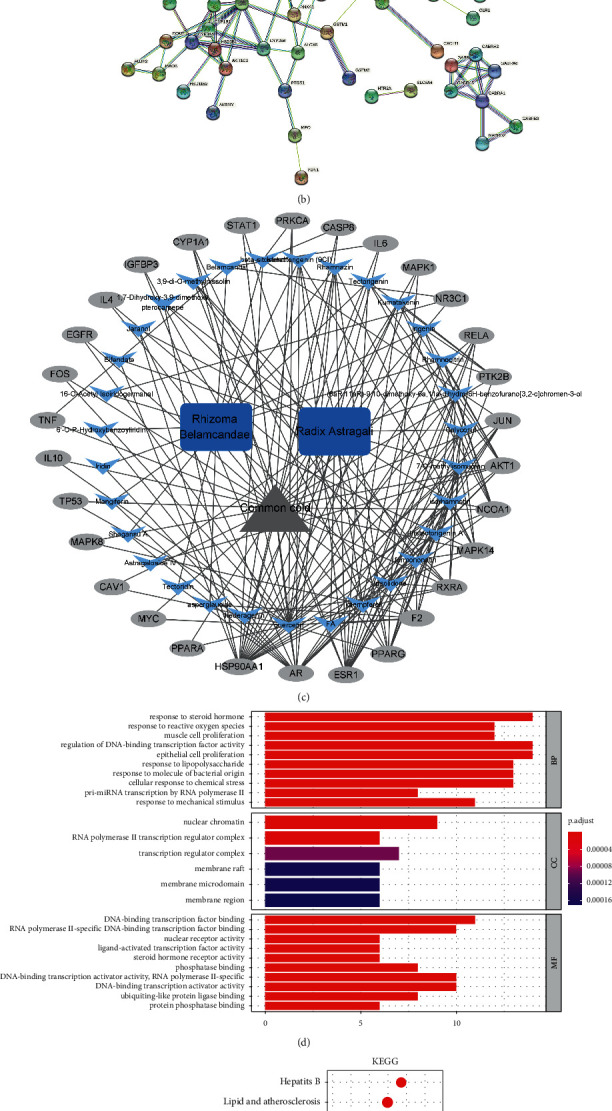
Background: There is no clear evidence-based medicine that points to the most effective drug treatments for the common cold. In view of its ability to relieve symptoms and shorten the disease course, as well as its minimal side effects, traditional Chinese medicine (TCM) has been widely used to treat the common cold. However, there is a lack of strong evidence to support the clinical efficacy of TCM. This study aimed to evaluate the efficacy and safety of Ganduqing granules in the treatment of the common cold based on the network pharmacology analysis.
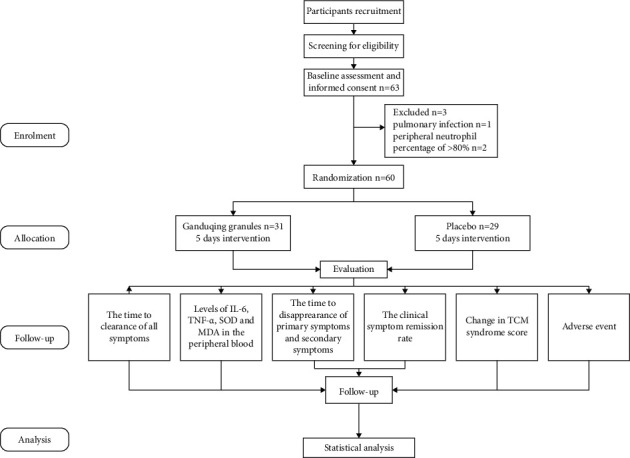
Methods: In this multicenter, randomized, double-blind, placebo-controlled trial, 60 eligible subjects will be randomly assigned to either the intervention group or the placebo group. The intervention group will be treated with Ganduqing granules, while the placebo group will be treated with placebo. After 5 days of intervention, the efficacy and safety of Ganduqing granules in the treatment of the common cold will be observed. The primary outcome is the time to clearance of all symptoms. The secondary outcomes included the levels of IL-6, TNF-α, SOD, and MDA in the peripheral blood, time to disappearance of primary symptoms and secondary symptoms, clinical symptom remission rate, and change in TCM syndrome score.
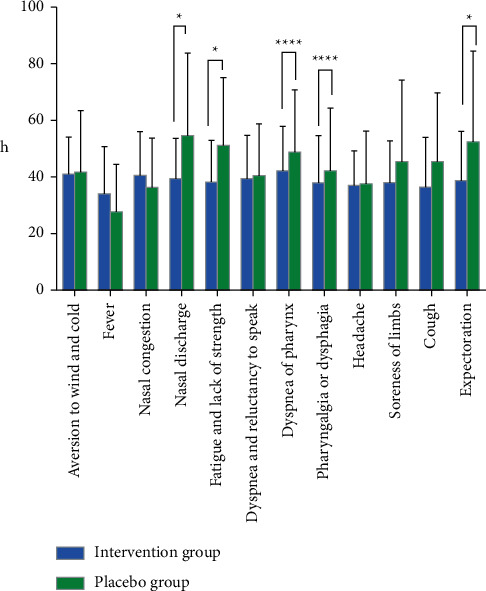
Results: Sixty participants completed the study. Ganduqing granules showed a greater effect on the time to clearance of all symptoms (P < 0.0001), nasal discharge (P=0.0124), fatigue and lack of strength (P=0.0138), dryness of the pharynx (P < 0.0001), pharyngalgia or dysphagia (P < 0.0001), and expectoration (P < 0.0431) compared with the placebo group. Participants in the intervention group had a greater decrease of IL-6 levels compared with the placebo group (P < 0.007); similar results were observed for the SOD (P < 0.033). However, the change in TNF-α and MDA levels in the intervention group was not significantly different from the placebo group. In addition, participants in the intervention group had a greater decrease of TCM syndrome score compared with the placebo group (P < 0.040).
Conclusion: Ganduqing granules could improve common cold symptoms, shorten the disease course, attenuated inflammation and oxidative stress, and provided objective evidence for the efficacy and safety of a Chinese herbal medicine in treating the common cold.
期刊介绍:
Evidence-Based Complementary and Alternative Medicine (eCAM) is an international, peer-reviewed journal that seeks to understand the sources and to encourage rigorous research in this new, yet ancient world of complementary and alternative medicine.
The journal seeks to apply scientific rigor to the study of complementary and alternative medicine (CAM) modalities, particularly traditional Asian healing systems. eCAM emphasizes health outcome, while documenting biological mechanisms of action. The journal is devoted to the advancement of science in the field of basic research, clinical studies, methodology or scientific theory in diverse areas of Biomedical Sciences. The journal does not consider articles on homeopathy.



 京公网安备 11010802042870号
京ICP备2023020795号-1
京公网安备 11010802042870号
京ICP备2023020795号-1

 分享
分享
 求助内容:
求助内容: 应助结果提醒方式:
 扫码关注我们
