{"title":"Genome-wide identification and expression analysis of the NAC transcription factor family in <i>Saccharum spontaneum</i> under different stresses.","authors":"Qingqing Shen, Zhenfeng Qian, Tianju Wang, Xueting Zhao, Shujie Gu, Xibing Rao, Shaozhi Lyu, Rongqiong Zhang, Lilian He, Fusheng Li","doi":"10.1080/15592324.2022.2088665","DOIUrl":null,"url":null,"abstract":"<p><p>The <i>NAC</i> (<i>NAM, ATAF1/2</i>, and <i>CUC2</i>) transcription factor family is one of the largest families unique to plants and is involved in plant growth and development, organs, morphogenesis, and stress responses. The <i>NAC</i> family has been identified in many plants. As the main source of resistance genes for sugarcane breeding, the <i>NAC</i> gene family in the wild species <i>Saccharum spontaneum</i> has not been systematically studied. In this study, 115 <i>SsNAC</i> genes were identified in the <i>S. spontaneum</i> genome, and these genes were heterogeneously distributed on 25 chromosomes. Phylogenetic analysis divided the <i>SsNAC</i> family members into 18 subgroups, and the gene structure and conserved motif analysis further supported the phylogenetic classification. Four groups of tandemly duplicated genes and nine pairs of segmentally duplicated genes were detected. The <i>SsNAC</i> gene has different expression patterns at different developmental stages of stems and leaves. Further qRT-PCR analysis showed that drought, low-temperature, salinity, pathogenic fungi, and other stresses as well as abscisic acid (ABA) and methyl jasmonate (MeJA) treatments significantly induced the expression of 12 <i>SsNAC</i> genes, indicating that these genes may play a key role in the resistance of <i>S. spontaneum</i> to biotic and abiotic stresses. In summary, the results from this study provide comprehensive information on the <i>NAC</i> transcription factor family, providing a reference for further functional studies of the <i>SsNAC</i> gene.</p>","PeriodicalId":2,"journal":{"name":"ACS Applied Bio Materials","volume":" ","pages":"2088665"},"PeriodicalIF":4.7000,"publicationDate":"2022-12-31","publicationTypes":"Journal Article","fieldsOfStudy":null,"isOpenAccess":false,"openAccessPdf":"https://www.ncbi.nlm.nih.gov/pmc/articles/PMC9225438/pdf/","citationCount":"0","resultStr":null,"platform":"Semanticscholar","paperid":null,"PeriodicalName":"ACS Applied Bio Materials","FirstCategoryId":"99","ListUrlMain":"https://doi.org/10.1080/15592324.2022.2088665","RegionNum":0,"RegionCategory":null,"ArticlePicture":[],"TitleCN":null,"AbstractTextCN":null,"PMCID":null,"EPubDate":"","PubModel":"","JCR":"Q2","JCRName":"MATERIALS SCIENCE, BIOMATERIALS","Score":null,"Total":0}
引用次数: 0
Abstract
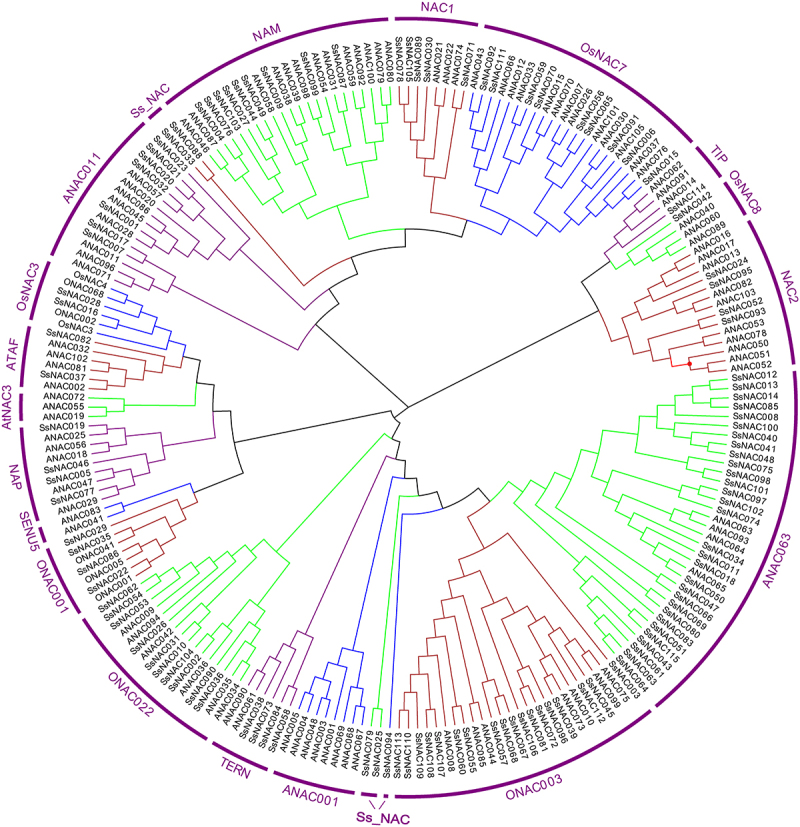
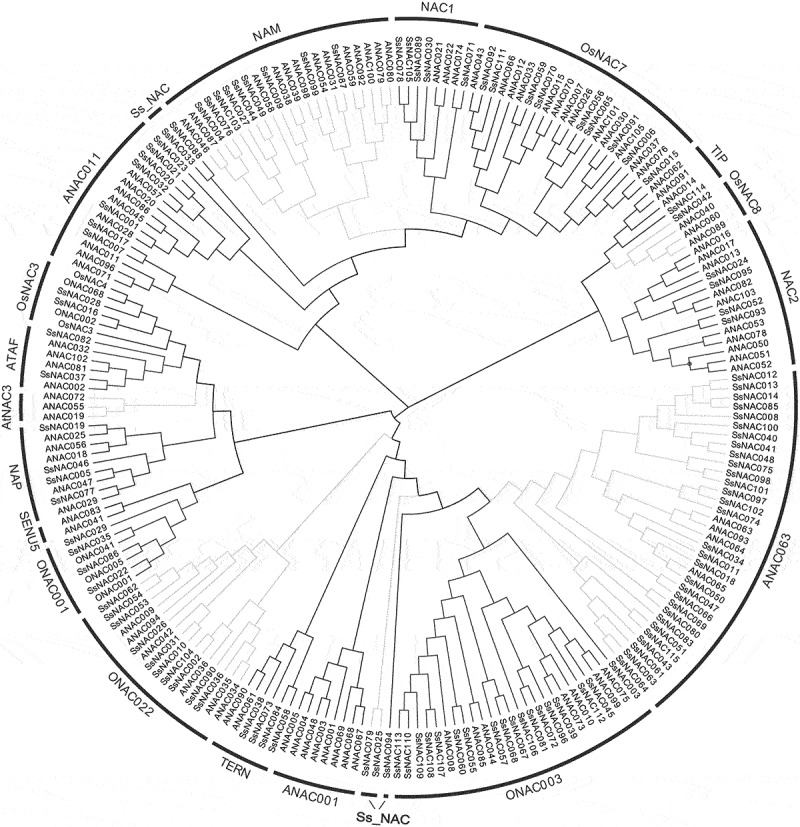
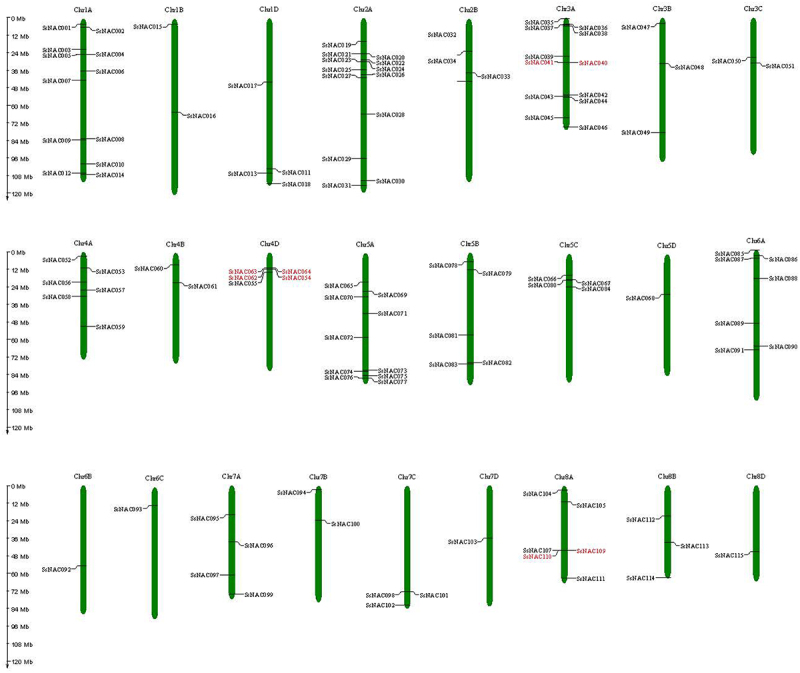
The NAC (NAM, ATAF1/2, and CUC2) transcription factor family is one of the largest families unique to plants and is involved in plant growth and development, organs, morphogenesis, and stress responses. The NAC family has been identified in many plants. As the main source of resistance genes for sugarcane breeding, the NAC gene family in the wild species Saccharum spontaneum has not been systematically studied. In this study, 115 SsNAC genes were identified in the S. spontaneum genome, and these genes were heterogeneously distributed on 25 chromosomes. Phylogenetic analysis divided the SsNAC family members into 18 subgroups, and the gene structure and conserved motif analysis further supported the phylogenetic classification. Four groups of tandemly duplicated genes and nine pairs of segmentally duplicated genes were detected. The SsNAC gene has different expression patterns at different developmental stages of stems and leaves. Further qRT-PCR analysis showed that drought, low-temperature, salinity, pathogenic fungi, and other stresses as well as abscisic acid (ABA) and methyl jasmonate (MeJA) treatments significantly induced the expression of 12 SsNAC genes, indicating that these genes may play a key role in the resistance of S. spontaneum to biotic and abiotic stresses. In summary, the results from this study provide comprehensive information on the NAC transcription factor family, providing a reference for further functional studies of the SsNAC gene.
期刊介绍:
ACS Applied Bio Materials is an interdisciplinary journal publishing original research covering all aspects of biomaterials and biointerfaces including and beyond the traditional biosensing, biomedical and therapeutic applications.
The journal is devoted to reports of new and original experimental and theoretical research of an applied nature that integrates knowledge in the areas of materials, engineering, physics, bioscience, and chemistry into important bio applications. The journal is specifically interested in work that addresses the relationship between structure and function and assesses the stability and degradation of materials under relevant environmental and biological conditions.




 京公网安备 11010802042870号
京ICP备2023020795号-1
京公网安备 11010802042870号
京ICP备2023020795号-1

 分享
分享
 求助内容:
求助内容: 应助结果提醒方式:
 扫码关注我们
