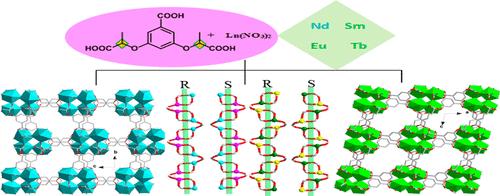
{"title":"Syntheses and Structures of Four Pairs of Coordination Polymers Based on 2,2′-((5-(Methoxycarbonyl)-1,3-phenylene)bis(oxy))dipropanoic Acid","authors":"Tao Liu, Ying-Hui Yu, Han-Zhong Zhang, Wen-Hong Jiang, Jin-Sheng Gao*, Guang-Feng Hou*","doi":"10.1021/acs.cgd.6b01763","DOIUrl":null,"url":null,"abstract":"<p >Hydrothermal reactions of rare earth (Nd, Sm, Eu, and Tb) and <span>l</span>- or <span>d</span>-lactic acid are used to construct four pairs of homochiral metal–organic frameworks (HMOFs) with polymetallic building blocks, namely, {[Nd<sub>2</sub>(L)<sub>2</sub>(H<sub>2</sub>O)<sub>3</sub>]·4H<sub>2</sub>O}<sub><i>n</i></sub> (<b>1-r</b>)/(<b>1-s</b>) and {[Ln<sub>2</sub>(L)<sub>2</sub>(H<sub>2</sub>O)<sub>2</sub>]·4H<sub>2</sub>O}<sub><i>n</i></sub> {Ln = Sm (<b>2</b>), Eu (<b>3</b>), Tb (<b>4</b>)} (<b><i>n</i>-r</b>)/(<b><i>n</i>-s</b>). The eight complexes were characterized by single-crystal X-ray diffraction, infrared spectra, elemental analysis, thermogravimetric analysis, electronic circular dichroism (ECD) spectra, and powder X-ray diffraction measurements. The complexes <b>1</b>–<b>4</b> featuring a 3D porous metal–organic framework crystallize in chiral space groups, and their chirality is proven by the solid-state ECD spectra. Moreover, the second-harmonic generation (SHG) investigation reveals that the complexes <b>1-r</b>, <b>2-r, 3-r</b>, and <b>4-r</b> have medium SHG eficiencies. The complexes <b>2</b>, <b>3</b>, and <b>4</b> exhibit relatively high luminescence properties, which could be ascribed to ligand-centered emission. The luminescence of complex <b>4-r</b> could be quenched by nitrobenzaldehyde, which may be used for molecular sensing and recognition.</p>","PeriodicalId":34,"journal":{"name":"Crystal Growth & Design","volume":"17 4","pages":"1788–1795"},"PeriodicalIF":3.4000,"publicationDate":"2017-02-10","publicationTypes":"Journal Article","fieldsOfStudy":null,"isOpenAccess":false,"openAccessPdf":"https://sci-hub-pdf.com/10.1021/acs.cgd.6b01763","citationCount":"25","resultStr":null,"platform":"Semanticscholar","paperid":null,"PeriodicalName":"Crystal Growth & Design","FirstCategoryId":"92","ListUrlMain":"https://pubs.acs.org/doi/10.1021/acs.cgd.6b01763","RegionNum":2,"RegionCategory":"化学","ArticlePicture":[],"TitleCN":null,"AbstractTextCN":null,"PMCID":null,"EPubDate":"","PubModel":"","JCR":"Q2","JCRName":"CHEMISTRY, MULTIDISCIPLINARY","Score":null,"Total":0}
引用次数: 25
Abstract
Hydrothermal reactions of rare earth (Nd, Sm, Eu, and Tb) and l- or d-lactic acid are used to construct four pairs of homochiral metal–organic frameworks (HMOFs) with polymetallic building blocks, namely, {[Nd2(L)2(H2O)3]·4H2O}n (1-r)/(1-s) and {[Ln2(L)2(H2O)2]·4H2O}n {Ln = Sm (2), Eu (3), Tb (4)} (n-r)/(n-s). The eight complexes were characterized by single-crystal X-ray diffraction, infrared spectra, elemental analysis, thermogravimetric analysis, electronic circular dichroism (ECD) spectra, and powder X-ray diffraction measurements. The complexes 1–4 featuring a 3D porous metal–organic framework crystallize in chiral space groups, and their chirality is proven by the solid-state ECD spectra. Moreover, the second-harmonic generation (SHG) investigation reveals that the complexes 1-r, 2-r, 3-r, and 4-r have medium SHG eficiencies. The complexes 2, 3, and 4 exhibit relatively high luminescence properties, which could be ascribed to ligand-centered emission. The luminescence of complex 4-r could be quenched by nitrobenzaldehyde, which may be used for molecular sensing and recognition.
期刊介绍:
The aim of Crystal Growth & Design is to stimulate crossfertilization of knowledge among scientists and engineers working in the fields of crystal growth, crystal engineering, and the industrial application of crystalline materials.
Crystal Growth & Design publishes theoretical and experimental studies of the physical, chemical, and biological phenomena and processes related to the design, growth, and application of crystalline materials. Synergistic approaches originating from different disciplines and technologies and integrating the fields of crystal growth, crystal engineering, intermolecular interactions, and industrial application are encouraged.



 京公网安备 11010802042870号
京ICP备2023020795号-1
京公网安备 11010802042870号
京ICP备2023020795号-1

 分享
分享
 求助内容:
求助内容: 应助结果提醒方式:
 扫码关注我们
