Life-threatening subclavian artery bleeding following percutaneous coronary intervention with stent implantation: A case report and review of literature.
{"title":"Life-threatening subclavian artery bleeding following percutaneous coronary intervention with stent implantation: A case report and review of literature.","authors":"Fei Shi, Ying Zhang, Li-Xian Sun, Sen Long","doi":"10.12998/wjcc.v10.i6.1937","DOIUrl":null,"url":null,"abstract":"<p><strong>Background: </strong>Vascular complications of transradial percutaneous coronary intervention (PCI) are rare and usually occur at the access site below the elbow. Life-threatening vascular complications during transradial PCI therapy, such as vessel perforation and dissection in the brachiocephalic, subclavian, internal mammary, and thyrocervical arteries, are rarely reported. Subclavian artery bleeding is a potentially serious complication of vascular interventional procedures leading to tracheal obstruction, hemothorax, respiratory failure, hemorrhagic shock, and death if not diagnosed early and treated promptly.</p><p><strong>Case summary: </strong>A male patient with typical angina pectoris underwent coronary angiography and stent implantation. During the procedure, the patient felt pharyngeal pain and tightness, which we mistook for myocardial ischemia. After PCI, swelling in the right neck and supraclavicular area was observed. The patient experienced dyspnea, emergency endotracheal intubation was performed, and then a sudden drop in blood pressure was observed. Ultrasound and contrast-enhanced computed tomography scans demonstrated a cervical hematoma severely compressing the trachea due to subclavian artery bleeding. Brachiocephalic angiography revealed a vascular injury site at the root of the right subclavian artery at the intersection of the right common carotid artery. A covered stent was deployed to the right subclavian artery with successful sealing of the perforation, and a bare stent was implanted in the junction of the right common carotid and brachiocephalic arteries to prevent obstruction of blood flow to the brain.</p><p><strong>Conclusion: </strong>Subclavian artery bleeding is a lifethreatening complication of PCI. Early prevention, rapid recognition, and prompt treatment may improve the prognosis.</p>","PeriodicalId":23912,"journal":{"name":"World Journal of Clinical Cases","volume":" ","pages":"1937-1945"},"PeriodicalIF":1.0000,"publicationDate":"2022-02-26","publicationTypes":"Journal Article","fieldsOfStudy":null,"isOpenAccess":false,"openAccessPdf":"https://ftp.ncbi.nlm.nih.gov/pub/pmc/oa_pdf/94/ce/WJCC-10-1937.PMC8891778.pdf","citationCount":"1","resultStr":null,"platform":"Semanticscholar","paperid":null,"PeriodicalName":"World Journal of Clinical Cases","FirstCategoryId":"3","ListUrlMain":"https://doi.org/10.12998/wjcc.v10.i6.1937","RegionNum":4,"RegionCategory":"医学","ArticlePicture":[],"TitleCN":null,"AbstractTextCN":null,"PMCID":null,"EPubDate":"","PubModel":"","JCR":"Q3","JCRName":"MEDICINE, GENERAL & INTERNAL","Score":null,"Total":0}
引用次数: 1
Abstract
Background: Vascular complications of transradial percutaneous coronary intervention (PCI) are rare and usually occur at the access site below the elbow. Life-threatening vascular complications during transradial PCI therapy, such as vessel perforation and dissection in the brachiocephalic, subclavian, internal mammary, and thyrocervical arteries, are rarely reported. Subclavian artery bleeding is a potentially serious complication of vascular interventional procedures leading to tracheal obstruction, hemothorax, respiratory failure, hemorrhagic shock, and death if not diagnosed early and treated promptly.
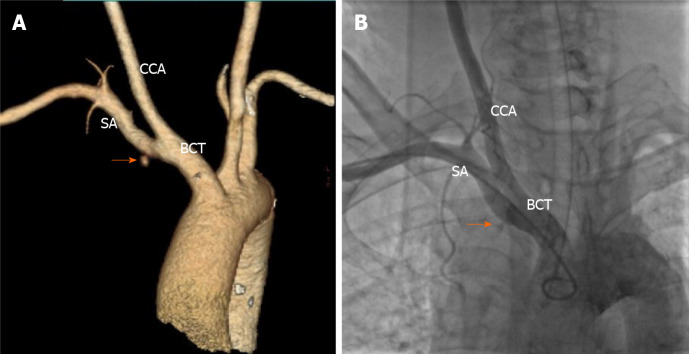
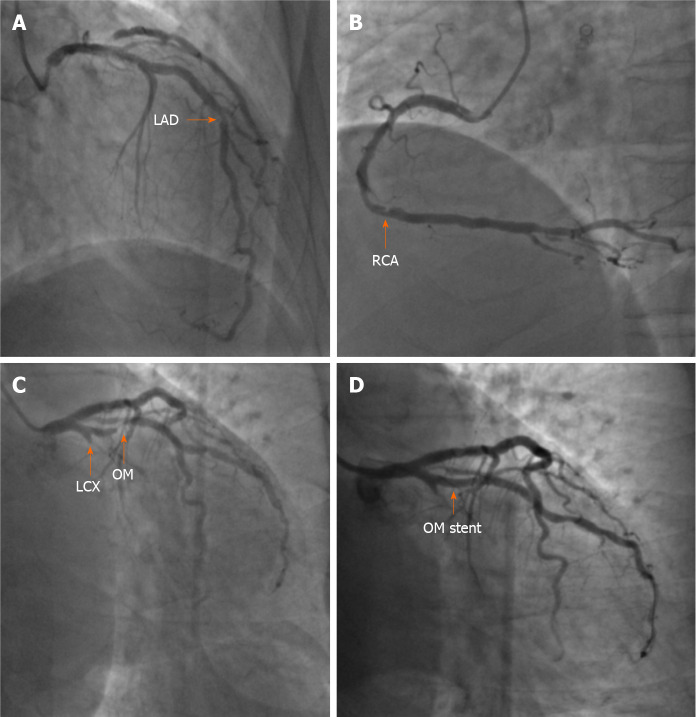
Case summary: A male patient with typical angina pectoris underwent coronary angiography and stent implantation. During the procedure, the patient felt pharyngeal pain and tightness, which we mistook for myocardial ischemia. After PCI, swelling in the right neck and supraclavicular area was observed. The patient experienced dyspnea, emergency endotracheal intubation was performed, and then a sudden drop in blood pressure was observed. Ultrasound and contrast-enhanced computed tomography scans demonstrated a cervical hematoma severely compressing the trachea due to subclavian artery bleeding. Brachiocephalic angiography revealed a vascular injury site at the root of the right subclavian artery at the intersection of the right common carotid artery. A covered stent was deployed to the right subclavian artery with successful sealing of the perforation, and a bare stent was implanted in the junction of the right common carotid and brachiocephalic arteries to prevent obstruction of blood flow to the brain.
Conclusion: Subclavian artery bleeding is a lifethreatening complication of PCI. Early prevention, rapid recognition, and prompt treatment may improve the prognosis.
期刊介绍:
The World Journal of Clinical Cases (WJCC) is a high-quality, peer reviewed, open-access journal. The primary task of WJCC is to rapidly publish high-quality original articles, reviews, editorials, and case reports in the field of clinical cases. In order to promote productive academic communication, the peer review process for the WJCC is transparent; to this end, all published manuscripts are accompanied by the anonymized reviewers’ comments as well as the authors’ responses. The primary aims of the WJCC are to improve diagnostic, therapeutic and preventive modalities and the skills of clinicians and to guide clinical practice in clinical cases.




 京公网安备 11010802042870号
京ICP备2023020795号-1
京公网安备 11010802042870号
京ICP备2023020795号-1

 分享
分享
 求助内容:
求助内容: 应助结果提醒方式:
 扫码关注我们
