Alberto Pérez-Cervera, Benjamin Lindner, Peter J Thomas
{"title":"Quantitative comparison of the mean-return-time phase and the stochastic asymptotic phase for noisy oscillators.","authors":"Alberto Pérez-Cervera, Benjamin Lindner, Peter J Thomas","doi":"10.1007/s00422-022-00929-6","DOIUrl":null,"url":null,"abstract":"<p><p>Seminal work by A. Winfree and J. Guckenheimer showed that a deterministic phase variable can be defined either in terms of Poincaré sections or in terms of the asymptotic (long-time) behaviour of trajectories approaching a stable limit cycle. However, this equivalence between the deterministic notions of phase is broken in the presence of noise. Different notions of phase reduction for a stochastic oscillator can be defined either in terms of mean-return-time sections or as the argument of the slowest decaying complex eigenfunction of the Kolmogorov backwards operator. Although both notions of phase enjoy a solid theoretical foundation, their relationship remains unexplored. Here, we quantitatively compare both notions of stochastic phase. We derive an expression relating both notions of phase and use it to discuss differences (and similarities) between both definitions of stochastic phase for (i) a spiral sink motivated by stochastic models for electroencephalograms, (ii) noisy limit-cycle systems-neuroscience models, and (iii) a stochastic heteroclinic oscillator inspired by a simple motor-control system.</p>","PeriodicalId":1,"journal":{"name":"Accounts of Chemical Research","volume":" ","pages":"219-234"},"PeriodicalIF":17.7000,"publicationDate":"2022-04-01","publicationTypes":"Journal Article","fieldsOfStudy":null,"isOpenAccess":false,"openAccessPdf":"https://www.ncbi.nlm.nih.gov/pmc/articles/PMC9068686/pdf/","citationCount":"0","resultStr":null,"platform":"Semanticscholar","paperid":null,"PeriodicalName":"Accounts of Chemical Research","FirstCategoryId":"5","ListUrlMain":"https://doi.org/10.1007/s00422-022-00929-6","RegionNum":1,"RegionCategory":"化学","ArticlePicture":[],"TitleCN":null,"AbstractTextCN":null,"PMCID":null,"EPubDate":"2022/3/23 0:00:00","PubModel":"Epub","JCR":"Q1","JCRName":"CHEMISTRY, MULTIDISCIPLINARY","Score":null,"Total":0}
引用次数: 0
Abstract
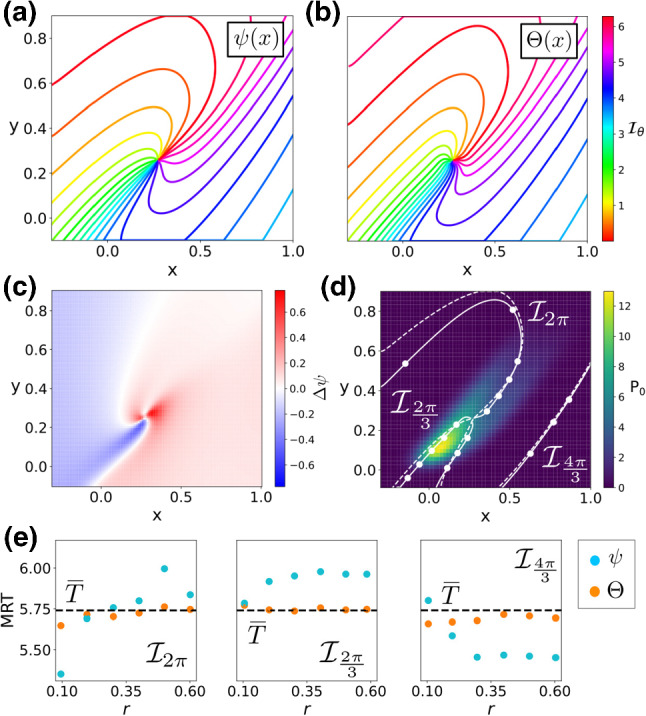
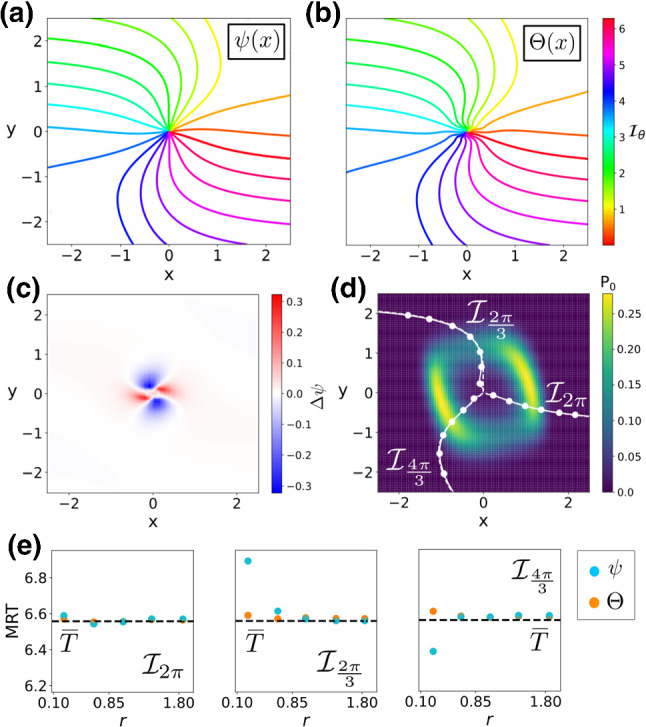
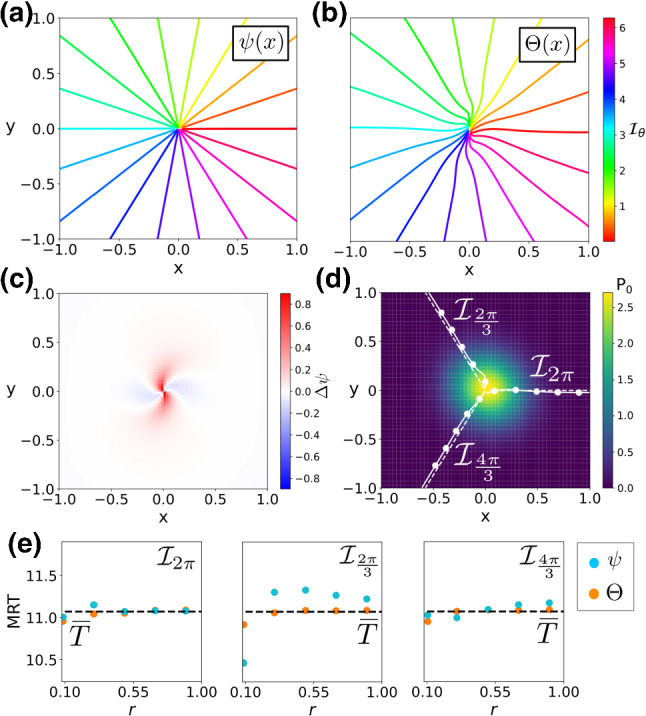
Seminal work by A. Winfree and J. Guckenheimer showed that a deterministic phase variable can be defined either in terms of Poincaré sections or in terms of the asymptotic (long-time) behaviour of trajectories approaching a stable limit cycle. However, this equivalence between the deterministic notions of phase is broken in the presence of noise. Different notions of phase reduction for a stochastic oscillator can be defined either in terms of mean-return-time sections or as the argument of the slowest decaying complex eigenfunction of the Kolmogorov backwards operator. Although both notions of phase enjoy a solid theoretical foundation, their relationship remains unexplored. Here, we quantitatively compare both notions of stochastic phase. We derive an expression relating both notions of phase and use it to discuss differences (and similarities) between both definitions of stochastic phase for (i) a spiral sink motivated by stochastic models for electroencephalograms, (ii) noisy limit-cycle systems-neuroscience models, and (iii) a stochastic heteroclinic oscillator inspired by a simple motor-control system.
期刊介绍:
Accounts of Chemical Research presents short, concise and critical articles offering easy-to-read overviews of basic research and applications in all areas of chemistry and biochemistry. These short reviews focus on research from the author’s own laboratory and are designed to teach the reader about a research project. In addition, Accounts of Chemical Research publishes commentaries that give an informed opinion on a current research problem. Special Issues online are devoted to a single topic of unusual activity and significance.
Accounts of Chemical Research replaces the traditional article abstract with an article "Conspectus." These entries synopsize the research affording the reader a closer look at the content and significance of an article. Through this provision of a more detailed description of the article contents, the Conspectus enhances the article's discoverability by search engines and the exposure for the research.




 京公网安备 11010802042870号
京ICP备2023020795号-1
京公网安备 11010802042870号
京ICP备2023020795号-1

 分享
分享
 求助内容:
求助内容: 应助结果提醒方式:
 扫码关注我们
