Yu Ma, Lei Zha, Qi Zhang, Lu Cao, Ru Zhao, Jing Ma, Kai Hou, Yue Pan, Hongliang Cong, Ximing Li
{"title":"Effect of PCSK9 Inhibitor on Contrast-Induced Acute Kidney Injury in Patients with Acute Myocardial Infarction Undergoing Intervention Therapy.","authors":"Yu Ma, Lei Zha, Qi Zhang, Lu Cao, Ru Zhao, Jing Ma, Kai Hou, Yue Pan, Hongliang Cong, Ximing Li","doi":"10.1155/2022/1638209","DOIUrl":null,"url":null,"abstract":"<p><p>Proprotein convertase subtilisin/kexin type 9 (PCSK9) inhibitors have been shown to inhibit pyroptosis and apoptosis, which play important roles in the development and progression of contrast-induced acute kidney injury (CI-AKI). However, to the best of our knowledge, no studies have investigated the potential effect of PCSK9 inhibitors on the prevalence of CI-AKI after percutaneous coronary intervention (PCI). This study aimed to determine whether PCSK9 inhibitors are associated with the prevalence of CI-AKI. The medical records of 309 (mean age, 63.35 years; 71.84% male) patients with acute myocardial infarction who underwent PCI at our institution were retrospectively analyzed. Overall, 149 and 160 patients were assigned to the evolocumab and control groups, respectively. Serum creatinine levels were examined preoperatively and 24-72 h postoperatively and compared between groups. Data were grouped according to the occurrence of CI-AKI, and a univariate analysis was conducted to exclude suspected influencing factors that led to CI-AKI occurrence. After adjusting for confounding factors, a logistic regression analysis was performed to assess the association between evolocumab administration (independent variable) and CI-AKI occurrence (dependent variable). The prevalence of CI-AKI was significantly lower in the evolocumab group (6.7%) than in the control group (20.0%; <i>p</i> < 0.01).We further evaluated the correlation between exposure factor and outcome. The relative risk(RR) between the use of evolocumab and the occurrence of CI-AKI was 0.34(95% CI 0.17-0.66,p<0.01).This result indicate a significant association between the use of evolocumab and a reduction in the incidence of CI-AKI.The logistic regression analysis results revealed that evolocumab was significantly associated with CI-AKI. The use of PCSK9 inhibitors, hydration therapy, and statin administration appears promising for preventing CI-AKI in patients with acute myocardial infarction undergoing PCI.</p>","PeriodicalId":1,"journal":{"name":"Accounts of Chemical Research","volume":" ","pages":"1638209"},"PeriodicalIF":17.7000,"publicationDate":"2022-08-23","publicationTypes":"Journal Article","fieldsOfStudy":null,"isOpenAccess":false,"openAccessPdf":"https://www.ncbi.nlm.nih.gov/pmc/articles/PMC9427281/pdf/","citationCount":"0","resultStr":null,"platform":"Semanticscholar","paperid":null,"PeriodicalName":"Accounts of Chemical Research","FirstCategoryId":"3","ListUrlMain":"https://doi.org/10.1155/2022/1638209","RegionNum":1,"RegionCategory":"化学","ArticlePicture":[],"TitleCN":null,"AbstractTextCN":null,"PMCID":null,"EPubDate":"2022/1/1 0:00:00","PubModel":"eCollection","JCR":"Q1","JCRName":"CHEMISTRY, MULTIDISCIPLINARY","Score":null,"Total":0}
引用次数: 0
Abstract
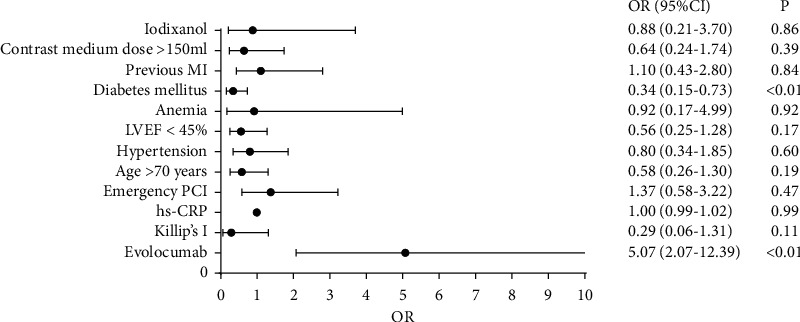
Proprotein convertase subtilisin/kexin type 9 (PCSK9) inhibitors have been shown to inhibit pyroptosis and apoptosis, which play important roles in the development and progression of contrast-induced acute kidney injury (CI-AKI). However, to the best of our knowledge, no studies have investigated the potential effect of PCSK9 inhibitors on the prevalence of CI-AKI after percutaneous coronary intervention (PCI). This study aimed to determine whether PCSK9 inhibitors are associated with the prevalence of CI-AKI. The medical records of 309 (mean age, 63.35 years; 71.84% male) patients with acute myocardial infarction who underwent PCI at our institution were retrospectively analyzed. Overall, 149 and 160 patients were assigned to the evolocumab and control groups, respectively. Serum creatinine levels were examined preoperatively and 24-72 h postoperatively and compared between groups. Data were grouped according to the occurrence of CI-AKI, and a univariate analysis was conducted to exclude suspected influencing factors that led to CI-AKI occurrence. After adjusting for confounding factors, a logistic regression analysis was performed to assess the association between evolocumab administration (independent variable) and CI-AKI occurrence (dependent variable). The prevalence of CI-AKI was significantly lower in the evolocumab group (6.7%) than in the control group (20.0%; p < 0.01).We further evaluated the correlation between exposure factor and outcome. The relative risk(RR) between the use of evolocumab and the occurrence of CI-AKI was 0.34(95% CI 0.17-0.66,p<0.01).This result indicate a significant association between the use of evolocumab and a reduction in the incidence of CI-AKI.The logistic regression analysis results revealed that evolocumab was significantly associated with CI-AKI. The use of PCSK9 inhibitors, hydration therapy, and statin administration appears promising for preventing CI-AKI in patients with acute myocardial infarction undergoing PCI.
期刊介绍:
Accounts of Chemical Research presents short, concise and critical articles offering easy-to-read overviews of basic research and applications in all areas of chemistry and biochemistry. These short reviews focus on research from the author’s own laboratory and are designed to teach the reader about a research project. In addition, Accounts of Chemical Research publishes commentaries that give an informed opinion on a current research problem. Special Issues online are devoted to a single topic of unusual activity and significance.
Accounts of Chemical Research replaces the traditional article abstract with an article "Conspectus." These entries synopsize the research affording the reader a closer look at the content and significance of an article. Through this provision of a more detailed description of the article contents, the Conspectus enhances the article's discoverability by search engines and the exposure for the research.




 京公网安备 11010802042870号
京ICP备2023020795号-1
京公网安备 11010802042870号
京ICP备2023020795号-1

 分享
分享
 求助内容:
求助内容: 应助结果提醒方式:
 扫码关注我们
