Peng Gao, Jiaqi Yin, Mengzhen Wang, Ruyue Wei, Wei Pan*, Na Li* and Bo Tang*,
{"title":"COF-DNA Bicolor Nanoprobes for Imaging Tumor-Associated mRNAs in Living Cells","authors":"Peng Gao, Jiaqi Yin, Mengzhen Wang, Ruyue Wei, Wei Pan*, Na Li* and Bo Tang*, ","doi":"10.1021/acs.analchem.2c03658","DOIUrl":null,"url":null,"abstract":"<p >Developing probes for the simultaneous detection of multiple tumor-associated mRNAs is beneficial for the precise diagnosis and early therapy of cancer. In this work, we prepared two COF-DNA bicolor probes at room temperature and freezing conditions and evaluated their performances in simultaneous imaging of intracellular tumor-associated mRNAs. By loading dye-labeled survivin- and TK1-mRNA recognition sequences on porphyrin COF NPs, nucleic acid-specific “off–on” nanoprobes were obtained. The nanoprobe prepared by the freezing method exhibits higher ssDNA loading density and better fluorescence quenching efficiency. Moreover, its signal-to-noise ratio is significantly higher than that prepared at room temperature, and the target recognition effect was unaffected. Significantly, the freezing-method-prepared nanoprobe has higher signal intensities in target-overexpressed cells compared to the room-temperature-prepared probe, while their signals in cells with low target expression are similar. Thus, the freezing-method-prepared nanoprobe is a promising tool for improved cancer diagnostic imaging. This work can offer new insights into the exploration of high-performance COF-based nanoprobes for multiple biomarker detection.</p>","PeriodicalId":27,"journal":{"name":"Analytical Chemistry","volume":"94 38","pages":"13293–13299"},"PeriodicalIF":6.7000,"publicationDate":"2022-09-15","publicationTypes":"Journal Article","fieldsOfStudy":null,"isOpenAccess":false,"openAccessPdf":"","citationCount":"9","resultStr":null,"platform":"Semanticscholar","paperid":null,"PeriodicalName":"Analytical Chemistry","FirstCategoryId":"92","ListUrlMain":"https://pubs.acs.org/doi/10.1021/acs.analchem.2c03658","RegionNum":1,"RegionCategory":"化学","ArticlePicture":[],"TitleCN":null,"AbstractTextCN":null,"PMCID":null,"EPubDate":"","PubModel":"","JCR":"Q1","JCRName":"CHEMISTRY, ANALYTICAL","Score":null,"Total":0}
引用次数: 9
Abstract
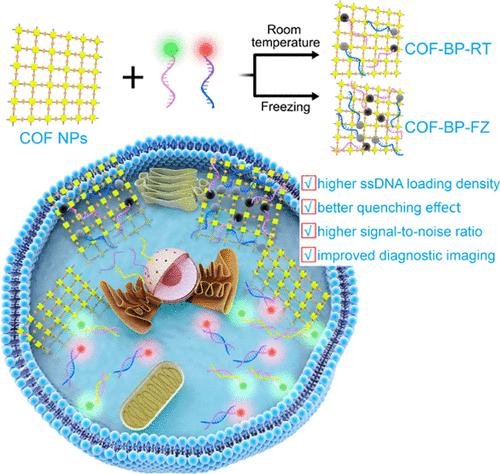
Developing probes for the simultaneous detection of multiple tumor-associated mRNAs is beneficial for the precise diagnosis and early therapy of cancer. In this work, we prepared two COF-DNA bicolor probes at room temperature and freezing conditions and evaluated their performances in simultaneous imaging of intracellular tumor-associated mRNAs. By loading dye-labeled survivin- and TK1-mRNA recognition sequences on porphyrin COF NPs, nucleic acid-specific “off–on” nanoprobes were obtained. The nanoprobe prepared by the freezing method exhibits higher ssDNA loading density and better fluorescence quenching efficiency. Moreover, its signal-to-noise ratio is significantly higher than that prepared at room temperature, and the target recognition effect was unaffected. Significantly, the freezing-method-prepared nanoprobe has higher signal intensities in target-overexpressed cells compared to the room-temperature-prepared probe, while their signals in cells with low target expression are similar. Thus, the freezing-method-prepared nanoprobe is a promising tool for improved cancer diagnostic imaging. This work can offer new insights into the exploration of high-performance COF-based nanoprobes for multiple biomarker detection.
期刊介绍:
Analytical Chemistry, a peer-reviewed research journal, focuses on disseminating new and original knowledge across all branches of analytical chemistry. Fundamental articles may explore general principles of chemical measurement science and need not directly address existing or potential analytical methodology. They can be entirely theoretical or report experimental results. Contributions may cover various phases of analytical operations, including sampling, bioanalysis, electrochemistry, mass spectrometry, microscale and nanoscale systems, environmental analysis, separations, spectroscopy, chemical reactions and selectivity, instrumentation, imaging, surface analysis, and data processing. Papers discussing known analytical methods should present a significant, original application of the method, a notable improvement, or results on an important analyte.



 京公网安备 11010802042870号
京ICP备2023020795号-1
京公网安备 11010802042870号
京ICP备2023020795号-1

 分享
分享
 求助内容:
求助内容: 应助结果提醒方式:
 扫码关注我们
