Jack Kerr, Edward Abraham, Amanda Vandewint, Erin Bigney, Jeffrey Hebert, Eden Richardson, Dana El-Mughayyar, Jill Chorney, Ron El-Hawary, Porsche Study Group, Rory McPhee, Neil Manson
{"title":"Predicting Health-Related Quality of Life Outcomes Following Major Scoliosis Surgery in Adolescents: A Latent Class Growth Analysis.","authors":"Jack Kerr, Edward Abraham, Amanda Vandewint, Erin Bigney, Jeffrey Hebert, Eden Richardson, Dana El-Mughayyar, Jill Chorney, Ron El-Hawary, Porsche Study Group, Rory McPhee, Neil Manson","doi":"10.1177/21925682221126451","DOIUrl":null,"url":null,"abstract":"<p><strong>Study design: </strong>Prospective cohort study.</p><p><strong>Objectives: </strong>To identify patient trajectories of recovery defined by change in health-related quality of life (HRQOL) following surgery for adolescent idiopathic scoliosis (AIS). To explore possible predictors of trajectory membership.</p><p><strong>Methods: </strong>Adolescent patients scheduled to undergo spinal fusion for AIS were enrolled in the <i>Post-Operative Recovery following Spinal Correction: Home Experience (PORSCHE)</i> study. Responses to the Pediatric Quality of Life Inventory-version 4 (PedsQL-4.0) were collected prior to surgery and 4 to 6 weeks, 3, 6, and 12 months post-operatively. Latent class growth analyses identified patient subgroups based on their unique trajectories of physical health (PH) and psychosocial health (PSH) outcomes using the PedsQL-4.0 subscale scores. Predictors included demographic, clinical, and psychosocial factors.</p><p><strong>Results: </strong>Data from up to 190 patients were included (87.4% female; mean±SD age = 14.6 ± 1.9 years). Three trajectory subgroups were identified for PH and 4 trajectories were found for PSH, with a majority of patients scoring within the established range of healthy adolescents 12 months post-surgery. Increased child and parent pain catastrophizing, child trait anxiety and previous hospitalizations were associated with poorer PH outcomes, whereas increased child and parent pain catastrophizing, child state and trait anxiety, and parent state and trait anxiety were associated with poorer PSH trajectories.</p><p><strong>Conclusions: </strong>The PH and PSH trajectories identified in this study and the factors associated with their membership may inform surgical decision-making for AIS while facilitating patient and family counselling regarding peri-operative recovery and expectations.</p>","PeriodicalId":2,"journal":{"name":"ACS Applied Bio Materials","volume":" ","pages":"902-913"},"PeriodicalIF":5.6000,"publicationDate":"2024-04-01","publicationTypes":"Journal Article","fieldsOfStudy":null,"isOpenAccess":false,"openAccessPdf":"https://www.ncbi.nlm.nih.gov/pmc/articles/PMC11192129/pdf/","citationCount":"0","resultStr":null,"platform":"Semanticscholar","paperid":null,"PeriodicalName":"ACS Applied Bio Materials","FirstCategoryId":"3","ListUrlMain":"https://doi.org/10.1177/21925682221126451","RegionNum":0,"RegionCategory":null,"ArticlePicture":[],"TitleCN":null,"AbstractTextCN":null,"PMCID":null,"EPubDate":"2022/9/20 0:00:00","PubModel":"Epub","JCR":"Q2","JCRName":"MATERIALS SCIENCE, BIOMATERIALS","Score":null,"Total":0}
引用次数: 0
Abstract
Study design: Prospective cohort study.
Objectives: To identify patient trajectories of recovery defined by change in health-related quality of life (HRQOL) following surgery for adolescent idiopathic scoliosis (AIS). To explore possible predictors of trajectory membership.
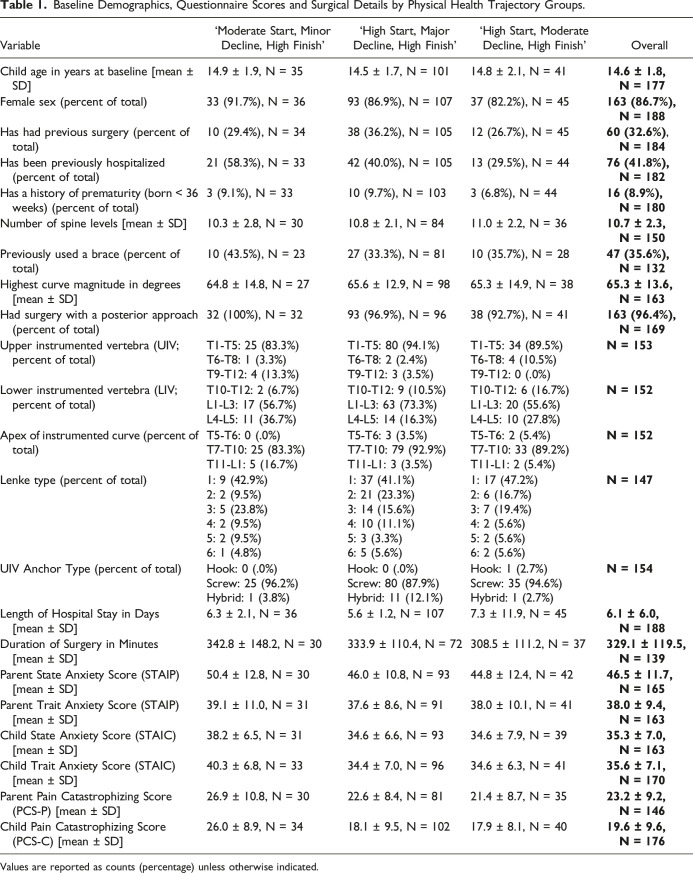
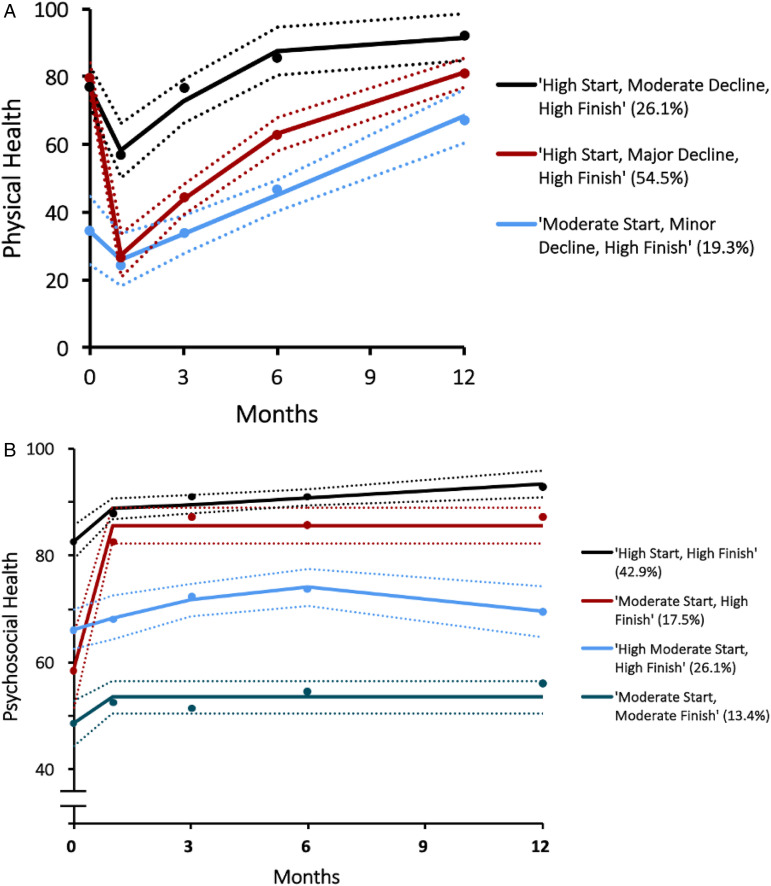
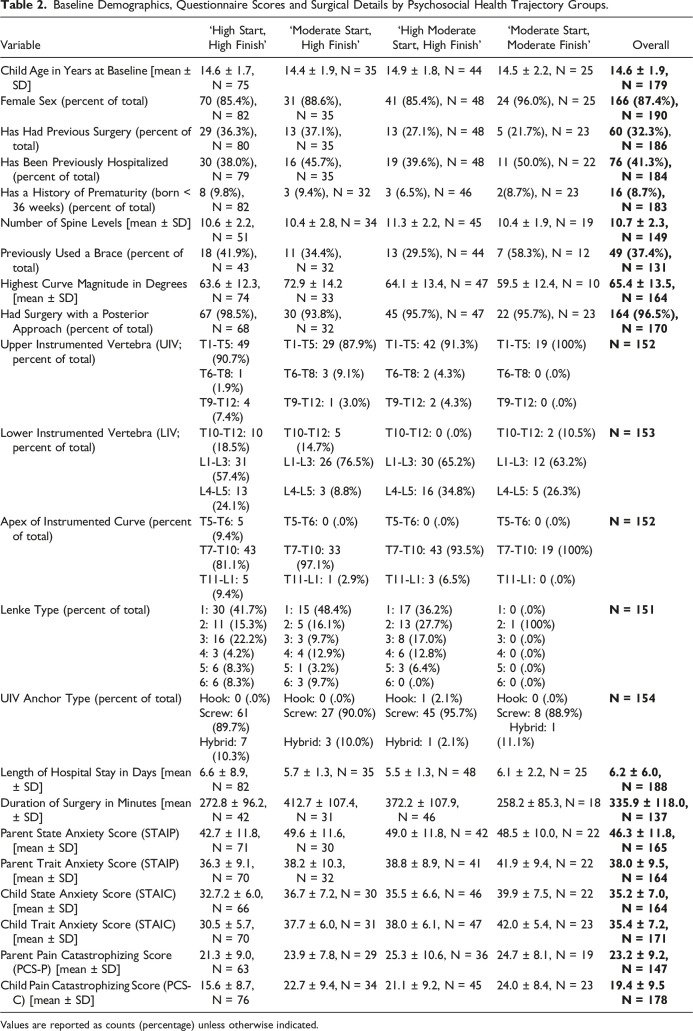
Methods: Adolescent patients scheduled to undergo spinal fusion for AIS were enrolled in the Post-Operative Recovery following Spinal Correction: Home Experience (PORSCHE) study. Responses to the Pediatric Quality of Life Inventory-version 4 (PedsQL-4.0) were collected prior to surgery and 4 to 6 weeks, 3, 6, and 12 months post-operatively. Latent class growth analyses identified patient subgroups based on their unique trajectories of physical health (PH) and psychosocial health (PSH) outcomes using the PedsQL-4.0 subscale scores. Predictors included demographic, clinical, and psychosocial factors.
Results: Data from up to 190 patients were included (87.4% female; mean±SD age = 14.6 ± 1.9 years). Three trajectory subgroups were identified for PH and 4 trajectories were found for PSH, with a majority of patients scoring within the established range of healthy adolescents 12 months post-surgery. Increased child and parent pain catastrophizing, child trait anxiety and previous hospitalizations were associated with poorer PH outcomes, whereas increased child and parent pain catastrophizing, child state and trait anxiety, and parent state and trait anxiety were associated with poorer PSH trajectories.
Conclusions: The PH and PSH trajectories identified in this study and the factors associated with their membership may inform surgical decision-making for AIS while facilitating patient and family counselling regarding peri-operative recovery and expectations.
期刊介绍:
ACS Applied Bio Materials is an interdisciplinary journal publishing original research covering all aspects of biomaterials and biointerfaces including and beyond the traditional biosensing, biomedical and therapeutic applications.
The journal is devoted to reports of new and original experimental and theoretical research of an applied nature that integrates knowledge in the areas of materials, engineering, physics, bioscience, and chemistry into important bio applications. The journal is specifically interested in work that addresses the relationship between structure and function and assesses the stability and degradation of materials under relevant environmental and biological conditions.





 京公网安备 11010802042870号
京ICP备2023020795号-1
京公网安备 11010802042870号
京ICP备2023020795号-1

 分享
分享
 求助内容:
求助内容: 应助结果提醒方式:
 扫码关注我们
