Ai Demura, Yutaka Demura, Kazuaki Sato, Masako Kinoshita
{"title":"Amplitude of Somatosensory Evoked Potentials (SEPs) Recorded in Short-Latency SEP Condition Is 80% of That in Giant SEP Condition.","authors":"Ai Demura, Yutaka Demura, Kazuaki Sato, Masako Kinoshita","doi":"10.1097/WNP.0000000000000966","DOIUrl":null,"url":null,"abstract":"<p><strong>Purpose: </strong>Giant somatosensory evoked potentials (SEPs) with enhanced long-loop reflex (C-reflex) are useful to detect cortical motor hyperexcitability in patients with myoclonic epilepsy. The recording conditions of giant SEPs are different from those of short-latency SEPs (SSEPs). We investigated the waveform characteristics obtained for each condition.</p><p><strong>Methods: </strong>Forty-eight upper limbs of 24 adult normal subjects (12 men, age 35.5 ± 9.7 years [mean ± SD]) were investigated. Somatosensory evoked potentials of each subject were recorded in both conditions on the same day. The main differences in recording conditions were reference electrodes (SSEP: Fz vs. giant SEP: the earlobe electrode ipsilateral to the stimulated limb), stimulus rate (5 vs. 1 Hz), and bandpass filter (20 Hz-3 kHz vs. 1 Hz-1 kHz). Somatosensory evoked potentials were elicited by unilateral percutaneous electrical stimulation of the median nerve at the wrist with intensity of 110% of the movement threshold and recoded at C3'/C4'.</p><p><strong>Results: </strong>The amplitudes of N20 onset-N20 and N20-P25 were significantly larger in giant SEP condition than in SSEP condition ( p < 0.001). The mean + 3SD of N20-P25 amplitude was 10.0 μV in giant SEP condition and 7.8 μV in SSEP condition. The N20-P25 amplitude was significantly correlated between giant SEP condition and SSEP condition ( R = 0.64, p < 0.001). C-reflex was not elicited.</p><p><strong>Conclusions: </strong>The amplitude of SEPs in SSEP condition is equivalent to 80% of that in giant SEP condition. The information is useful for detecting cortical hyperexcitability in various neurological disorders including myoclonic epilepsy.</p>","PeriodicalId":2,"journal":{"name":"ACS Applied Bio Materials","volume":" ","pages":"285-290"},"PeriodicalIF":4.7000,"publicationDate":"2024-03-01","publicationTypes":"Journal Article","fieldsOfStudy":null,"isOpenAccess":false,"openAccessPdf":"https://www.ncbi.nlm.nih.gov/pmc/articles/PMC10898544/pdf/","citationCount":"0","resultStr":null,"platform":"Semanticscholar","paperid":null,"PeriodicalName":"ACS Applied Bio Materials","FirstCategoryId":"3","ListUrlMain":"https://doi.org/10.1097/WNP.0000000000000966","RegionNum":0,"RegionCategory":null,"ArticlePicture":[],"TitleCN":null,"AbstractTextCN":null,"PMCID":null,"EPubDate":"2022/8/26 0:00:00","PubModel":"Epub","JCR":"Q2","JCRName":"MATERIALS SCIENCE, BIOMATERIALS","Score":null,"Total":0}
引用次数: 0
Abstract
Purpose: Giant somatosensory evoked potentials (SEPs) with enhanced long-loop reflex (C-reflex) are useful to detect cortical motor hyperexcitability in patients with myoclonic epilepsy. The recording conditions of giant SEPs are different from those of short-latency SEPs (SSEPs). We investigated the waveform characteristics obtained for each condition.
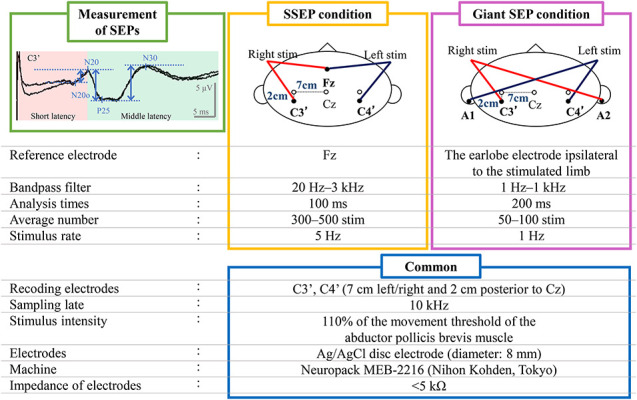
Methods: Forty-eight upper limbs of 24 adult normal subjects (12 men, age 35.5 ± 9.7 years [mean ± SD]) were investigated. Somatosensory evoked potentials of each subject were recorded in both conditions on the same day. The main differences in recording conditions were reference electrodes (SSEP: Fz vs. giant SEP: the earlobe electrode ipsilateral to the stimulated limb), stimulus rate (5 vs. 1 Hz), and bandpass filter (20 Hz-3 kHz vs. 1 Hz-1 kHz). Somatosensory evoked potentials were elicited by unilateral percutaneous electrical stimulation of the median nerve at the wrist with intensity of 110% of the movement threshold and recoded at C3'/C4'.
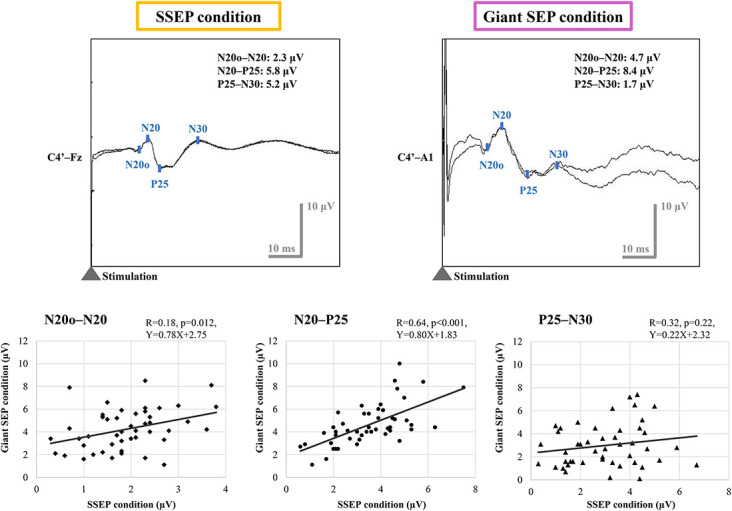
Results: The amplitudes of N20 onset-N20 and N20-P25 were significantly larger in giant SEP condition than in SSEP condition ( p < 0.001). The mean + 3SD of N20-P25 amplitude was 10.0 μV in giant SEP condition and 7.8 μV in SSEP condition. The N20-P25 amplitude was significantly correlated between giant SEP condition and SSEP condition ( R = 0.64, p < 0.001). C-reflex was not elicited.
Conclusions: The amplitude of SEPs in SSEP condition is equivalent to 80% of that in giant SEP condition. The information is useful for detecting cortical hyperexcitability in various neurological disorders including myoclonic epilepsy.
期刊介绍:
ACS Applied Bio Materials is an interdisciplinary journal publishing original research covering all aspects of biomaterials and biointerfaces including and beyond the traditional biosensing, biomedical and therapeutic applications.
The journal is devoted to reports of new and original experimental and theoretical research of an applied nature that integrates knowledge in the areas of materials, engineering, physics, bioscience, and chemistry into important bio applications. The journal is specifically interested in work that addresses the relationship between structure and function and assesses the stability and degradation of materials under relevant environmental and biological conditions.





 京公网安备 11010802042870号
京ICP备2023020795号-1
京公网安备 11010802042870号
京ICP备2023020795号-1

 分享
分享
 求助内容:
求助内容: 应助结果提醒方式:
 扫码关注我们
