Cannabis Use Patterns and Related Health Outcomes Among Spanish Speakers in the United States and Internationally.
IF 4.7 Q2 MATERIALS SCIENCE, BIOMATERIALSACS Applied Bio MaterialsPub Date : 2022-09-30eCollection Date: 2022-09-01
Renée Martin-Willett, Elizabeth Zambrano Garza, L Cinnamon Bidwell
{"title":"Cannabis Use Patterns and Related Health Outcomes Among Spanish Speakers in the United States and Internationally.","authors":"Renée Martin-Willett, Elizabeth Zambrano Garza, L Cinnamon Bidwell","doi":"","DOIUrl":null,"url":null,"abstract":"<p><p>Cannabis and health research continue to largely ignore the usage patterns, perceptions, and medically related use in Spanish-speaking communities. The primary aim of this study was to collect data among Spanish-speaking communities on cannabis use that specifically characterizes granular demographic information, medically motivated and recreational use patterns including potency of products, medical motivations for use, and what perceptions are held as to risks and benefits. Secondarily, exploratory analyses were made to investigate potential effects of location or acculturation status. Five hundred forty-nine individuals completed the survey, including 294 residing in the United States (US) (<i>M<sub>age</sub></i> =31.8, <i>SD</i>=9.72; 154 women, 137 men, 3 non-binary and self-described individuals), 174 residing outside of the US (International) (<i>M<sub>age</sub></i> =26.6, <i>SD</i>=8.75; 77 women, 96 men, 1 non-binary and self-described individuals), and 81 who did not report country of residence (Unknown location) (<i>M<sub>age</sub></i> =26.7, <i>SD</i>=7.37; 17 women, 61 men, 3 non-binary and self-described individuals). Overall use was mostly recreational, while the US group was significantly more motivated by medical or combined medical and recreational reasons than the other two groups (<i>p</i>=0.02). The most common reason for medical use was anxiety or depression (14% of sample). The US group also smoked or vaporized significantly more often than the other two groups and was more likely to include daily users (<i>p</i><0.001). The sample generally viewed the effects of cannabis use more favorably than negatively, but there were significant differences in these views between users and non-users. The rich heterogeneity suggested by these data belies the importance of taking an equity focused approach to cannabis research and will help to improve representation in the field.</p>","PeriodicalId":2,"journal":{"name":"ACS Applied Bio Materials","volume":" ","pages":"327-341"},"PeriodicalIF":4.7000,"publicationDate":"2022-09-30","publicationTypes":"Journal Article","fieldsOfStudy":null,"isOpenAccess":false,"openAccessPdf":"https://ftp.ncbi.nlm.nih.gov/pub/pmc/oa_pdf/80/58/yjbm_95_3_327.PMC9511952.pdf","citationCount":"0","resultStr":null,"platform":"Semanticscholar","paperid":null,"PeriodicalName":"ACS Applied Bio Materials","FirstCategoryId":"5","ListUrlMain":"","RegionNum":0,"RegionCategory":null,"ArticlePicture":[],"TitleCN":null,"AbstractTextCN":null,"PMCID":null,"EPubDate":"2022/9/1 0:00:00","PubModel":"eCollection","JCR":"Q2","JCRName":"MATERIALS SCIENCE, BIOMATERIALS","Score":null,"Total":0}
引用次数: 0
Abstract
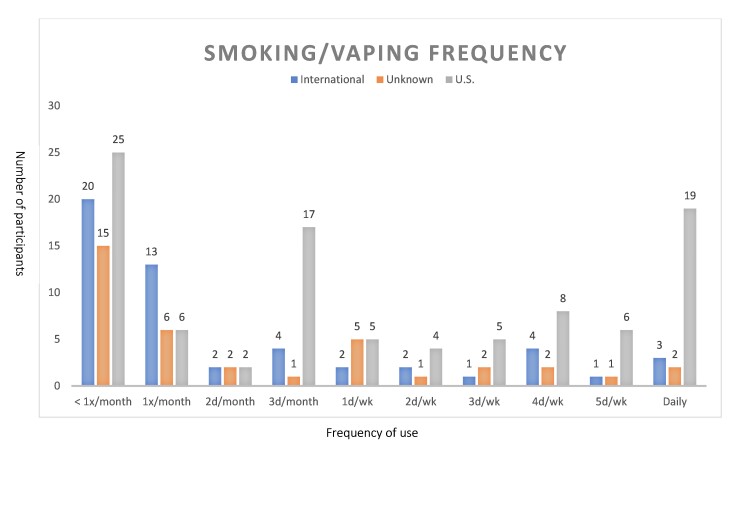
Cannabis and health research continue to largely ignore the usage patterns, perceptions, and medically related use in Spanish-speaking communities. The primary aim of this study was to collect data among Spanish-speaking communities on cannabis use that specifically characterizes granular demographic information, medically motivated and recreational use patterns including potency of products, medical motivations for use, and what perceptions are held as to risks and benefits. Secondarily, exploratory analyses were made to investigate potential effects of location or acculturation status. Five hundred forty-nine individuals completed the survey, including 294 residing in the United States (US) (Mage =31.8, SD=9.72; 154 women, 137 men, 3 non-binary and self-described individuals), 174 residing outside of the US (International) (Mage =26.6, SD=8.75; 77 women, 96 men, 1 non-binary and self-described individuals), and 81 who did not report country of residence (Unknown location) (Mage =26.7, SD=7.37; 17 women, 61 men, 3 non-binary and self-described individuals). Overall use was mostly recreational, while the US group was significantly more motivated by medical or combined medical and recreational reasons than the other two groups (p=0.02). The most common reason for medical use was anxiety or depression (14% of sample). The US group also smoked or vaporized significantly more often than the other two groups and was more likely to include daily users (p<0.001). The sample generally viewed the effects of cannabis use more favorably than negatively, but there were significant differences in these views between users and non-users. The rich heterogeneity suggested by these data belies the importance of taking an equity focused approach to cannabis research and will help to improve representation in the field.
期刊介绍:
ACS Applied Bio Materials is an interdisciplinary journal publishing original research covering all aspects of biomaterials and biointerfaces including and beyond the traditional biosensing, biomedical and therapeutic applications.
The journal is devoted to reports of new and original experimental and theoretical research of an applied nature that integrates knowledge in the areas of materials, engineering, physics, bioscience, and chemistry into important bio applications. The journal is specifically interested in work that addresses the relationship between structure and function and assesses the stability and degradation of materials under relevant environmental and biological conditions.
 分享
分享




 京公网安备 11010802042870号
京ICP备2023020795号-1
京公网安备 11010802042870号
京ICP备2023020795号-1

 求助内容:
求助内容: 应助结果提醒方式:
 扫码关注我们
