Georgia Papadogeorgou, Zhengwu Zhang, David B Dunson
{"title":"Soft Tensor Regression.","authors":"Georgia Papadogeorgou, Zhengwu Zhang, David B Dunson","doi":"","DOIUrl":null,"url":null,"abstract":"<p><p>Statistical methods relating tensor predictors to scalar outcomes in a regression model generally vectorize the tensor predictor and estimate the coefficients of its entries employing some form of regularization, use summaries of the tensor covariate, or use a low dimensional approximation of the coefficient tensor. However, low rank approximations of the coefficient tensor can suffer if the true rank is not small. We propose a tensor regression framework which assumes a <i>soft</i> version of the parallel factors (PARAFAC) approximation. In contrast to classic PARAFAC where each entry of the coefficient tensor is the sum of products of row-specific contributions across the tensor modes, the soft tensor regression (Softer) framework allows the row-specific contributions to vary around an overall mean. We follow a Bayesian approach to inference, and show that softening the PARAFAC increases model flexibility, leads to improved estimation of coefficient tensors, more accurate identification of important predictor entries, and more precise predictions, even for a low approximation rank. From a theoretical perspective, we show that employing Softer leads to a weakly consistent posterior distribution of the coefficient tensor, <i>irrespective of the true or approximation tensor rank</i>, a result that is not true when employing the classic PARAFAC for tensor regression. In the context of our motivating application, we adapt Softer to symmetric and semi-symmetric tensor predictors and analyze the relationship between brain network characteristics and human traits.</p>","PeriodicalId":4,"journal":{"name":"ACS Applied Energy Materials","volume":" ","pages":""},"PeriodicalIF":5.5000,"publicationDate":"2021-01-01","publicationTypes":"Journal Article","fieldsOfStudy":null,"isOpenAccess":false,"openAccessPdf":"https://www.ncbi.nlm.nih.gov/pmc/articles/PMC9222480/pdf/","citationCount":"0","resultStr":null,"platform":"Semanticscholar","paperid":null,"PeriodicalName":"ACS Applied Energy Materials","FirstCategoryId":"94","ListUrlMain":"","RegionNum":3,"RegionCategory":"材料科学","ArticlePicture":[],"TitleCN":null,"AbstractTextCN":null,"PMCID":null,"EPubDate":"","PubModel":"","JCR":"Q2","JCRName":"CHEMISTRY, PHYSICAL","Score":null,"Total":0}
引用次数: 0
Abstract
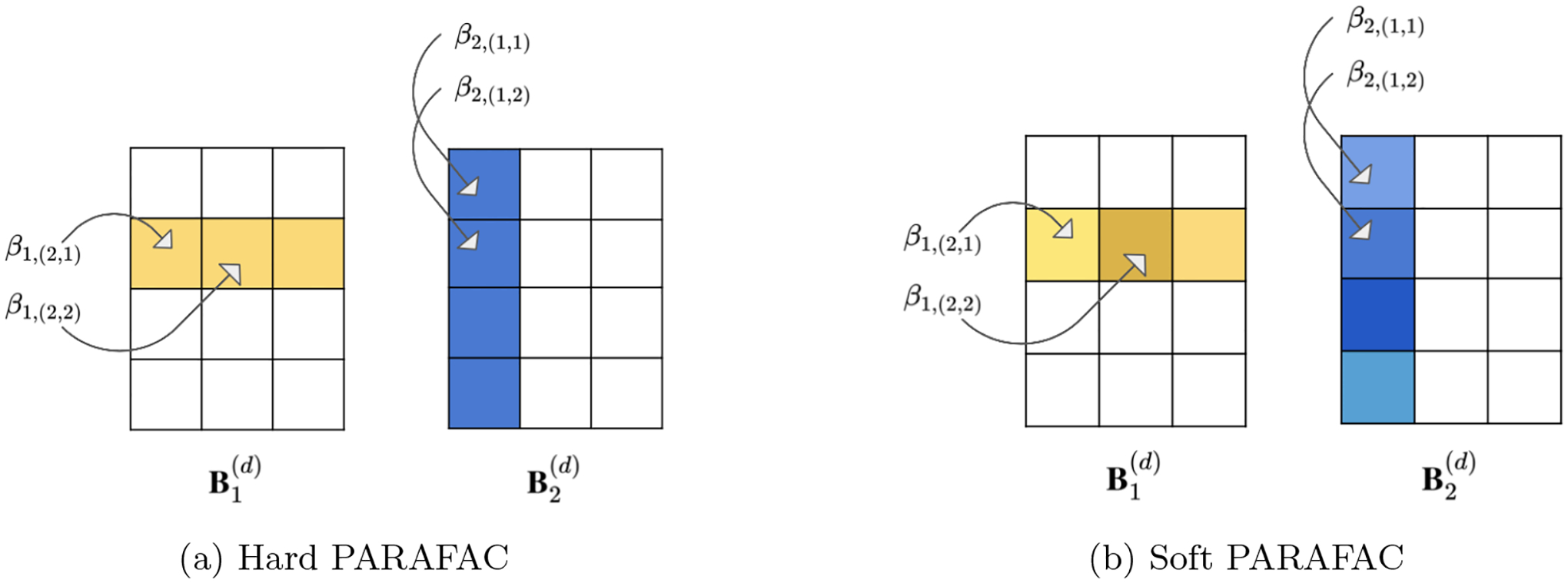
Statistical methods relating tensor predictors to scalar outcomes in a regression model generally vectorize the tensor predictor and estimate the coefficients of its entries employing some form of regularization, use summaries of the tensor covariate, or use a low dimensional approximation of the coefficient tensor. However, low rank approximations of the coefficient tensor can suffer if the true rank is not small. We propose a tensor regression framework which assumes a soft version of the parallel factors (PARAFAC) approximation. In contrast to classic PARAFAC where each entry of the coefficient tensor is the sum of products of row-specific contributions across the tensor modes, the soft tensor regression (Softer) framework allows the row-specific contributions to vary around an overall mean. We follow a Bayesian approach to inference, and show that softening the PARAFAC increases model flexibility, leads to improved estimation of coefficient tensors, more accurate identification of important predictor entries, and more precise predictions, even for a low approximation rank. From a theoretical perspective, we show that employing Softer leads to a weakly consistent posterior distribution of the coefficient tensor, irrespective of the true or approximation tensor rank, a result that is not true when employing the classic PARAFAC for tensor regression. In the context of our motivating application, we adapt Softer to symmetric and semi-symmetric tensor predictors and analyze the relationship between brain network characteristics and human traits.
期刊介绍:
ACS Applied Energy Materials is an interdisciplinary journal publishing original research covering all aspects of materials, engineering, chemistry, physics and biology relevant to energy conversion and storage. The journal is devoted to reports of new and original experimental and theoretical research of an applied nature that integrate knowledge in the areas of materials, engineering, physics, bioscience, and chemistry into important energy applications.
 分享
分享



 京公网安备 11010802042870号
京ICP备2023020795号-1
京公网安备 11010802042870号
京ICP备2023020795号-1

 求助内容:
求助内容: 应助结果提醒方式:
 扫码关注我们
