{"title":"Albumin to Total Cholesterol Ratio and Mortality in Peritoneal Dialysis.","authors":"Xianfeng Wu, Jiao Meng, Lei Zhou, Xiaojiang Zhan, Yueqiang Wen, Xiaoyang Wang, Xiaoran Feng, Niansong Wang, Fenfen Peng, Junnan Wu","doi":"10.3389/fmed.2022.896443","DOIUrl":null,"url":null,"abstract":"<p><strong>Background: </strong>Serum albumin and total cholesterol are associated with mortality. In clinical practice, evaluating the association of combining album and total cholesterol with mortality may be more reasonable. Thus, we examined the association between serum albumin to total cholesterol ratio and mortality in peritoneal dialysis (PD) patients.</p><p><strong>Methods: </strong>We conducted a retrospective cohort study of 3447 incident continuous ambulatory peritoneal dialysis (CAPD) patients from five PD centers in China from 1 January 2005 and 31 May 2020. The association between albumin to total cholesterol ratio and mortality was evaluated.</p><p><strong>Results: </strong>With a median follow-up of 39.3 months, 762 (22.1%) all-cause deaths occurred, including 382 (11.1%) cardiovascular deaths. As compared with a serum albumin to total cholesterol ratio of 0.77-0.82 (reference range), a higher ratio (>0.82) was associated with increased risks of all-cause mortality[hazards ratio (HR), 1.54; 95% confidence interval (CI), 1.16-2.05, <i>E</i>-value = 2.45] and cardiovascular mortality (HR, 2.10; 95% CI, 1.35-3.29, <i>E</i>-value = 3.62). A lower ratio (<0.77) was also associated with increased risks of all-cause mortality (HR, 1.46; 95% CI, 1.10-1.94, <i>E</i>-value = 2.28) and cardiovascular mortality (HR, 1.78; 95% CI, 1.14-2.78, <i>E</i>-value = 2.96) compared with the reference. No interaction was observed in subgroup analyses of age, sex, diabetes mellitus, hypertension, prior cardiovascular disease, and hyperlipidemia, and malnutrition (serum albumin <3.6 g/dL).</p><p><strong>Conclusion: </strong>An albumin to total cholesterol ratio before the start of PD between 0.77 and 0.82 was associated with a lower risk of death than a higher or lower ratio, resulting in a U-curve association. Therefore, serum albumin to total cholesterol ratio, as an inexpensive and readily available biochemical biomarker, may further improve the stratification risk of mortality in PD patients.</p>","PeriodicalId":12488,"journal":{"name":"Frontiers in Medicine","volume":" ","pages":"896443"},"PeriodicalIF":3.1000,"publicationDate":"2022-06-09","publicationTypes":"Journal Article","fieldsOfStudy":null,"isOpenAccess":false,"openAccessPdf":"https://www.ncbi.nlm.nih.gov/pmc/articles/PMC9218528/pdf/","citationCount":"0","resultStr":null,"platform":"Semanticscholar","paperid":null,"PeriodicalName":"Frontiers in Medicine","FirstCategoryId":"3","ListUrlMain":"https://doi.org/10.3389/fmed.2022.896443","RegionNum":3,"RegionCategory":"医学","ArticlePicture":[],"TitleCN":null,"AbstractTextCN":null,"PMCID":null,"EPubDate":"2022/1/1 0:00:00","PubModel":"eCollection","JCR":"Q1","JCRName":"MEDICINE, GENERAL & INTERNAL","Score":null,"Total":0}
引用次数: 0
Abstract
Background: Serum albumin and total cholesterol are associated with mortality. In clinical practice, evaluating the association of combining album and total cholesterol with mortality may be more reasonable. Thus, we examined the association between serum albumin to total cholesterol ratio and mortality in peritoneal dialysis (PD) patients.
Methods: We conducted a retrospective cohort study of 3447 incident continuous ambulatory peritoneal dialysis (CAPD) patients from five PD centers in China from 1 January 2005 and 31 May 2020. The association between albumin to total cholesterol ratio and mortality was evaluated.
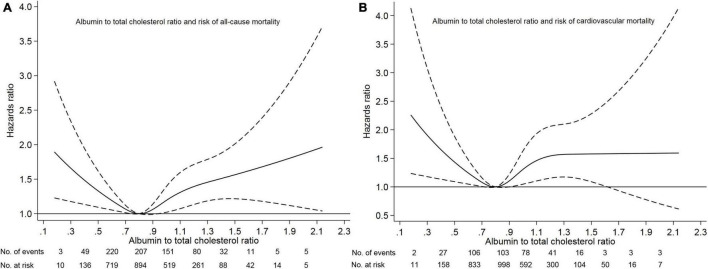
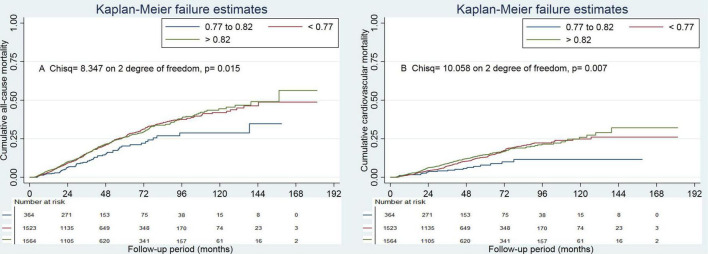
Results: With a median follow-up of 39.3 months, 762 (22.1%) all-cause deaths occurred, including 382 (11.1%) cardiovascular deaths. As compared with a serum albumin to total cholesterol ratio of 0.77-0.82 (reference range), a higher ratio (>0.82) was associated with increased risks of all-cause mortality[hazards ratio (HR), 1.54; 95% confidence interval (CI), 1.16-2.05, E-value = 2.45] and cardiovascular mortality (HR, 2.10; 95% CI, 1.35-3.29, E-value = 3.62). A lower ratio (<0.77) was also associated with increased risks of all-cause mortality (HR, 1.46; 95% CI, 1.10-1.94, E-value = 2.28) and cardiovascular mortality (HR, 1.78; 95% CI, 1.14-2.78, E-value = 2.96) compared with the reference. No interaction was observed in subgroup analyses of age, sex, diabetes mellitus, hypertension, prior cardiovascular disease, and hyperlipidemia, and malnutrition (serum albumin <3.6 g/dL).
Conclusion: An albumin to total cholesterol ratio before the start of PD between 0.77 and 0.82 was associated with a lower risk of death than a higher or lower ratio, resulting in a U-curve association. Therefore, serum albumin to total cholesterol ratio, as an inexpensive and readily available biochemical biomarker, may further improve the stratification risk of mortality in PD patients.
期刊介绍:
Frontiers in Medicine publishes rigorously peer-reviewed research linking basic research to clinical practice and patient care, as well as translating scientific advances into new therapies and diagnostic tools. Led by an outstanding Editorial Board of international experts, this multidisciplinary open-access journal is at the forefront of disseminating and communicating scientific knowledge and impactful discoveries to researchers, academics, clinicians and the public worldwide.
In addition to papers that provide a link between basic research and clinical practice, a particular emphasis is given to studies that are directly relevant to patient care. In this spirit, the journal publishes the latest research results and medical knowledge that facilitate the translation of scientific advances into new therapies or diagnostic tools. The full listing of the Specialty Sections represented by Frontiers in Medicine is as listed below. As well as the established medical disciplines, Frontiers in Medicine is launching new sections that together will facilitate
- the use of patient-reported outcomes under real world conditions
- the exploitation of big data and the use of novel information and communication tools in the assessment of new medicines
- the scientific bases for guidelines and decisions from regulatory authorities
- access to medicinal products and medical devices worldwide
- addressing the grand health challenges around the world



 京公网安备 11010802042870号
京ICP备2023020795号-1
京公网安备 11010802042870号
京ICP备2023020795号-1

 分享
分享
 求助内容:
求助内容: 应助结果提醒方式:
 扫码关注我们
