Nguyễn Hoàng Ly, Moon-Kyung Kim, Hyewon Lee, Cheolmin Lee, Sang Jun Son, Kyung-Duk Zoh, Yasser Vasseghian, Sang-Woo Joo
{"title":"Advanced microplastic monitoring using Raman spectroscopy with a combination of nanostructure-based substrates.","authors":"Nguyễn Hoàng Ly, Moon-Kyung Kim, Hyewon Lee, Cheolmin Lee, Sang Jun Son, Kyung-Duk Zoh, Yasser Vasseghian, Sang-Woo Joo","doi":"10.1007/s40097-022-00506-0","DOIUrl":null,"url":null,"abstract":"<p><p>Micro(nano)plastic (MNP) pollutants have not only impacted human health directly, but are also associated with numerous chemical contaminants that increase toxicity in the natural environment. Most recent research about increasing plastic pollutants in natural environments have focused on the toxic effects of MNPs in water, the atmosphere, and soil. The methodologies of MNP identification have been extensively developed for actual applications, but they still require further study, including on-site detection. This review article provides a comprehensive update on the facile detection of MNPs by Raman spectroscopy, which aims at early diagnosis of potential risks and human health impacts. In particular, Raman imaging and nanostructure-enhanced Raman scattering have emerged as effective analytical technologies for identifying MNPs in an environment. Here, the authors give an update on the latest advances in plasmonic nanostructured materials-assisted SERS substrates utilized for the detection of MNP particles present in environmental samples. Moreover, this work describes different plasmonic materials-including pure noble metal nanostructured materials and hybrid nanomaterials-that have been used to fabricate and develop SERS platforms to obtain the identifying MNP particles at low concentrations. Plasmonic nanostructure-enhanced materials consisting of pure noble metals and hybrid nanomaterials can significantly enhance the surface-enhanced Raman scattering (SERS) spectra signals of pollutant analytes due to their localized hot spots. This concise topical review also provides updates on recent developments and trends in MNP detection by means of SERS using a variety of unique materials, along with three-dimensional (3D) SERS substrates, nanopipettes, and microfluidic chips. A novel material-assisted spectral Raman technique and its effective application are also introduced for selective monitoring and trace detection of MNPs in indoor and outdoor environments.</p><p><strong>Graphical abstract: </strong></p>","PeriodicalId":8,"journal":{"name":"ACS Biomaterials Science & Engineering","volume":" ","pages":"865-888"},"PeriodicalIF":5.5000,"publicationDate":"2022-01-01","publicationTypes":"Journal Article","fieldsOfStudy":null,"isOpenAccess":false,"openAccessPdf":"https://www.ncbi.nlm.nih.gov/pmc/articles/PMC9206222/pdf/","citationCount":"0","resultStr":null,"platform":"Semanticscholar","paperid":null,"PeriodicalName":"ACS Biomaterials Science & Engineering","FirstCategoryId":"92","ListUrlMain":"https://doi.org/10.1007/s40097-022-00506-0","RegionNum":2,"RegionCategory":"医学","ArticlePicture":[],"TitleCN":null,"AbstractTextCN":null,"PMCID":null,"EPubDate":"2022/6/18 0:00:00","PubModel":"Epub","JCR":"Q2","JCRName":"MATERIALS SCIENCE, BIOMATERIALS","Score":null,"Total":0}
引用次数: 0
Abstract
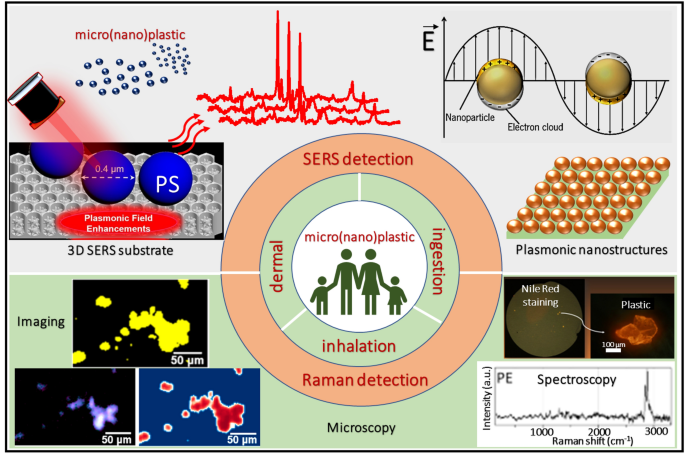
Micro(nano)plastic (MNP) pollutants have not only impacted human health directly, but are also associated with numerous chemical contaminants that increase toxicity in the natural environment. Most recent research about increasing plastic pollutants in natural environments have focused on the toxic effects of MNPs in water, the atmosphere, and soil. The methodologies of MNP identification have been extensively developed for actual applications, but they still require further study, including on-site detection. This review article provides a comprehensive update on the facile detection of MNPs by Raman spectroscopy, which aims at early diagnosis of potential risks and human health impacts. In particular, Raman imaging and nanostructure-enhanced Raman scattering have emerged as effective analytical technologies for identifying MNPs in an environment. Here, the authors give an update on the latest advances in plasmonic nanostructured materials-assisted SERS substrates utilized for the detection of MNP particles present in environmental samples. Moreover, this work describes different plasmonic materials-including pure noble metal nanostructured materials and hybrid nanomaterials-that have been used to fabricate and develop SERS platforms to obtain the identifying MNP particles at low concentrations. Plasmonic nanostructure-enhanced materials consisting of pure noble metals and hybrid nanomaterials can significantly enhance the surface-enhanced Raman scattering (SERS) spectra signals of pollutant analytes due to their localized hot spots. This concise topical review also provides updates on recent developments and trends in MNP detection by means of SERS using a variety of unique materials, along with three-dimensional (3D) SERS substrates, nanopipettes, and microfluidic chips. A novel material-assisted spectral Raman technique and its effective application are also introduced for selective monitoring and trace detection of MNPs in indoor and outdoor environments.
期刊介绍:
ACS Biomaterials Science & Engineering is the leading journal in the field of biomaterials, serving as an international forum for publishing cutting-edge research and innovative ideas on a broad range of topics:
Applications and Health – implantable tissues and devices, prosthesis, health risks, toxicology
Bio-interactions and Bio-compatibility – material-biology interactions, chemical/morphological/structural communication, mechanobiology, signaling and biological responses, immuno-engineering, calcification, coatings, corrosion and degradation of biomaterials and devices, biophysical regulation of cell functions
Characterization, Synthesis, and Modification – new biomaterials, bioinspired and biomimetic approaches to biomaterials, exploiting structural hierarchy and architectural control, combinatorial strategies for biomaterials discovery, genetic biomaterials design, synthetic biology, new composite systems, bionics, polymer synthesis
Controlled Release and Delivery Systems – biomaterial-based drug and gene delivery, bio-responsive delivery of regulatory molecules, pharmaceutical engineering
Healthcare Advances – clinical translation, regulatory issues, patient safety, emerging trends
Imaging and Diagnostics – imaging agents and probes, theranostics, biosensors, monitoring
Manufacturing and Technology – 3D printing, inks, organ-on-a-chip, bioreactor/perfusion systems, microdevices, BioMEMS, optics and electronics interfaces with biomaterials, systems integration
Modeling and Informatics Tools – scaling methods to guide biomaterial design, predictive algorithms for structure-function, biomechanics, integrating bioinformatics with biomaterials discovery, metabolomics in the context of biomaterials
Tissue Engineering and Regenerative Medicine – basic and applied studies, cell therapies, scaffolds, vascularization, bioartificial organs, transplantation and functionality, cellular agriculture




 京公网安备 11010802042870号
京ICP备2023020795号-1
京公网安备 11010802042870号
京ICP备2023020795号-1

 分享
分享
 求助内容:
求助内容: 应助结果提醒方式:
 扫码关注我们
