Alice Curwen, Scott Jones, Ceri Stayley, Laura Eden, Heather McKay, Peers Davies, Fiona Lovatt, Stephen Dunham, Rachael Tarlinton
{"title":"Failure to detect Schmallenberg virus RNA in ram semen in the UK (2016-2018).","authors":"Alice Curwen, Scott Jones, Ceri Stayley, Laura Eden, Heather McKay, Peers Davies, Fiona Lovatt, Stephen Dunham, Rachael Tarlinton","doi":"10.1002/vro2.39","DOIUrl":null,"url":null,"abstract":"<p><strong>Background: </strong>Schmallenberg virus (SBV) is a midge-borne arbovirus that first emerged in the European ruminant population in 2011 and has since settled to an endemic pattern of disease outbreaks on an approximately 4-year cycle when herd immunity from the previous circulation drops to a point allowing renewed widescale virus circulation. The impacts of trade restrictions on genetic products (semen, embryos) from affected areas were severe, particularly after the discovery that the virus is intermittently shed in the semen of a small number of bulls. The trade in small ruminant (ram and goat) semen is less than that of bulls; nonetheless, there has been no study into the shedding rate of SBV in ram semen.</p><p><strong>Methods: </strong>Semen samples (<i>n</i> = 65) were collected as part of UK ram trials and artificial insemination studies around the period of the 2016-2018 SBV recirculation. Semen was preserved in RNA<i>later</i> for shipping, and RNA extraction with RNeasy and S gene RT-quantitative PCR performed for SBV nucleic acid detection.</p><p><strong>Results: </strong>No SBV RNA was detected in any samples.</p><p><strong>Conclusions: </strong>While larger numbers of animals would be needed to completely exclude the possibility of SBV shedding in ram semen, this trial nonetheless highlights that this is likely a rare event if it occurs at all and is unlikely to play a role in disease transmission.</p>","PeriodicalId":1,"journal":{"name":"Accounts of Chemical Research","volume":" ","pages":"e39"},"PeriodicalIF":17.7000,"publicationDate":"2022-06-20","publicationTypes":"Journal Article","fieldsOfStudy":null,"isOpenAccess":false,"openAccessPdf":"https://www.ncbi.nlm.nih.gov/pmc/articles/PMC9208715/pdf/","citationCount":"0","resultStr":null,"platform":"Semanticscholar","paperid":null,"PeriodicalName":"Accounts of Chemical Research","FirstCategoryId":"1085","ListUrlMain":"https://doi.org/10.1002/vro2.39","RegionNum":1,"RegionCategory":"化学","ArticlePicture":[],"TitleCN":null,"AbstractTextCN":null,"PMCID":null,"EPubDate":"2022/12/1 0:00:00","PubModel":"eCollection","JCR":"Q1","JCRName":"CHEMISTRY, MULTIDISCIPLINARY","Score":null,"Total":0}
引用次数: 0
Abstract
Background: Schmallenberg virus (SBV) is a midge-borne arbovirus that first emerged in the European ruminant population in 2011 and has since settled to an endemic pattern of disease outbreaks on an approximately 4-year cycle when herd immunity from the previous circulation drops to a point allowing renewed widescale virus circulation. The impacts of trade restrictions on genetic products (semen, embryos) from affected areas were severe, particularly after the discovery that the virus is intermittently shed in the semen of a small number of bulls. The trade in small ruminant (ram and goat) semen is less than that of bulls; nonetheless, there has been no study into the shedding rate of SBV in ram semen.
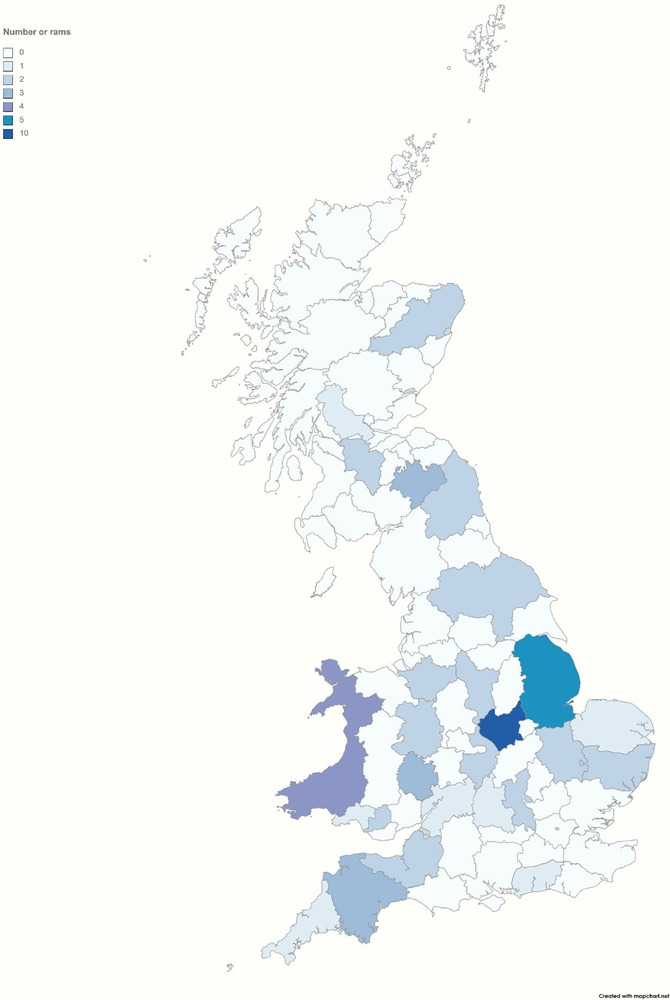
Methods: Semen samples (n = 65) were collected as part of UK ram trials and artificial insemination studies around the period of the 2016-2018 SBV recirculation. Semen was preserved in RNAlater for shipping, and RNA extraction with RNeasy and S gene RT-quantitative PCR performed for SBV nucleic acid detection.
Results: No SBV RNA was detected in any samples.
Conclusions: While larger numbers of animals would be needed to completely exclude the possibility of SBV shedding in ram semen, this trial nonetheless highlights that this is likely a rare event if it occurs at all and is unlikely to play a role in disease transmission.
期刊介绍:
Accounts of Chemical Research presents short, concise and critical articles offering easy-to-read overviews of basic research and applications in all areas of chemistry and biochemistry. These short reviews focus on research from the author’s own laboratory and are designed to teach the reader about a research project. In addition, Accounts of Chemical Research publishes commentaries that give an informed opinion on a current research problem. Special Issues online are devoted to a single topic of unusual activity and significance.
Accounts of Chemical Research replaces the traditional article abstract with an article "Conspectus." These entries synopsize the research affording the reader a closer look at the content and significance of an article. Through this provision of a more detailed description of the article contents, the Conspectus enhances the article's discoverability by search engines and the exposure for the research.




 京公网安备 11010802042870号
京ICP备2023020795号-1
京公网安备 11010802042870号
京ICP备2023020795号-1

 分享
分享
 求助内容:
求助内容: 应助结果提醒方式:
 扫码关注我们
