{"title":"Does \"no-touch\" technique hysteroscopy increase the risk of infection?","authors":"Evrim Ebru Kovalak","doi":"10.4274/tjod.galenos.2022.04272","DOIUrl":null,"url":null,"abstract":"<p><strong>Objective: </strong>Today, thanks to its many advantages, hysteroscopy with a vaginoscopic approach (no-touch) is increasingly being used more in outpatient diagnoses and treatments. However, there are concerns that the \"no-touch\" technique increases ascending genital tract infections since a speculum is not inserted, and disinfection of the cervix cannot achieve.</p><p><strong>Materials and methods: </strong>Between 2011 and 2017, 302 patients who underwent office hysteroscopy with the vaginoscopic approach (group 1) and 254 patients who underwent hysteroscopy with the standard method under anesthesia in the operating room (group 2) were compared in terms of early complications (within two weeks postoperatively). The primary outcome was early postoperative infection, and the secondary outcome was other early complications, such as bleeding and rupture.</p><p><strong>Results: </strong>In this study, the success rate of hysteroscopy with the vaginoscopic approach was 96.4%. According to the visual analog scale scoring system, 88.7% of the patients described mild-to-moderate pain. When group 1 and 2 were compared in terms of postoperative infection (3% and 2.4%, respectively) and other early complication rates (0% and 0.8%, respectively), no statistically significant difference was found (p>0.05).</p><p><strong>Conclusion: </strong>Hysteroscopy with a vaginoscopic approach continues to be the gold standard method that is safe and well-tolerated by patients.</p>","PeriodicalId":45340,"journal":{"name":"Turkish Journal of Obstetrics and Gynecology","volume":"19 2","pages":"145-151"},"PeriodicalIF":1.3000,"publicationDate":"2022-06-27","publicationTypes":"Journal Article","fieldsOfStudy":null,"isOpenAccess":false,"openAccessPdf":"https://ftp.ncbi.nlm.nih.gov/pub/pmc/oa_pdf/63/07/TJOG-19-145.PMC9249365.pdf","citationCount":"0","resultStr":null,"platform":"Semanticscholar","paperid":null,"PeriodicalName":"Turkish Journal of Obstetrics and Gynecology","FirstCategoryId":"1085","ListUrlMain":"https://doi.org/10.4274/tjod.galenos.2022.04272","RegionNum":0,"RegionCategory":null,"ArticlePicture":[],"TitleCN":null,"AbstractTextCN":null,"PMCID":null,"EPubDate":"","PubModel":"","JCR":"Q4","JCRName":"OBSTETRICS & GYNECOLOGY","Score":null,"Total":0}
引用次数: 0
Abstract
Objective: Today, thanks to its many advantages, hysteroscopy with a vaginoscopic approach (no-touch) is increasingly being used more in outpatient diagnoses and treatments. However, there are concerns that the "no-touch" technique increases ascending genital tract infections since a speculum is not inserted, and disinfection of the cervix cannot achieve.
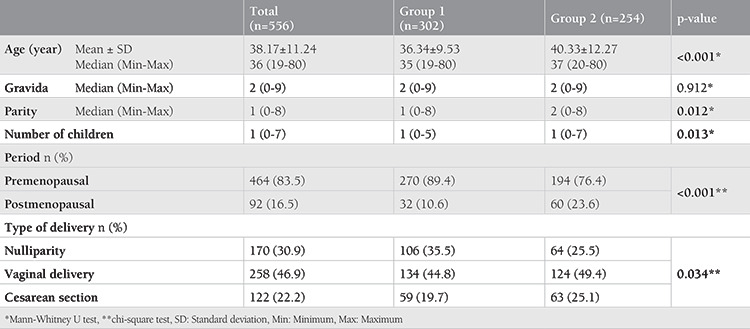
Materials and methods: Between 2011 and 2017, 302 patients who underwent office hysteroscopy with the vaginoscopic approach (group 1) and 254 patients who underwent hysteroscopy with the standard method under anesthesia in the operating room (group 2) were compared in terms of early complications (within two weeks postoperatively). The primary outcome was early postoperative infection, and the secondary outcome was other early complications, such as bleeding and rupture.
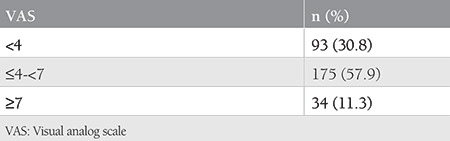
Results: In this study, the success rate of hysteroscopy with the vaginoscopic approach was 96.4%. According to the visual analog scale scoring system, 88.7% of the patients described mild-to-moderate pain. When group 1 and 2 were compared in terms of postoperative infection (3% and 2.4%, respectively) and other early complication rates (0% and 0.8%, respectively), no statistically significant difference was found (p>0.05).
Conclusion: Hysteroscopy with a vaginoscopic approach continues to be the gold standard method that is safe and well-tolerated by patients.




 京公网安备 11010802042870号
京ICP备2023020795号-1
京公网安备 11010802042870号
京ICP备2023020795号-1

 分享
分享
 求助内容:
求助内容: 应助结果提醒方式:
 扫码关注我们
