Haesoo Jung, Da-Min Jung, Sang-Soo Lee, Eun-Mi Kim, Kyungah Yoon, Kee K Kim
{"title":"<i>Mangifera Indica</i> leaf extracts promote hair growth via activation of Wnt signaling pathway in human dermal papilla cells.","authors":"Haesoo Jung, Da-Min Jung, Sang-Soo Lee, Eun-Mi Kim, Kyungah Yoon, Kee K Kim","doi":"10.1080/19768354.2022.2085790","DOIUrl":null,"url":null,"abstract":"<p><p>The crosstalk between androgens and Wnt signaling pathways is critical in the hair growth cycle. Therefore, natural products that target these two pathways for the inhibition of hair loss are sought after. In this study, we investigated the effect of water extracts of <i>Mangifera indica</i> leaves (WEML) on hair growth. WEML treatment significantly reduced the expression levels of both dickkopf-1 (<i>DKK1</i>) and type 2 5α-reductase (SRD5A2) involved in Wnt signal suppression activity and dihydrotestosterone (DHT) synthesis, respectively, in human follicle dermal papilla cells (HFDP). In addition, WEML treatment effectively upregulated Wnt target genes and downregulated <i>DKK</i>1 expression that was increased by DHT treatment. Degranulation analysis in rat basophilic leukemia mast cell line (RBL-2H3) using β-hexosaminidase release assay confirmed that WEML did not exhibit allergenic activity. Furthermore, hair growth was significantly enhanced in <i>in vivo</i> mice model treated with WEML. These results suggest that <i>M. indica</i> leave extract contains bioactive materials that can be used to treat hair loss.</p>","PeriodicalId":2,"journal":{"name":"ACS Applied Bio Materials","volume":" ","pages":"129-136"},"PeriodicalIF":4.7000,"publicationDate":"2022-06-11","publicationTypes":"Journal Article","fieldsOfStudy":null,"isOpenAccess":false,"openAccessPdf":"https://www.ncbi.nlm.nih.gov/pmc/articles/PMC9246026/pdf/","citationCount":"0","resultStr":null,"platform":"Semanticscholar","paperid":null,"PeriodicalName":"ACS Applied Bio Materials","FirstCategoryId":"99","ListUrlMain":"https://doi.org/10.1080/19768354.2022.2085790","RegionNum":0,"RegionCategory":null,"ArticlePicture":[],"TitleCN":null,"AbstractTextCN":null,"PMCID":null,"EPubDate":"2022/1/1 0:00:00","PubModel":"eCollection","JCR":"Q2","JCRName":"MATERIALS SCIENCE, BIOMATERIALS","Score":null,"Total":0}
引用次数: 0
Abstract
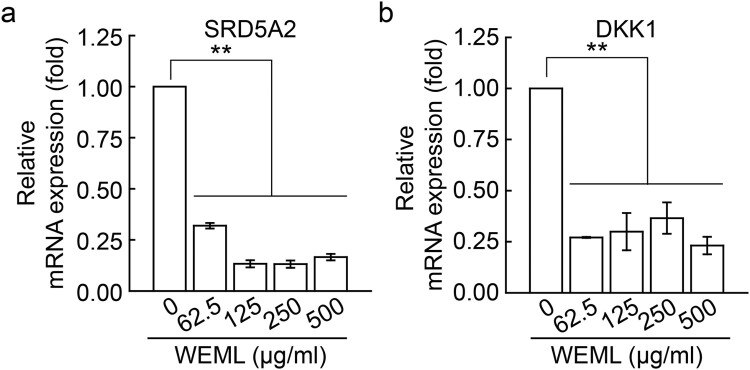
The crosstalk between androgens and Wnt signaling pathways is critical in the hair growth cycle. Therefore, natural products that target these two pathways for the inhibition of hair loss are sought after. In this study, we investigated the effect of water extracts of Mangifera indica leaves (WEML) on hair growth. WEML treatment significantly reduced the expression levels of both dickkopf-1 (DKK1) and type 2 5α-reductase (SRD5A2) involved in Wnt signal suppression activity and dihydrotestosterone (DHT) synthesis, respectively, in human follicle dermal papilla cells (HFDP). In addition, WEML treatment effectively upregulated Wnt target genes and downregulated DKK1 expression that was increased by DHT treatment. Degranulation analysis in rat basophilic leukemia mast cell line (RBL-2H3) using β-hexosaminidase release assay confirmed that WEML did not exhibit allergenic activity. Furthermore, hair growth was significantly enhanced in in vivo mice model treated with WEML. These results suggest that M. indica leave extract contains bioactive materials that can be used to treat hair loss.
期刊介绍:
ACS Applied Bio Materials is an interdisciplinary journal publishing original research covering all aspects of biomaterials and biointerfaces including and beyond the traditional biosensing, biomedical and therapeutic applications.
The journal is devoted to reports of new and original experimental and theoretical research of an applied nature that integrates knowledge in the areas of materials, engineering, physics, bioscience, and chemistry into important bio applications. The journal is specifically interested in work that addresses the relationship between structure and function and assesses the stability and degradation of materials under relevant environmental and biological conditions.





 京公网安备 11010802042870号
京ICP备2023020795号-1
京公网安备 11010802042870号
京ICP备2023020795号-1

 分享
分享
 求助内容:
求助内容: 应助结果提醒方式:
 扫码关注我们
