{"title":"A New Variant of the <i>IER3IP1</i> Gene: The First Case of Microcephaly, Epilepsy, and Diabetes Syndrome 1 from Turkey","authors":"Elif Söbü, Gül Demet Kaya Özçora, Elif Yılmaz Güleç, Bahtiyar Şahinoğlu, Feride Tahmiscioğlu Bucak","doi":"10.4274/jcrpe.galenos.2022.2022-8-12","DOIUrl":null,"url":null,"abstract":"<p><p>Microcephaly, epilepsy and diabetes syndrome 1 (MEDS1) is a rare autosomal recessive disorder caused by defects in the immediate early response 3 interacting protein 1 (<i>IER3IP1</i>) gene. Only nine cases have been described in the literature. MEDS1 manifests as microcephaly with simplified gyral pattern in combination with severe infantile epileptic encephalopathy and early-onset permanent diabetes. A simplified gyral pattern has been described in all cases reported to date. Diagnosis is made by demonstration of specific mutations in the <i>IER3IP1</i> gene. In this study, we present an additional case of a patient with MEDS1 who was homozygous for the c.53C>T p.(Ala18Val) variant. This case, the first to be reported from Turkey, differs from other cases due to the absence of a typical simplified gyral pattern on early brain magnetic resonance imaging, the late onset of diabetes, and the presence of a new genetic variant. The triad of microcephaly, generalized seizures and permanent neonatal diabetes should prompt screening for mutations in <i>IER3IP1</i>.</p>","PeriodicalId":1,"journal":{"name":"Accounts of Chemical Research","volume":" ","pages":"344-350"},"PeriodicalIF":17.7000,"publicationDate":"2024-09-05","publicationTypes":"Journal Article","fieldsOfStudy":null,"isOpenAccess":false,"openAccessPdf":"https://www.ncbi.nlm.nih.gov/pmc/articles/PMC11590771/pdf/","citationCount":"0","resultStr":null,"platform":"Semanticscholar","paperid":null,"PeriodicalName":"Accounts of Chemical Research","FirstCategoryId":"92","ListUrlMain":"https://doi.org/10.4274/jcrpe.galenos.2022.2022-8-12","RegionNum":1,"RegionCategory":"化学","ArticlePicture":[],"TitleCN":null,"AbstractTextCN":null,"PMCID":null,"EPubDate":"2022/11/23 0:00:00","PubModel":"Epub","JCR":"Q1","JCRName":"CHEMISTRY, MULTIDISCIPLINARY","Score":null,"Total":0}
引用次数: 0
Abstract
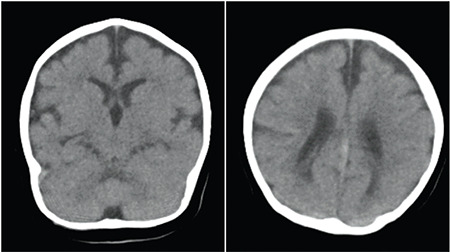
Microcephaly, epilepsy and diabetes syndrome 1 (MEDS1) is a rare autosomal recessive disorder caused by defects in the immediate early response 3 interacting protein 1 (IER3IP1) gene. Only nine cases have been described in the literature. MEDS1 manifests as microcephaly with simplified gyral pattern in combination with severe infantile epileptic encephalopathy and early-onset permanent diabetes. A simplified gyral pattern has been described in all cases reported to date. Diagnosis is made by demonstration of specific mutations in the IER3IP1 gene. In this study, we present an additional case of a patient with MEDS1 who was homozygous for the c.53C>T p.(Ala18Val) variant. This case, the first to be reported from Turkey, differs from other cases due to the absence of a typical simplified gyral pattern on early brain magnetic resonance imaging, the late onset of diabetes, and the presence of a new genetic variant. The triad of microcephaly, generalized seizures and permanent neonatal diabetes should prompt screening for mutations in IER3IP1.
期刊介绍:
Accounts of Chemical Research presents short, concise and critical articles offering easy-to-read overviews of basic research and applications in all areas of chemistry and biochemistry. These short reviews focus on research from the author’s own laboratory and are designed to teach the reader about a research project. In addition, Accounts of Chemical Research publishes commentaries that give an informed opinion on a current research problem. Special Issues online are devoted to a single topic of unusual activity and significance.
Accounts of Chemical Research replaces the traditional article abstract with an article "Conspectus." These entries synopsize the research affording the reader a closer look at the content and significance of an article. Through this provision of a more detailed description of the article contents, the Conspectus enhances the article's discoverability by search engines and the exposure for the research.






 京公网安备 11010802042870号
京ICP备2023020795号-1
京公网安备 11010802042870号
京ICP备2023020795号-1

 分享
分享
 求助内容:
求助内容: 应助结果提醒方式:
 扫码关注我们
